
Fatigue Assessment Scale (FAS) Test
How the Scales are Structured
Who Usually Takes This Test?
See How You Compare
Below is a preview of how scores are typically distributed across each scale.
Example Questions From the Test
- Never
- Rarely
- Sometimes
- Often
- Always
- Never
- Rarely
- Sometimes
- Often
- Always
- Never
- Rarely
- Sometimes
- Often
- Always
Fatigue Assessment Scale (FAS) Test - Description and methodology of the test
For people noticing persistent tiredness, this Fatigue Assessment Scale (FAS) Test provides a structured way to consider how fatigue affects everyday functioning. It is suited to anyone who wants a clearer fatigue self-assessment across physical, mental, and activity-related experiences. The result reflects overall fatigue severity and fatigability, placing responses in low, moderate, or high fatigue categories.
What This Assessment Measures
Rather than focusing only on sleepiness, this fatigue questionnaire treats fatigue as a pattern involving energy, activity, motivation, and mental performance. Its situations include tiring quickly, physical or mental exhaustion, difficulty starting tasks, reduced daytime activity, and trouble thinking clearly or concentrating.
The main themes are:
- Physical exhaustion shows how strongly tiredness is felt and how quickly energy is depleted.
- Activity and motivation indicate whether fatigue reduces initiative or daily participation.
- Cognitive functioning reflects difficulty thinking clearly or sustaining concentration.
- Everyday capacity captures whether energy feels sufficient for ordinary life.
The Fatigue Assessment Scale ranges from 10 to 50. Low fatigue covers 10-21, Moderate fatigue 22-34, and High fatigue 35-50. It measures overall fatigue severity and fatigability. The scale supports self-assessment and monitoring change over time. Higher scores may indicate clinically significant fatigue requiring professional attention.
Methodology and Evidence Base
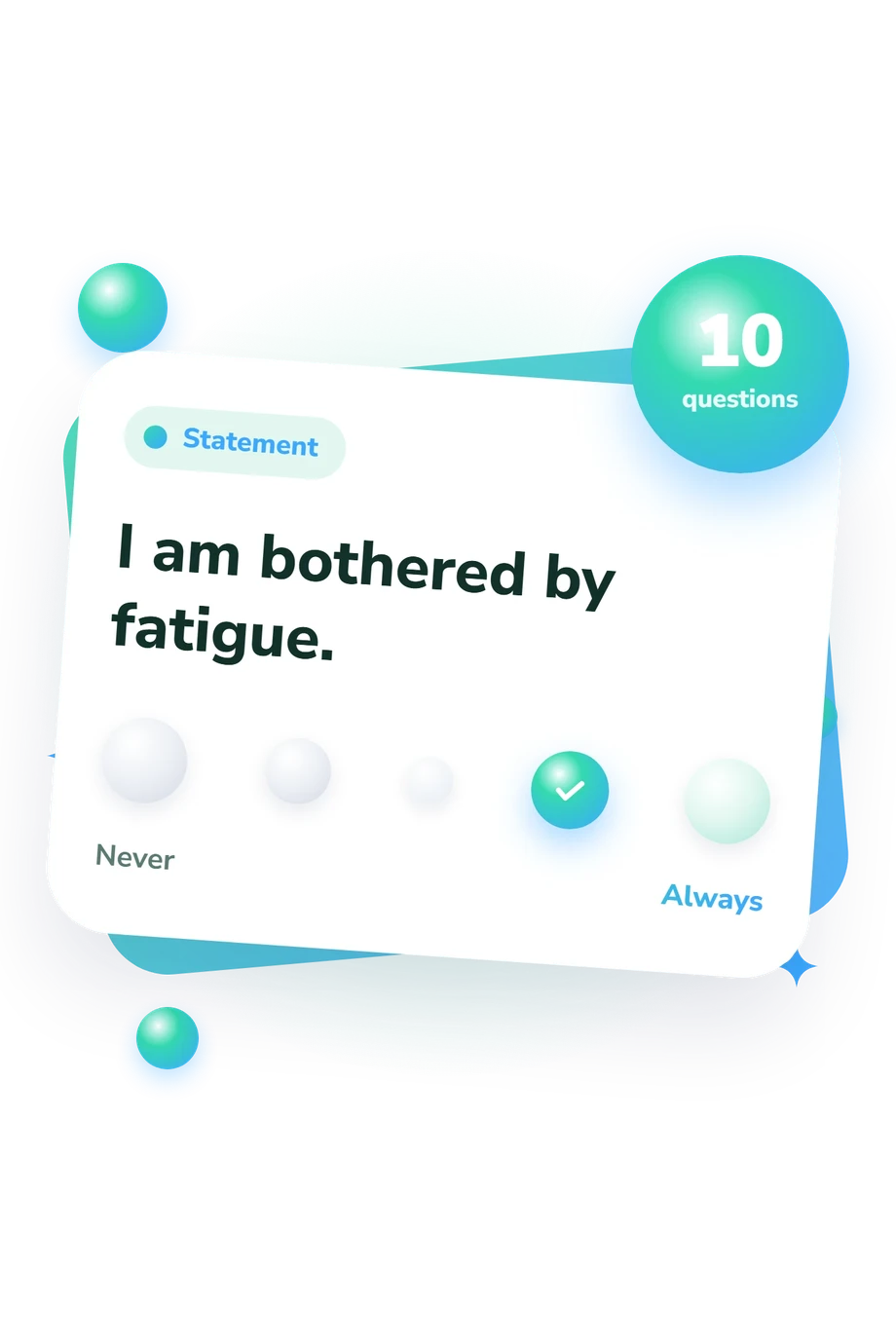
Each statement uses a five-point frequency response, generally ranging from Never to Always. Items describe both fatigue experiences and adequate energy or concentration, allowing respondents to indicate how often each statement fits their experience. The selected responses produce a total score interpreted through the three displayed fatigue categories.
The questionnaire is conceptually consistent with the published FAS described by Michielsen et al. (2003), a brief self-rated measure, and with the dimensionality study by Michielsen and colleagues (2004). Those studies do not validate this online administration or its displayed bands, and the online version is not necessarily identical to their administrations, samples, or validation conditions. The bands are the categories used by this questionnaire and should be interpreted as its result categories.
In practice, this fatigue severity test works best when answers represent your typical experience. Current context-including sleep, illness, mood, stress, and workload-and self-awareness can shift self-reported scores, so interpret the result as a structured snapshot rather than a diagnosis or substitute for broader clinical evaluation.
- Michielsen, Helen J., De Vries, Jolanda, and Van Heck, Guus L. (2003). Psychometric qualities of a brief self-rated fatigue measure: The Fatigue Assessment Scale. Journal of Psychosomatic Research, 54(4), 345-352. 10.1016/S0022-3999(02)00392-6
- Michielsen, Helen J., De Vries, Jolanda, Van Heck, Guus L., Van de Vijver, Fons J. R., and Sijtsma, Klaas (2004). Examination of the Dimensionality of Fatigue: The Construction of the Fatigue Assessment Scale (FAS). European Journal of Psychological Assessment, 20(1), 39-48. 10.1027/1015-5759.20.1.39
Updated: