
Self Compassion Test

This 26-item SCS questionnaire developed by Kristin Neff measures self-compassion across six dimensions — self-kindness, self-criticism, common humanity, self-isolation, mindfulness, and over-identification — revealing exactly how you relate to yourself during stress, failure, and difficult emotions. Take this self compassion test in about 5 minutes to identify which dimensions need strengthening and where your capacity for inner kindness is already working well.
Start Online Test
Questions265 minutes
Hi! My name is Freudly, i am an AI therapist, I will give you an interpretation of the test after you complete it.
08:30
October 2, 2025
October 2, 2025
Material has been updated
26,601 view
3,419 completions
2,605 likes
Verified by Daniel Hall
Psychologist with 25 years of experience
Share
Scale Explorer

How the Scales are Structured

example score
2/5
Self-Isolation (SI)
This scale measures how much a person feels alone and disconnected from others during difficult times (higher scores indicate less self-isolation).
High self-isolation
Moderate self-isolation
Low self-isolation
12.5High self-isolation2.63.6Moderate self-isolation3.75Low self-isolation
A score of 2 falls in the High self-isolation range, suggesting a stronger tendency to feel lonely and separated from others when facing difficulties.
example score
3/5
Over-Identification (OI)
Assesses how strongly a person tends to get absorbed in difficult emotions and thoughts rather than maintaining balanced awareness.
High excessive identification
Moderate
Low excessive identification
12.5High excessive identification2.63.6Moderate3.75Low excessive identification
A score of 3 falls in the Moderate range, suggesting a mixed pattern of sometimes getting caught up in distress while also being able at times to keep perspective.
example score
2/5
Common Humanity (CH)
Measures how strongly a person experiences their difficulties as part of shared human experience rather than as something isolating or uniquely personal.
Low unity
Moderate unity
High unity
12.5Low unity2.63.6Moderate unity3.75High unity
A score of 2 falls in the Low unity range, suggesting a tendency to view setbacks as more isolating and personal rather than commonly shared by others.
example score
3/5
Self-Criticism (SC)
Measures the tendency to judge and criticize one’s own flaws, with higher scores indicating less self-criticism.
High self-criticism
Moderate self-criticism
Low self-criticism
12.5High self-criticism2.63.6Moderate self-criticism3.75Low self-criticism
A score of 3.0 falls in the Moderate self-criticism range, suggesting a balanced mix of self-evaluative thoughts without being consistently harsh or consistently lenient.
example score
3/5
Self-Kindness (SK)
This scale measures how much a person responds to their own difficulties with care and understanding rather than self-criticism.
Low self-kindness
Moderate self-kindness
High self-kindness
12.5Low self-kindness2.63.6Moderate self-kindness3.75High self-kindness
A score of 3 indicates a moderate tendency to be kind and supportive toward yourself during setbacks, with some room to reduce self-criticism in difficult moments.
example score
3/5
Self-Compassion (SC)
Measures overall self-compassion, including self-kindness, mindful awareness, and a sense of common humanity in response to difficulty.
Low
Moderate
High
12.5Low2.63.6Moderate3.75High
A score of 3 indicates a moderate level of self-compassion, suggesting some capacity for supportive self-relating alongside occasional self-criticism or emotional over-identification.
example score
3/5
Mindfulness (M)
Mindfulness measures how evenly and consciously you relate to your experiences without over-identifying with or minimizing them.
Low
Moderate
High
12.5Low2.63.6Moderate3.75High
A score of 3 indicates a moderate level of mindful awareness, suggesting you can usually notice and hold experiences in balance, though this may vary in stressful moments.
Start Online Test
just completed the test
DATA-BASED USER COHORTS

Who Usually Takes This Test?

Stressed and self-critical adults
41%OF USERS
People who often blame themselves after mistakes or feel overwhelmed by stress take it to understand how supportive they are toward themselves.
Therapy and counseling clients
34%OF USERS
Clients in psychotherapy or counseling use it to pinpoint which parts of self-compassion (kindness, common humanity, mindfulness) need strengthening.
Mental health screening seekers
25%OF USERS
Those worried about burnout, depression, or suicidal thoughts take it as a quick check of protective self-attitudes and potential risk signals.
BASED ON AGGREGATED, ANONYMIZED DATA FROM TENS OF THOUSANDS OF FREUDLY USERS.
Benchmarking

See How You Compare

Once you complete the test, your results are compared with real-world data from people in your country.
Below is a preview of how scores are typically distributed across each scale.
Self-Isolation (S)
Average
3
Normal range
2.43.6
min.
1
max.
5
Majority
This curve shows how scores are typically distributed.
Once you complete the test, your result will appear on the scale so you can see how you compare.
Excessive Identification (EI)
Average
3
Normal range
2.43.6
min.
1
max.
5
Majority
This curve shows how scores are typically distributed.
Once you complete the test, your result will appear on the scale so you can see how you compare.
Unity with Humanity (UwH)
Average
3
Normal range
2.43.7
min.
1
max.
5
Majority
This curve shows how scores are typically distributed.
Once you complete the test, your result will appear on the scale so you can see how you compare.
Self-Criticism (S)
Average
3.5
Normal range
2.94
min.
1
max.
5
Majority
This curve shows how scores are typically distributed.
Once you complete the test, your result will appear on the scale so you can see how you compare.
Kindness to Yourself (KtY)
Average
3
Normal range
2.43.5
min.
1
max.
5
Majority
This curve shows how scores are typically distributed.
Once you complete the test, your result will appear on the scale so you can see how you compare.
Self-Compassion (S)
Average
2.5
Normal range
23
min.
1
max.
5
Majority
This curve shows how scores are typically distributed.
Once you complete the test, your result will appear on the scale so you can see how you compare.
Mindfulness (M)
Average
3.3
Normal range
2.83.9
min.
1
max.
5
Majority
This curve shows how scores are typically distributed.
Once you complete the test, your result will appear on the scale so you can see how you compare.
Featured On
CLEAR ANSWERS TO COMMON QUESTIONS

Frequently Asked Questions

What does this self compassion test measure?
This self compassion test measures how you relate to yourself during stress, failure, and difficult emotions across six dimensions: self-kindness, self-criticism, common humanity, self-isolation, mindfulness, and over-identification. The six subscales are organized into three opposing pairs, revealing both the strengths and the specific gaps in your capacity for self-compassion.
How long does it take and how many items are included?
The questionnaire includes 26 items and typically takes about 5 minutes to complete. Rate each item based on how often the described response applies to you in general — not just during a single recent event.
Who should take a self compassion test?
It is designed for adults who are hard on themselves during stress or failure and want to understand which specific patterns are most active. Therapists use the self compassion assessment as a baseline before compassion-focused therapy or mindfulness-based interventions, and coaches use it to identify where inner critic patterns are limiting a client's resilience and growth.
How are the results of a self compassion assessment interpreted?
Each subscale score falls into a low, moderate, or high range. The pattern across all six subscales is more informative than any single score — for example, high self-criticism combined with low common humanity suggests isolation-driven self-judgment, which responds differently to intervention than high over-identification with low mindfulness. Results are descriptive indicators, not a clinical diagnosis.
What is the difference between self-compassion and self-esteem?
Self-esteem is a global evaluation of personal worth that tends to fluctuate with performance and social comparison. Self-compassion is a stable way of relating to oneself with kindness and understanding regardless of whether things are going well or poorly. Research by Neff and others shows that self-compassion predicts emotional wellbeing more reliably than self-esteem — and without the defensive fragility that high self-esteem can produce.
Can this self compassion questionnaire be used in therapy?
Yes. The SCS is one of the most widely used outcome measures in compassion-focused therapy, mindfulness-based cognitive therapy, and ACT. Therapists administer it at baseline and repeat it across treatment to track whether self-kindness is increasing, self-criticism is decreasing, and mindfulness is strengthening. The subscale profile helps identify which component to prioritize in sessions.
Can self-compassion be developed or is it fixed?
Self-compassion is a trainable skill, not a fixed trait. Research consistently shows that compassion-focused therapy, mindfulness training, and self-compassion-based programs produce meaningful increases in SCS scores alongside reductions in anxiety, depression, and self-criticism. This self compassion test can be repeated over time to document that progress objectively.
WHAT THE TEST MEASURES
About This Assessment

The self compassion test is a 26-item self-report instrument based on Kristin Neff's Self-Compassion Scale (SCS) that measures how a person relates to themselves during periods of stress, failure, and emotional difficulty. It produces scores across six dimensions organized into three opposing pairs: self-kindness vs self-criticism, common humanity vs self-isolation, and mindfulness vs over-identification. Together, these six subscales reveal both the strengths and the specific gaps in a person's capacity for self-compassion.

Why Take a Self Compassion Test
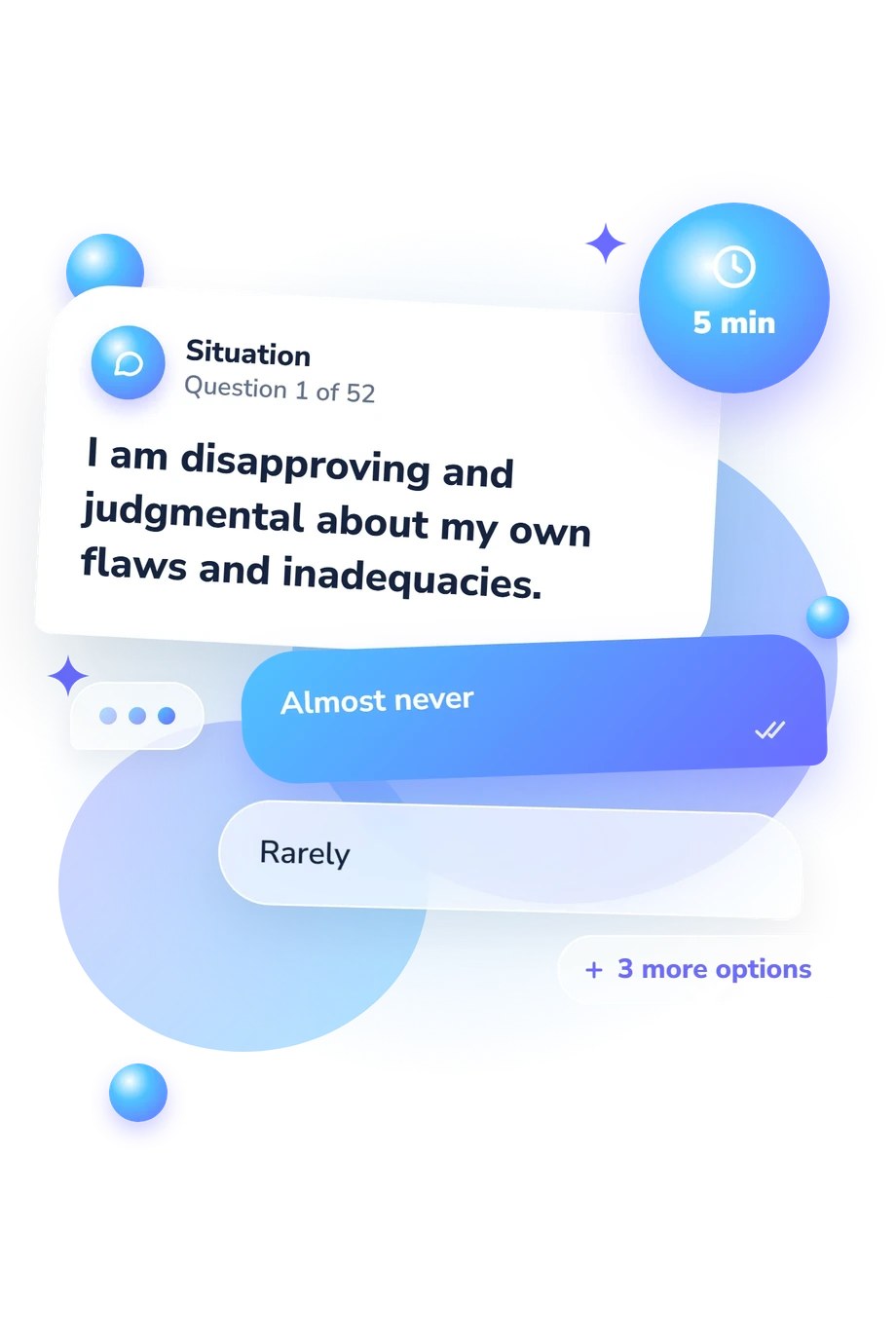
Self-compassion is one of the most consistently supported protective factors in mental health research — more predictive of resilience, emotional regulation, and recovery from setbacks than self-esteem. Yet most people have never examined how they actually treat themselves during difficulty. A structured self compassion assessment identifies whether the inner critic, a tendency to isolate, or emotional over-identification are the primary barriers — making development work far more targeted than generic self-care advice.

A self compassion questionnaire like the SCS is widely used in therapy, counseling, and coaching to establish a baseline before compassion-focused therapy or mindfulness-based interventions, and to track change over time. For individuals, results provide a concrete and nuanced picture of how the inner critic operates and where self-kindness is genuinely present versus absent.

What the Assessment Measures

  • Self-Kindness — the tendency to treat oneself with care and understanding during pain or failure rather than harsh self-judgment.
  • Self-Criticism — the opposing pattern: judging and blaming oneself harshly for perceived inadequacies, mistakes, or failures.
  • Common Humanity — recognizing that suffering, failure, and imperfection are universal human experiences rather than personal signs of inadequacy.
  • Self-Isolation — the opposing pattern: feeling alone and cut off from others when facing difficulty, as if one's suffering is uniquely personal.
  • Mindfulness — the ability to hold painful thoughts and feelings in balanced awareness without suppressing or exaggerating them.
  • Over-Identification — the opposing pattern: becoming absorbed and swept away by difficult emotions and thoughts rather than observing them with perspective.

Who This Assessment Is For

The self compassion test is appropriate for adults who are hard on themselves during stress or failure and want to understand which specific patterns — self-criticism, isolation, or emotional over-identification — are most active. Therapists and counselors use the self compassion assessment as a baseline measure before compassion-focused therapy, mindfulness-based cognitive therapy, or ACT, and to track change across treatment. Coaches use it to identify where inner critic patterns are limiting a client's performance, risk-taking, or recovery from setbacks. Researchers use the SCS extensively to study links between self-compassion, mental health, resilience, and wellbeing across diverse populations. No clinical background is required — each item describes a specific way of responding to difficulty, and respondents simply rate how often it applies to them.

Clinical Validity and Use in Practice

The Self-Compassion Scale was developed by Kristin Neff and has been validated across dozens of countries and cultures, consistently demonstrating strong internal consistency, good test-retest reliability, and convergent validity with established measures of wellbeing, anxiety, depression, and emotional regulation. Meta-analyses show that self-compassion is a robust predictor of reduced psychopathology and greater resilience — and that it is trainable through targeted interventions. The six-subscale structure is particularly valuable in clinical and coaching practice because it distinguishes which of the three component pairs is most limiting for each individual. Scores are most useful when interpreted as a profile across all six dimensions rather than as a single overall index, and should be considered alongside clinical interview data and presenting concerns.

Author: Kristin D. Neff
Literature: Gilbert, P. The compassionate mind. Constable & Robinson. 2009.; MacBeth, A., & Gumley, A. Exploring compassion: A meta-analysis of the association between self-compassion and psychopathology. Clinical Psychology Review. 2012.; Neff, K. D. Development and validation of a scale to measure self-compassion. Self and Identity. 2003.
Test Question Form
You Might Also Like
World Health Organization-Five Well-Being Index (WHO-5)
This brief self-report measure is designed to screen current subjective wel…
Start Test
Symptom Checklist of Well-Being
This measure provides a brief, structured self-report screen of current psy…
Start Test
Popular tests
Narcissistic Personality Inventory (NPI)
This self-report measure is used to assess narcissism as a personality trai…
Start Test
Yale-Brown Obsessive Compulsive Scale (Y-BOCS)
This measure is used to rapidly quantify the current severity of obsessive…
Start Test
CRAFFT Screening Test (CRAFFT 2.1)
This brief screening measure is designed to identify potential alcohol and…
Start Test
Patient Health Questionnaire-9 (PHQ-9)
This measure is commonly used to quickly screen for the presence and severi…
Start Test
Maslach Burnout Inventory (MBI)
This self-report measure is used to assess occupational burnout symptoms in…
Start Test
Adolescent Anxiety Questionnaire
This measure is designed to support a brief appraisal of anxiety symptoms a…
Start Test
Emotional Creativity Inventory (ECI)
This self-report measure assesses individual differences in the originality…
Start Test
Horne–Ostberg Morningness–Eveningness Questionnaire (MEQ)
Circadian preferences influence typical patterns of alertness and sleep tim…
Start Test
Ambivalent Sexism Inventory (ASI)
This measure is designed to assess attitudes toward women, including both o…
Start Test
Internalized Misogyny Scale (IMS)
This measure is designed to assess internalized negative beliefs and stereo…
Start Test
Perceived Stress Scale (PSS-10)
This self-report measure assesses the degree to which individuals appraise…
Start Test
Impulsive Behavior Scale (SUPPS-P)
Impulsivity is a multidimensional construct that is often assessed with bri…
Start Test
Clinical Institute Withdrawal Assessment for Alcohol, Revised (CIWA-Ar)
This rating scale is used to rapidly assess the severity of alcohol withdra…
Start Test
Positive and Negative Affect Schedule (PANAS)
This measure provides a brief self-report assessment of current or typical…
Start Test
Light Triad Scale (LTS)
This self-report measure assesses prosocial personality tendencies and orie…
Start Test
Suicidal Ideation Scale
In clinical settings, the Suicidal Ideation Scale is used to structure an i…
Start Test
Body Dysmorphic Disorder Scale (BDD-D)
This brief self-report measure is designed to screen for and quantify distr…
Start Test
Beck Anxiety Inventory (BAI)
This measure is a brief self-report inventory used to screen for anxiety sy…
Start Test
Differential Test of Perfectionism
This instrument is used to screen for perfectionism-related attitudes and t…
Start Test
Locus of Control Scale
This measure assesses generalized expectancies regarding the degree to whic…
Start Test
New Apathy Scale
This brief self-report measure is used to screen for apathy-related symptom…
Start Test
Perth Alexithymia Questionnaire (PAQ)
This measure assesses individual differences in alexithymia, including diff…
Start Test
Social Intelligence Scale
This brief self-report measure is designed to support rapid screening of in…
Start Test
Fear Test
This measure is designed to evaluate individual differences in fear-related…
Start Test
Neuroticism Level Scale
The measure is intended for brief screening of an individual’s propensity t…
Start Test
Aggressiveness Indicators Screening Questionnaire
This screening tool is designed to quickly identify behavioral indicators a…
Start Test
Comments
Leave a Comment