
Social Interest Scale in Group Psychotherapy Test
How the Scales are Structured
Who Usually Takes This Test?
See How You Compare
Below is a preview of how scores are typically distributed across each scale.
Example Questions From the Test
- Yes
- No
- Yes
- No
- Yes
- No
Social Interest Scale in Group Psychotherapy Test - Description and methodology of the test
People joining group psychotherapy can use the Social Interest Scale in Group Psychotherapy Test to examine how they relate to the shared therapeutic process. It focuses on observable participation and interpersonal responses rather than a single symptom. As a group psychotherapy assessment, it helps respondents reflect on attention to members, openness, reciprocity, and involvement in discussion.
What This Assessment Explores
The questionnaire examines social interest in group life: noticing members, responding to their presence, sharing experiences, and joining the exchange. It is intended for people in group psychotherapy who want a structured view of interpersonal engagement.
These item themes show the situations contributing to the profile:
- Attendance and continuity show whether a participant remains available to the group process.
- Attention to members shows notice of absences, nonverbal changes, and personal details.
- Expression and disclosure describe sharing experiences, feelings, successes, and difficulties.
- Reciprocity and inclusion reflect empathy, response, and efforts to involve quieter members.
The social interest questionnaire reports one Social Interest Scale on a 0-31 range. Bands are Low social interest 0-13, Moderate social interest 14-24, and High social interest 25-31. Higher results indicate greater social interest; moderate results indicate moderate social engagement. Results may help monitor change during psychotherapy.
Methodology and Scientific Basis
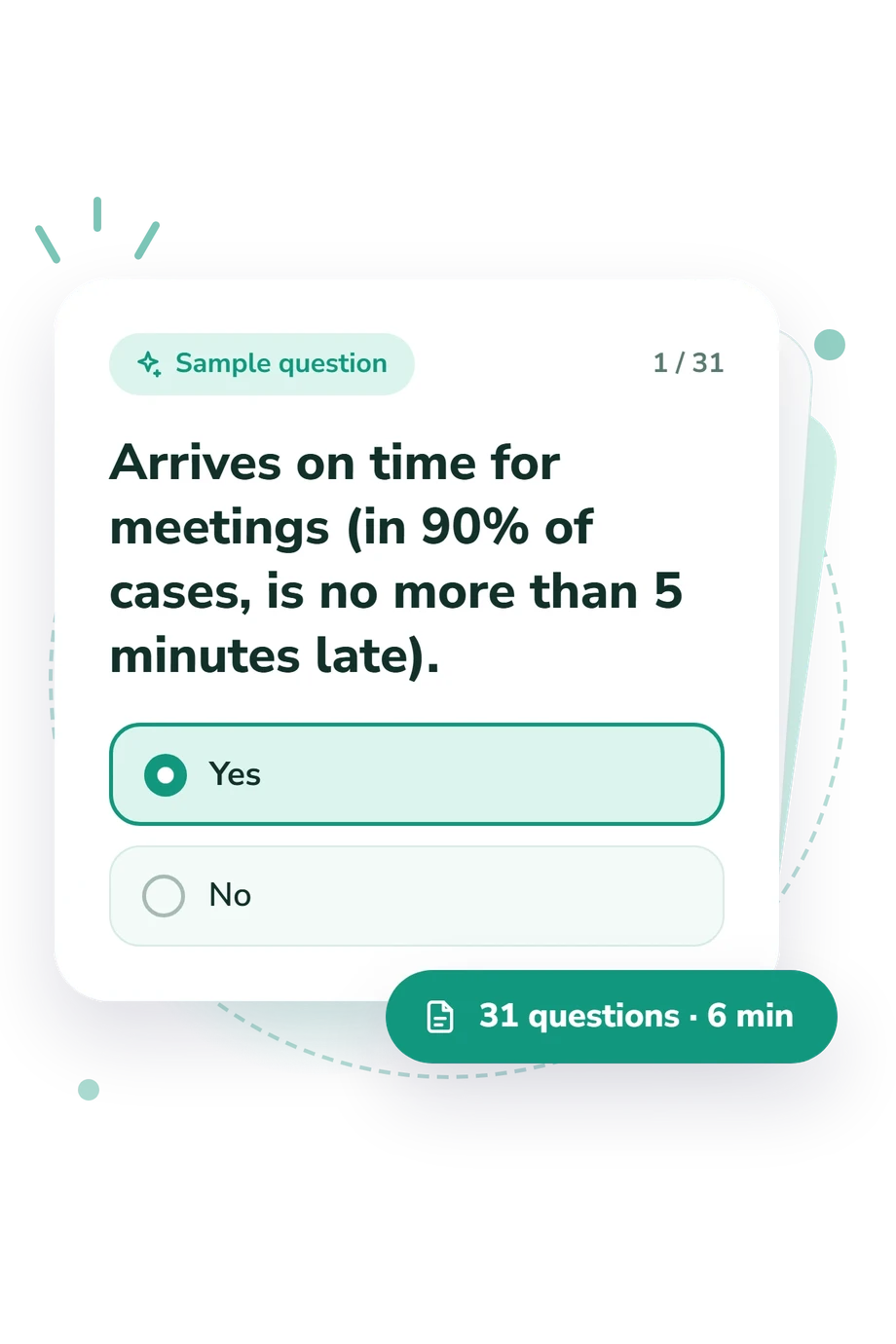
The demonstrated items use yes-or-no responses and present situations including attendance, names, empathy, interruption, superiority or inferiority, and reactions to members joining or leaving. The format calls for behavioral judgment, not an open narrative.
As a group therapy participation measure, the result condenses responses into the displayed bands. The online version does not specify how individual answers contribute to the total, so weighting or reverse-scoring should not be inferred.
The questionnaire is conceptually consistent with Gottesfeld’s 1963 Social Interest Scale for Group Psychotherapy, but it is not presented as that validated instrument or as a documented adaptation. Adler’s account supplies the theoretical context; Leak’s 2006 work offers a revised measure separate from this questionnaire.
The online version is presented without independent norms, reliability estimates, or standardization details. Interpretation is therefore descriptive: the band indicates the level of social interest represented by the answers, not a diagnosis or fixed trait. Responses may shift with group relationships, mood, self-awareness, and the wish to present oneself favorably; interpretation is best paired with actual participation and the therapist’s broader understanding.
- Gottesfeld, H. (1963). A social interest scale for patients in group psychotherapy. Journal of Individual Psychology, 19(1), 77-79.
- Gottesfeld, H. (1991). A social interest scale for patients in group psychotherapy. Individual Psychology: The Journal of Adlerian Theory, Research & Practice, 47(1), 97-100.
- Adler, Alfred. (1938). Social Interest: A Challenge to Mankind. London: Faber and Faber.
- Leak, Gary K. (2006). Development and validation of a revised measure of Adlerian social interest. Social Behavior and Personality: An International Journal, 34(4), 443-450. 10.2224/sbp.2006.34.4.443
Updated: