
Hong Psychological Reactance Scale (HPRS) Test
How the Scales are Structured
Who Usually Takes This Test?
See How You Compare
Below is a preview of how scores are typically distributed across each scale.
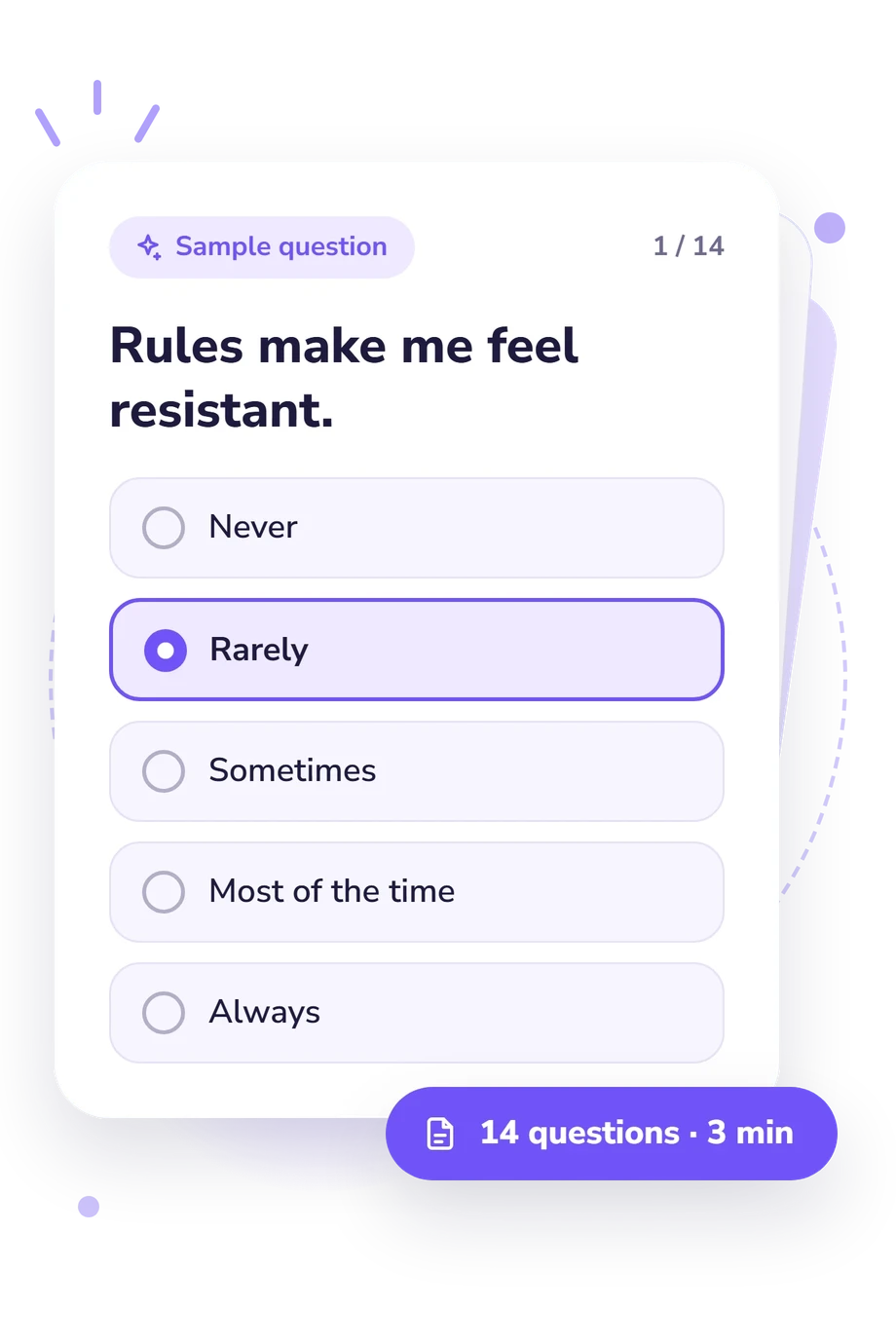
Example Questions From the Test
- Never
- Rarely
- Sometimes
- Most of the time
- Always
- Never
- Rarely
- Sometimes
- Most of the time
- Always
- Never
- Rarely
- Sometimes
- Most of the time
- Always
Hong Psychological Reactance Scale (HPRS) Test - Description and methodology of the test
Readers facing friction over decisions, boundaries, or cooperation may find this psychological reactance assessment useful when they want to examine a pattern before changing a response. The Hong Psychological Reactance Scale (HPRS) Test can help someone consider whether conflict reflects a need for choice, a reaction to another person’s approach, or a broader way of making decisions. Its profile offers prompts for deciding which situations deserve closer attention.
What This Assessment Explores
The items address rules, forbidden choices, dependence, advice, correction, conformity, and attempts to direct behavior. They show how autonomy and resistance to external influence may appear in ordinary situations. This reactance questionnaire supports self-reflection about everyday responses to guidance and control.
The five displayed dimensions are:
- Psychological Reactance (1-5) measures resistance to external pressure: Low resistance 1-2.6; Balanced resistance 2.7-3.9; High resistance 4-5.
- Emotional Response to Restricted Choice (3-15) measures sensitivity to restricted choice: Low sensitivity 3-7; Moderate sensitivity 8-11; High sensitivity 12-15.
- Resistance to Advice and Recommendations (3-15) measures rejection of advice: Low 3-7; Moderate 8-11; High 12-15.
- Resistance to External Influence (3-15) measures resistance to control: Low 3-7; Moderate 8-11; High 12-15.
- Reluctance to Comply With Rules and Norms (4-20) measures resistance to social demands: Generally compliant 4-9; Selective resistance 10-14; Strong resistance 15-20.
Methodology and Evidence Base
Each item uses a five-point frequency response from Never through Always and describes a reaction rather than factual knowledge. Because answers are self-reported, mood, memory, recent conflict, and context can influence the profile. This self-report psychology test is therefore best read as a snapshot of perceived reactions.
The questionnaire is conceptually consistent with the Hong Psychological Reactance Scale published by Hong and Page in 1989 and with psychological reactance theory. Later analyses by Hong in 1992, Hong and Faedda in 1996, and Shen and Dillard in 2005 examined factor structure, refinement, and psychometric properties. This online form should not be assumed identical to those research versions or standardized by their samples.
The result reports five displayed scale scores and result bands, but the item-level calculation is undocumented. These bands describe its result categories; population norms and diagnostic thresholds are not provided. Higher results may reflect stronger self-direction or sensitivity to pressure, while lower results may reflect greater acceptance of guidance and norms. Interpretation is strongest when the profile is considered alongside the situations behind each answer and the person’s goals.
- Hong, Sung-Mook, and Sandra Page. "A Psychological Reactance Scale: Development, Factor Structure and Reliability." Psychological Reports, 64(3_suppl), 1323-1326, 1989. 10.2466/pr0.1989.64.3c.1323
- Hong, Sung-Mook. "Hong's Psychological Reactance Scale: A Further Factor Analytic Validation." Psychological Reports, 70(2), 512-514, 1992. 10.2466/pr0.1992.70.2.512
- Hong, Sung-Mook, and Salvatora Faedda. "Refinement of the Hong Psychological Reactance Scale." Educational and Psychological Measurement, 56(1), 173-182, 1996. 10.1177/0013164496056001014
- Shen, Lijiang, and James Price Dillard. "Psychometric Properties of the Hong Psychological Reactance Scale." Journal of Personality Assessment, 85(1), 74-81, 2005. 10.1207/s15327752jpa8501_07
Updated: