
Situational Contingencies of Self-Worth Scale (CSE) Test
How the Scales are Structured
Who Usually Takes This Test?
See How You Compare
Below is a preview of how scores are typically distributed across each scale.
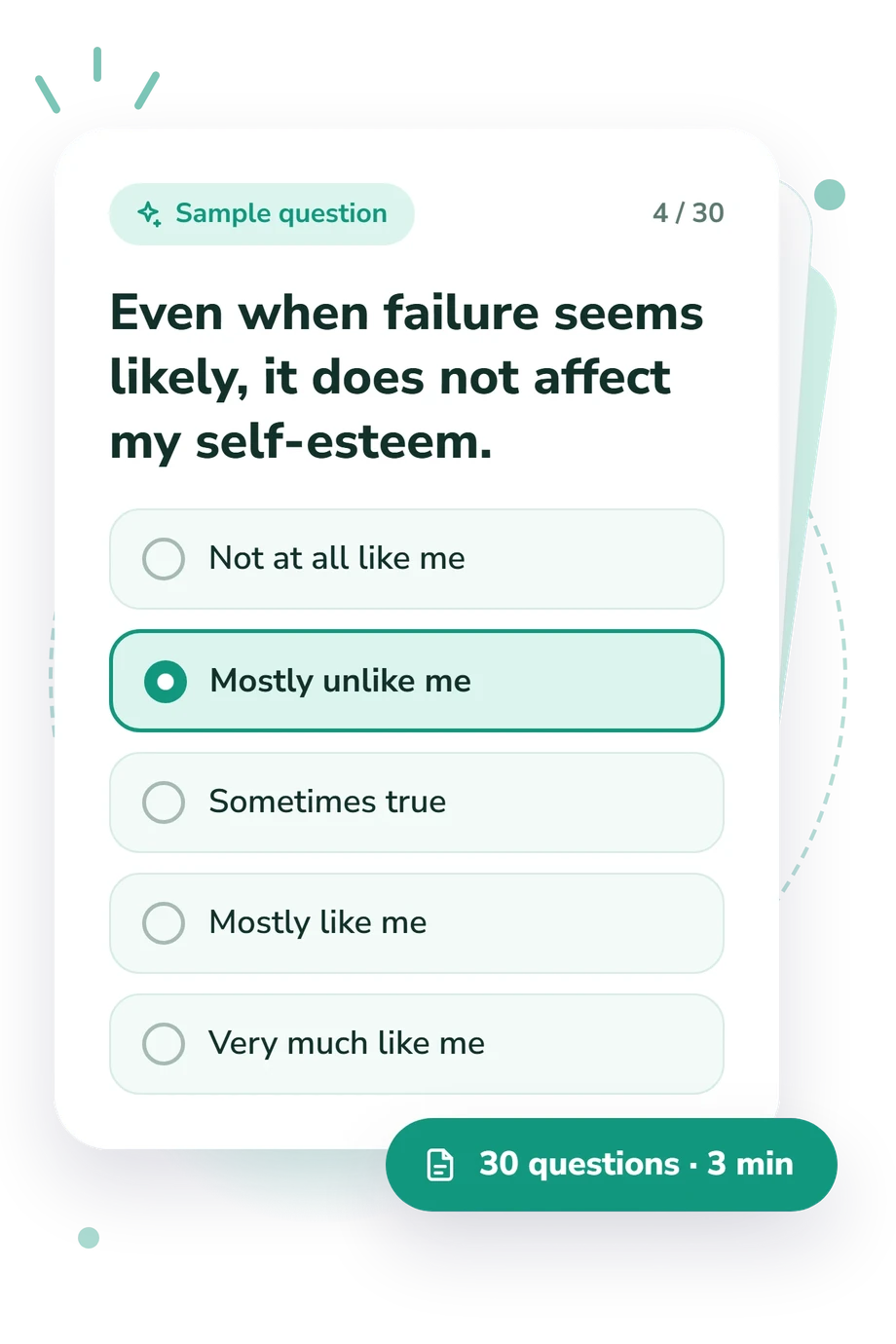
Example Questions From the Test
- Not at all like me
- Somewhat unlike me
- Sometimes true
- Somewhat like me
- Very much like me
- Not at all like me
- Mostly unlike me
- Sometimes true
- Mostly like me
- Very much like me
- Not at all like me
- Mostly not like me
- Sometimes like me
- Mostly like me
- Very much like me
Situational Contingencies of Self-Worth Scale (CSE) Test - Description and methodology of the test
For readers who want to understand how feelings of self-worth may shift in response to everyday feedback, this Situational Contingencies of Self-Worth Scale (CSE) Test offers a focused self-reflection exercise for noticing patterns in self-view. This contingent self-esteem questionnaire explores how evaluation, rejection, failure, or praise may affect self-view in ordinary social and performance situations.
What This Assessment Explores
The questionnaire examines contingent self-worth: how feelings about oneself depend on outcomes and social signals. Items cover four overlapping themes: competence, personal standards, acceptance with relationship feedback, and appearance.
The result estimates overall dependence on situational variables, not separate scores for each theme. Situational Contingencies of Self-Worth (A) ranges from 0-10: Low dependence (0-4), Moderate dependence (5-6), or High dependence (7-10). Higher scores indicate pronounced dependence of self-attitude on situational variables; this may contribute to vulnerability in evaluative situations and may be associated with anger or hostility.
The items show how these themes appear:
- Competence statements show whether success or failure affects self-esteem.
- Personal standards show whether missing personal or others’ expectations lowers self-regard.
- Acceptance and relationship feedback show how approval or rejection affects self-feelings.
- Appearance statements show whether looks or comments about them change self-worth.
Methodology and Scientific Basis
Each statement uses five response options, from 1, “Not at all like me,” to 5, “Very much like me.” The items ask about success, failure, praise, rejection, appearance, and meeting expectations; some are worded as independence from an event, so interpretation depends on the direction of each statement.
The primary source is Wolfe and Crocker’s instrument measuring dependence of self-worth on situations. This questionnaire is presented as an online version of that instrument, rather than the Paradise and Kernis Contingent Self-Esteem Scale or a documented adaptation of it. Paradise and Kernis’s scale and Kernis and Goldman’s discussion provide related conceptual context, while the framework treats self-esteem dependence as situational rather than fixed.
Responses produce one displayed result, but the questionnaire does not specify the points assigned to each answer. Its bands are descriptive levels for this assessment, not universal clinical cutoffs, and norms or reliability estimates are not provided for this online version.
Because self-awareness, current mood, recent feedback, and response bias can affect answers, use the result to notice patterns in self-esteem rather than as a diagnosis.
- Savchenko, T. N., & Faustova, A. G. (2016). Adaptation of M. Kernis-A. Paradise “The Contingent Self-Esteem Scale”. Experimental Psychology (Russia), 9(4), 79-89. 10.17759/exppsy.2016090408
- Paradise, A. W., & Kernis, M. H. (1999). Development of the Contingent Self-Esteem Scale. Unpublished scale, University of Georgia.
- Kernis, M. H., & Goldman, B. M. (2006). Assessing Stability of Self-Esteem and Contingent Self-Esteem. In M. H. Kernis (Ed.), Self-Esteem Issues and Answers: A Sourcebook of Current Perspectives (pp. 77-82). Psychology Press.
Updated: