
Weinstein Noise Sensitivity Scale (WNSS) Test
How the Scales are Structured
Who Usually Takes This Test?
See How You Compare
Below is a preview of how scores are typically distributed across each scale.
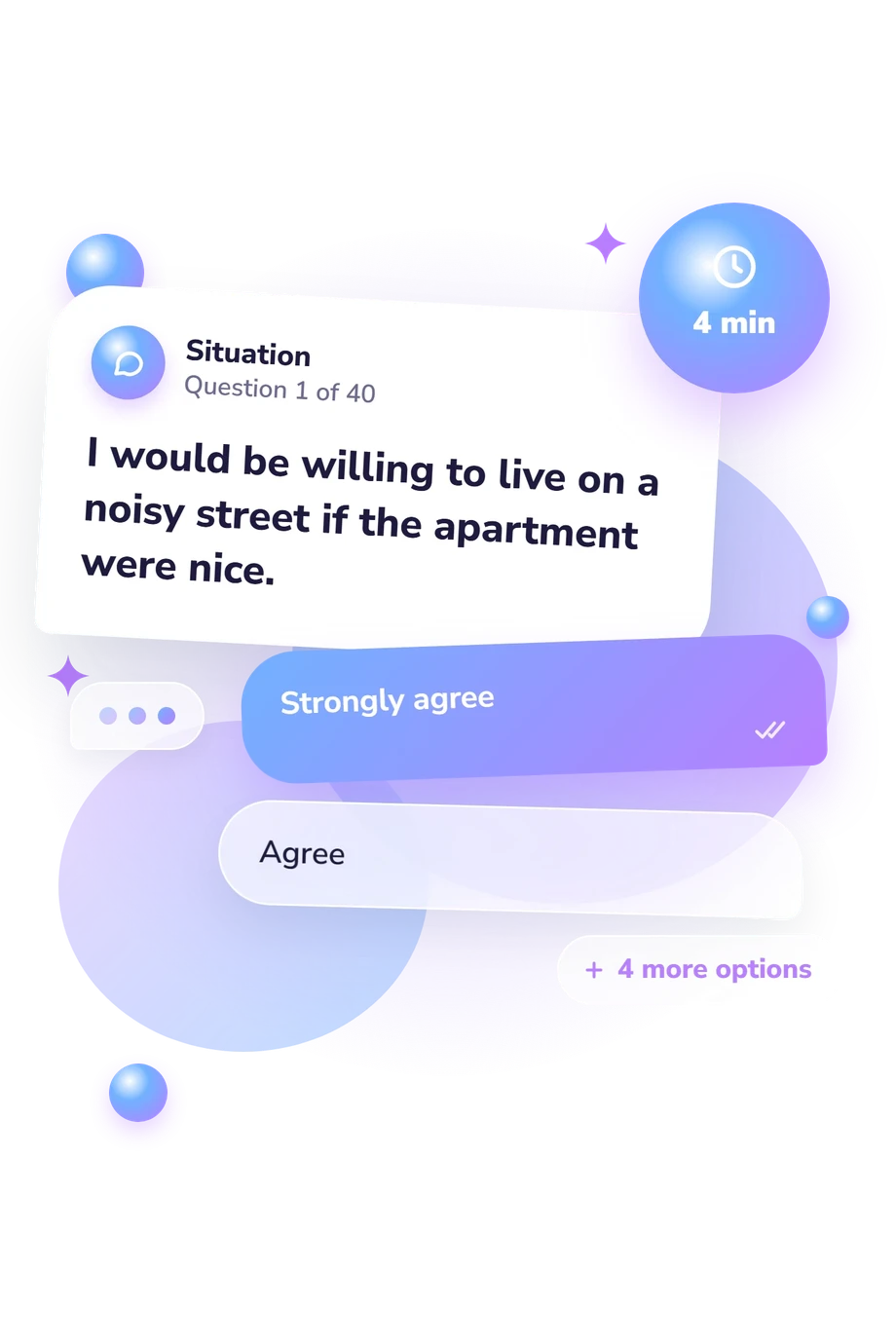
Example Questions From the Test
- Completely agree
- Agree
- Somewhat agree
- Somewhat disagree
- Disagree
- Completely disagree
- Strongly agree
- Agree
- Somewhat agree
- Somewhat disagree
- Disagree
- Strongly disagree
- Completely agree
- Agree
- Somewhat agree
- Somewhat disagree
- Disagree
- Completely disagree
Weinstein Noise Sensitivity Scale (WNSS) Test - Description and methodology of the test
People who notice recurring reactions to sound may use the Weinstein Noise Sensitivity Scale (WNSS) Test to examine whether they reflect a broader tendency. This noise sensitivity assessment concerns a general attitude toward noise, not hearing acuity or the effect of one isolated sound event. It is suited to readers who want to distinguish a relatively stable noise-related tendency from a situation-specific response.
What This Assessment Explores
Noise sensitivity is treated as a relatively stable attitude toward sound, shaped by stressors, coping habits, and psychological, biological, and social factors. The questions place that tendency in ordinary settings such as neighbors, traffic, music, sleep, study, and the need for silence.
The noise sensitivity questionnaire covers annoyance, irritability, distraction, difficulty relaxing, waking easily, concentration, adaptation to background sound, and tolerance of noisy homes or public spaces. Together, these situations show how consistently sound affects daily comfort rather than whether a person can physically detect it.
The result is presented through one scale:
- Noise Sensitivity: 20-120 indicates the overall tendency to experience noise as intrusive, distracting, irritating, or difficult to ignore. Low sensitivity is 20-53, Moderate sensitivity is 54-86, and High sensitivity is 87-120.
That level describes a general pattern across the items; it does not identify the cause of a reaction.
Methodology and Scientific Basis
Each statement uses an ordered six-choice agreement format, from complete or strong agreement to complete or strong disagreement. The items include both tolerance-oriented and sensitivity-oriented wording, so agreement should not automatically be read as greater sensitivity. The displayed bands describe levels on this scale, not clinical categories.
Research by Senese et al. (2012) examined an Italian version of the WNSS across age, sex, and setting, while Weinstein’s 1978 longitudinal study is the original source. Zimmer and Ellermeier’s 1999 comparison evaluated the measure alongside other noise-sensitivity approaches. These studies support the construct, but this questionnaire is conceptually consistent with the original work, not a reproduction of the published Italian version; its validation or standardization evidence should not be assigned to this online presentation.
As a noise sensitivity measure, the test is best read as a structured self-report profile. Responses may reflect current stress, sleep, living conditions, expectations, and candor, so results can shift with circumstances. Use the pattern for self-reflection about concentration, relaxation, or nighttime disturbance, and interpret persistent or severe sound intolerance in its broader personal context.
- Senese, Vincenzo Paolo, Francesco Ruotolo, Gennaro Ruggiero, and Tina Iachini. "The Italian Version of the Weinstein Noise Sensitivity Scale: Measurement Invariance Across Age, Sex, and Context." European Journal of Psychological Assessment, 2012, 28(2), 118-124. 10.1027/1015-5759/a000099
- Weinstein, Neil D. "Individual Differences in Reactions to Noise: A Longitudinal Study in a College Dormitory." Journal of Applied Psychology, 1978, 63(4), 458-466. 10.1037/0021-9010.63.4.458
- Zimmer, Karin, and Wolfgang Ellermeier. "Psychometric Properties of Four Measures of Noise Sensitivity: A Comparison." Journal of Environmental Psychology, 1999, 19(3), 295-302. 10.1006/jevp.1999.0133
Updated: