
Hypersensitive Narcissism Scale (HSNS) Test
How the Scales are Structured
Who Usually Takes This Test?
See How You Compare
Below is a preview of how scores are typically distributed across each scale.
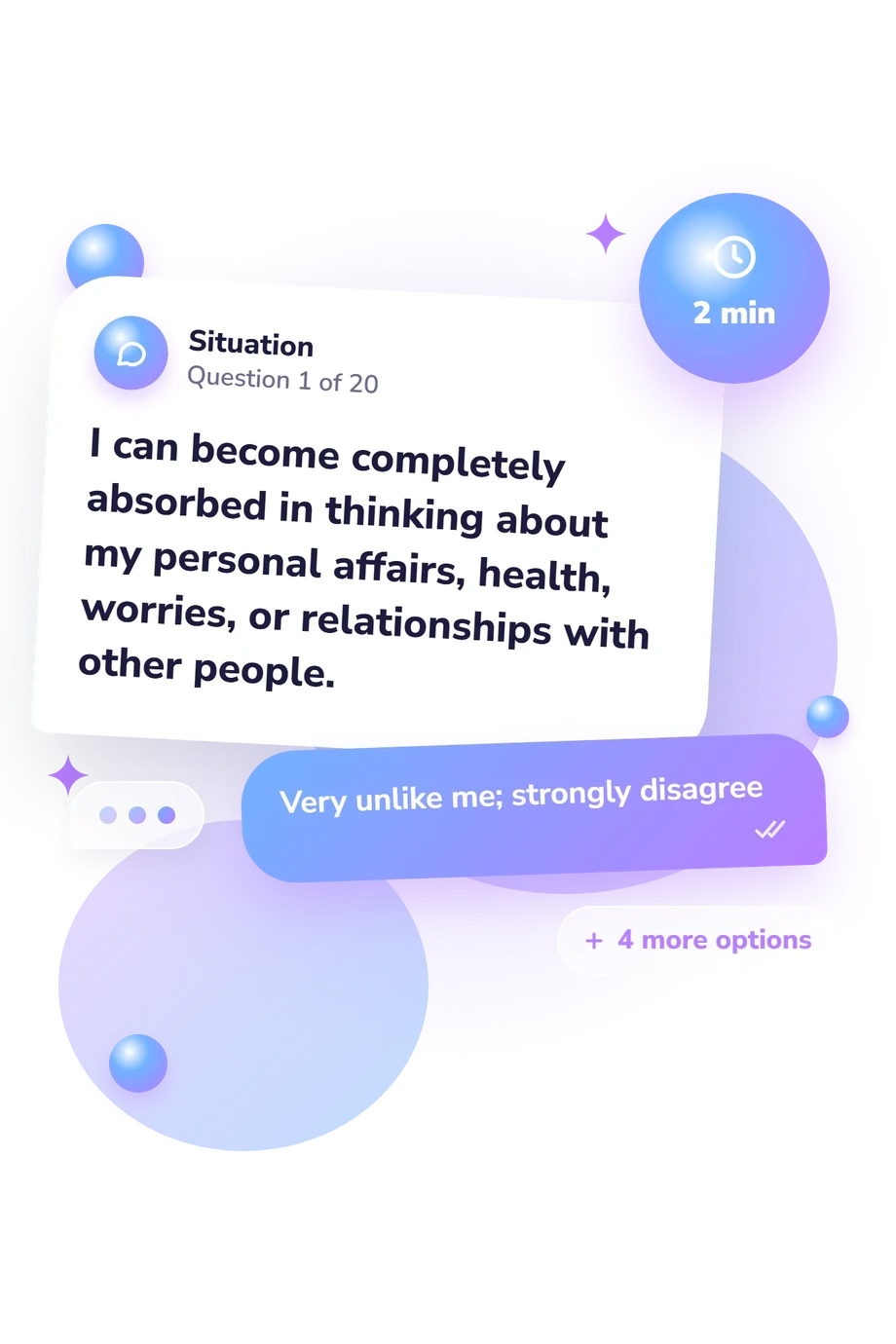
Example Questions From the Test
- Very unlike me, strongly disagree
- Does not describe me
- Neither agree nor disagree
- Describes me
- Describes me very well, strongly agree
- Very unlike me, strongly disagree
- Not like me
- Neither
- Describes me
- Very much like me, strongly agree
- Very unlike me; completely disagree
- Not characteristic of me
- Neither true nor untrue
- Characteristic of me
- Very characteristic of me; completely agree
Hypersensitive Narcissism Scale (HSNS) Test - Description and methodology of the test
People who notice strong reactions to criticism, a need for recognition, or discomfort in social situations may use this assessment to examine vulnerable forms of narcissistic experience. The Hypersensitive Narcissism Scale (HSNS) Test organizes these reactions for readers examining sensitivity, recognition needs, and self-focused responses in relationships. This hypersensitive narcissism test groups those reactions into a structured profile.
What This Assessment Measures
Rather than treating narcissism as only overt self-importance, the questionnaire focuses on a vulnerable, inwardly preoccupied expression with covert features. Items address hurt feelings, taking remarks personally, self-consciousness, wanting credit, absorption in private concerns, conditional belonging, and irritation when others seek sympathy. Together, these themes connect emotional sensitivity with interpersonal attention.
These themes form four recurring areas of experience that contribute to one result, not separate scores:
- Sensitivity to criticism shows how strongly perceived slights affect the respondent.
- Self-consciousness captures concern about being watched, judged, or different.
- Recognition needs indicate how important credit and being valued may feel.
- Interpersonal absorption reflects how private concerns can eclipse attention to others.
This vulnerable narcissism questionnaire uses the Sensitive Narcissism scale: 10-50; Lower sensitivity (10-22), Moderate sensitivity (23-35), Higher sensitivity (36-50). Higher scores indicate greater preoccupation with personal significance, emotional sensitivity, and recognition needs.
Methodology and Evidence Base
Each statement uses a five-position self-report response, moving from strong disagreement or very unlike me to strong agreement or very characteristic of me. Wording varies slightly, but the task is consistent: judge how well each statement or experience describes the respondent. The displayed result is directional: higher values correspond to more of the sensitivity and recognition concerns defined above.
The questionnaire presents the ten-item Hypersensitive Narcissism Scale developed by Mark H. Hendin and Jonathan M. Cheek. A 2009 study by Fossati and colleagues reported reliability and validity findings for the published HSNS, while Wink’s 1991 work described narcissism as having distinct interpersonal presentations, including a more vulnerable pattern. These sources support interpretation of the themes, not proof that this online version reproduces the samples, norms, or validation procedures.
The result works as a narcissism self-assessment by offering a structured snapshot of self-perceived tendencies. The displayed bands are descriptive categories rather than clinical cutoffs, and responses may shift with current stress, self-awareness, or the wish to present oneself favorably; broader context is needed before drawing firm conclusions about personality or relationships.
- Hendin, Holly M., and Jonathan M. Cheek. (1997). Assessing Hypersensitive Narcissism: A Reexamination of Murray's Narcism Scale. Journal of Research in Personality, 31(4), 588-599. 10.1006/jrpe.1997.2204
- Fossati, Andrea, Serena Borroni, Federica Grazioli, Lorenzo Dornetti, Irene Marcassoli, Cesare Maffei, and Jonathan M. Cheek. (2009). Tracking the hypersensitive dimension in narcissism: Reliability and validity of the Hypersensitive Narcissism Scale. Personality and Mental Health, 3(4), 235-247. 10.1002/pmh.92
- Wink, Paul. (1991). Two faces of narcissism. Journal of Personality and Social Psychology, 61(4), 590-597. 10.1037/0022-3514.61.4.590
Updated: