
Uncertainty Response Scale (URS) Test
How the Scales are Structured
Who Usually Takes This Test?
See How You Compare
Below is a preview of how scores are typically distributed across each scale.
Example Questions From the Test
- Never
- Rarely
- Sometimes
- Often
- Always
- Never
- Rarely
- Sometimes
- Often
- Always
- Never
- Rarely
- Sometimes
- Often
- Always
Uncertainty Response Scale (URS) Test - Description and methodology of the test
People who feel unsettled by unclear choices, changing plans, or unpredictable outcomes can use this assessment to examine their typical responses. The Uncertainty Response Scale (URS) Test organizes those experiences into a profile of flexibility, thinking patterns, and emotional discomfort. It helps readers see how they handle uncertainty in everyday situations, identify where it creates strain, and notice where they remain open to change.
What This Assessment Explores
The assessment examines responses to unclear or changing situations: openness to change, thinking during difficult decisions, and emotions such as worry, fear, anger, or overwhelm. It suits readers seeking insight into everyday responses to uncertainty.
The profile contains three dimensions:
- Readiness for Change (8-40) measures capacity to accept and adapt to change. Low readiness (8-23), Moderate readiness (24-35), and High readiness (36-40) show the displayed bands.
- Cognitive Responses (6-30) measures thinking and perception under uncertainty. Flexible (6-16), Mixed (17-27), and Negative/decisive difficulty (28-30) are the displayed bands.
- Emotional Reactions (11-55) measures discomfort and anxiety during uncertain situations. Low (11-19), Moderate (20-39), and High (40-55) indicate the displayed bands.
Together, the results describe readiness, cognitive difficulty, and emotional strain under uncertainty; they do not establish that one pattern dominates.
Methodology and Scientific Basis
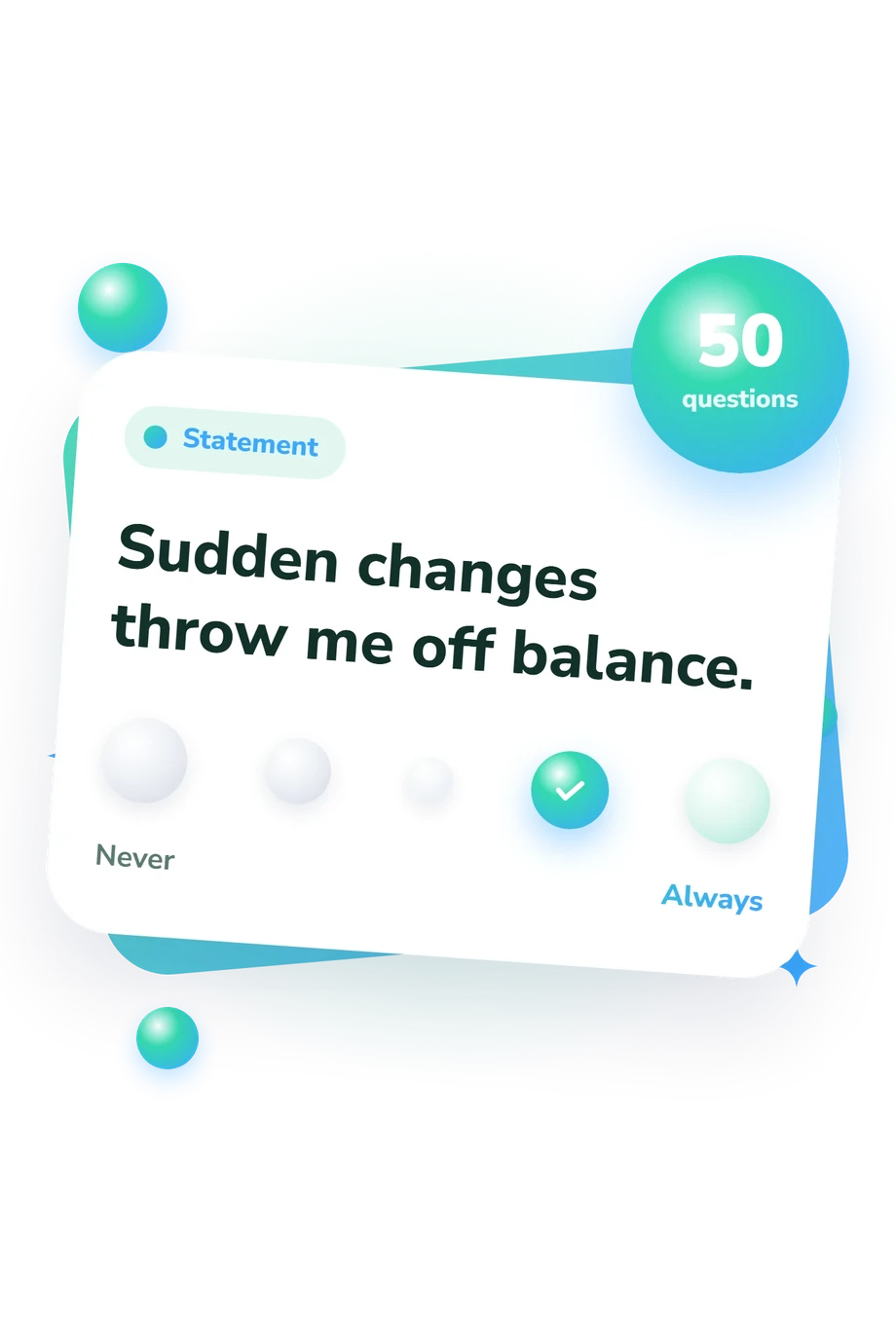
Each statement uses a five-point frequency response from Never to Always. The items cover sudden change, mistakes, planning, control, unclear situations, and new experiences. Respondents report how often each pattern describes them rather than choosing a correct answer.
Responses are combined into separate dimension scores, producing a profile rather than one overall label. The displayed bands organize scores; individual response weights and reverse-scoring are unspecified, so interpret them descriptively rather than as formula-based classifications.
The questionnaire is conceptually consistent with Uncertainty Response Scale (Greco & Roger, 2001), which examines emotional, cognitive, and change-oriented responses to uncertainty, but it is not presented as an adaptation. Lucas Casanova and colleagues (2019) studied factorial validity and measurement invariance in a 25-item Portuguese adaptation, supporting the three-part structure in that sample. It does not establish identical psychometric properties for this version.
For interpretation, this uncertainty response assessment is best read as a structured snapshot. Current stress, transitions, self-awareness, and presentation concerns can shape self-report answers. The online version offers displayed bands, not population norms, so scores are descriptive and should be interpreted in context.
- Greco, V., & Roger, D. (2001). Coping with uncertainty: The construction and validation of a new measure. Personality and Individual Differences, 31(4), 519-534. 10.1016/S0191-8869(00)00156-2
- Lucas Casanova, M., Pacheco, L. S., Costa, P., Lawthom, R., & Coimbra, J. L. (2019). Factorial validity and measurement invariance of the uncertainty response scale. Psicologia: Reflexão e Crítica, 32(1), 23. 10.1186/s41155-019-0135-2
Updated: