
Work-Related Flow Scale (WOLF-S) Test
How the Scales are Structured
Who Usually Takes This Test?
See How You Compare
Below is a preview of how scores are typically distributed across each scale.
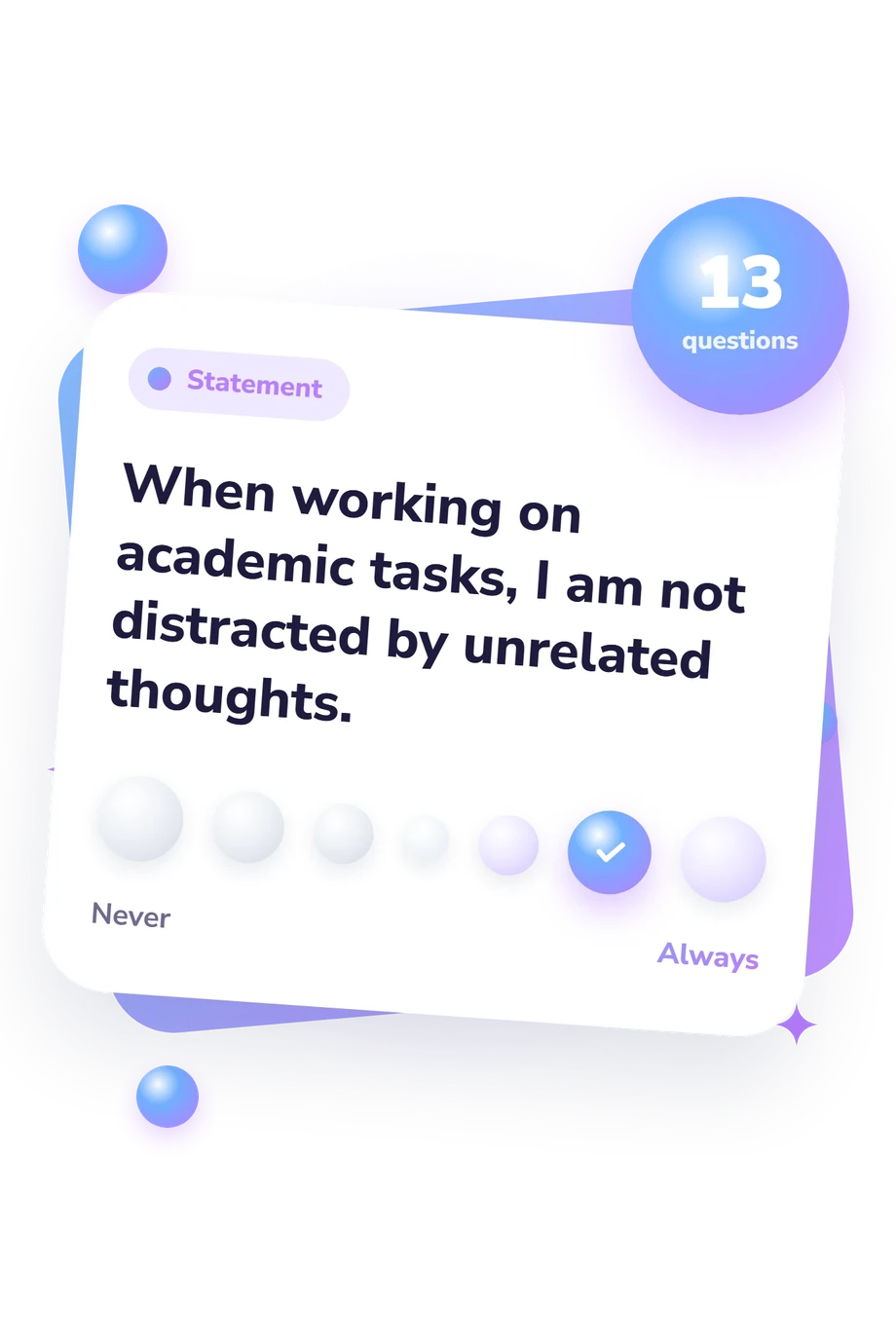
Example Questions From the Test
- Never
- Very rarely
- Rarely
- Sometimes
- Often
- Very often
- Always
- Never
- Very rarely
- Rarely
- Sometimes
- Often
- Very often
- Always
- Never
- Very rarely
- Rarely
- Sometimes
- Often
- Very often
- Always
Work-Related Flow Scale (WOLF-S) Test - Description and methodology of the test
Students and other learners can use this profile to examine what makes academic work absorbing or difficult. The Work-Related Flow Scale (WOLF-S) Test focuses on the lived experience of learning rather than grades, linking motivation, enjoyment, concentration, and immersion. The profile helps readers identify patterns in interest, attention, enjoyment, and immersion during study, offering a practical view of study-related flow.
What This Assessment Explores
Here, academic flow is treated as a learning experience in which attention stays with the task, interest sustains effort, and studying feels meaningful. Its design is useful for understanding study engagement because the items address distraction, immersion, positive emotion, ungraded effort, and internally valued learning, so the profile separates related aspects of engagement.
These dimensions show what the result describes:
- Intrinsic Motivation (5-35) reflects self-directed interest in learning; Low 5-15, Moderate 16-25, and High 26-35.
- Enjoyment of Studying (4-28) reflects positive feelings during learning; Low pleasure 4-12, Moderate pleasure 13-20, and High pleasure 21-28.
- Absorption (4-28) reflects immersion and reduced awareness of surroundings; Low absorption 4-12, Moderate absorption 13-20, and High absorption 21-28.
- Flow State (13-91) reflects concentrated, controlled engagement associated with positive emotion, effectiveness, and satisfaction; Low flow 13-38, Moderate flow 39-64, and High flow 65-91.
Methodology and Evidence Base
As a self-report questionnaire, every statement uses seven ordered choices running from Never to Always; the items address intrinsic reasons for studying, enjoyment, and attentional absorption. The scoring is dimensional: responses produce separate profile scores and an overall flow result, where higher values indicate more of the relevant tendency.
Methodologically, the profile reflects flow theory described by Jeanne Nakamura and Mihaly Csikszentmihalyi, where deep involvement combines focused attention, a sense of control, and an intrinsically rewarding experience. This study flow questionnaire is a separate online measure that is conceptually consistent with the Study-Related Flow Inventory (WOLF-S) and the Work-Related Flow Inventory (WOLF), rather than a direct adaptation of either published instrument.
Interpret the bands as descriptive indications rather than fixed traits. Workload, deadlines, mood, subject matter, self-awareness, and candour can affect self-report. The published WOLF-S has validation evidence, but that evidence does not establish this online form’s own norms, standardization, or psychometric properties; use it to notice patterns and consider them over time.
- Bakker, Arnold, Tajana Ljubin Golub, and Majda Rijavec. (2017). Validation of the Study-Related Flow Inventory (WOLF-S). Croatian Journal of Education, 19(1), 147-173. 10.15516/cje.v19i1.2194
- Bakker, Arnold B. (2008). The Work-Related Flow Inventory: Construction and Initial Validation of the WOLF. Journal of Vocational Behavior, 72(3), 400-414. 10.1016/j.jvb.2007.11.007
- Nakamura, Jeanne, and Mihaly Csikszentmihalyi. (2002). The Concept of Flow. In C. R. Snyder and Shane J. Lopez (Eds.), Handbook of Positive Psychology, 89-105. Oxford University Press. 10.1093/oso/9780195135336.003.0007
Updated: