
Tuckman Procrastination Scale (TPS) Test
How the Scales are Structured
Who Usually Takes This Test?
See How You Compare
Below is a preview of how scores are typically distributed across each scale.
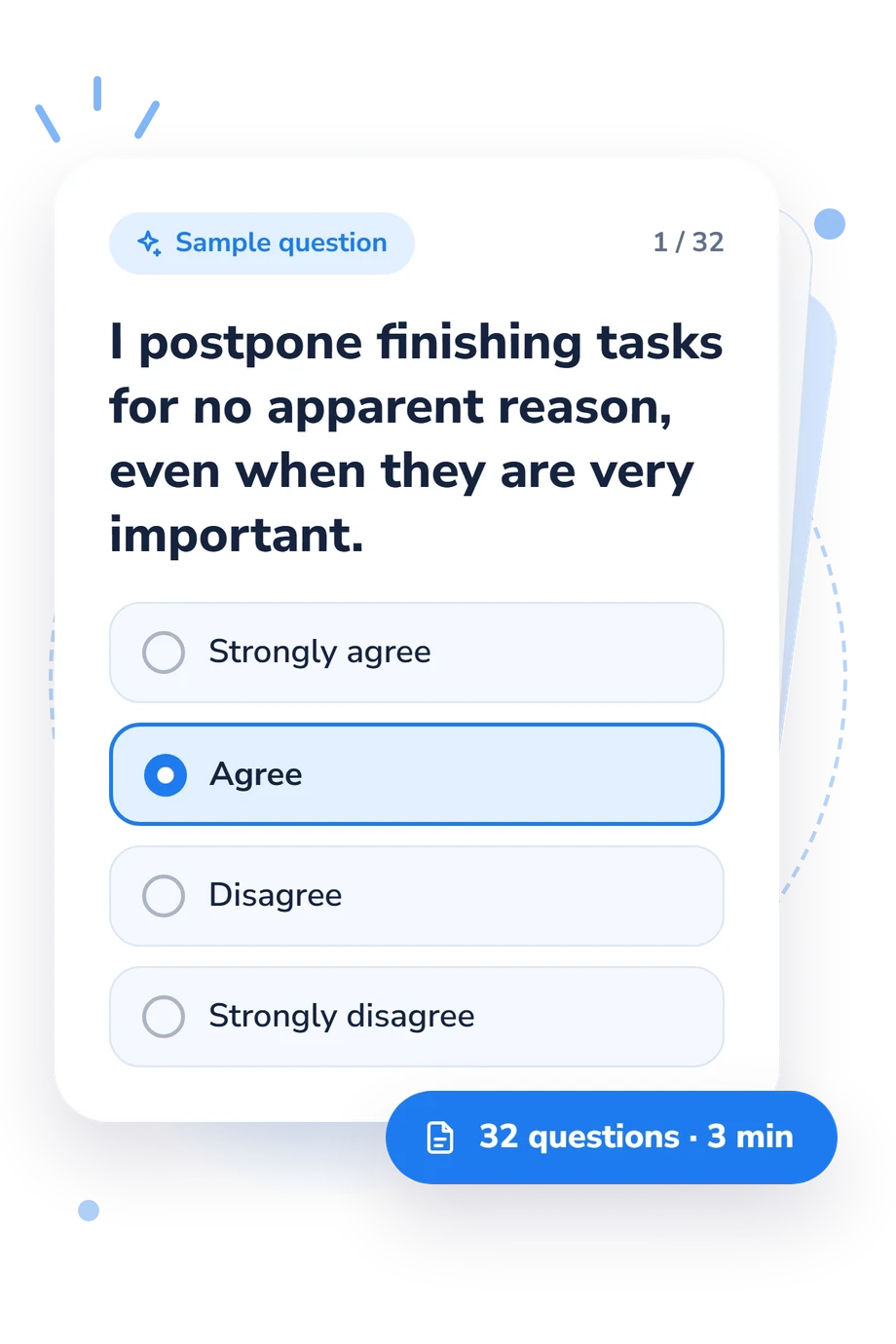
Example Questions From the Test
- Strongly agree
- Agree
- Disagree
- Strongly disagree
- Strongly agree
- Agree
- Disagree
- Strongly disagree
- Strongly agree
- Agree
- Disagree
- Strongly disagree
Tuckman Procrastination Scale (TPS) Test - Description and methodology of the test
People who want to understand why important work gets delayed can use the Tuckman Procrastination Scale (TPS) Test as a focused self-report check of task initiation, persistence, and time use. As a procrastination assessment, it helps readers identify whether postponing reflects a recurring pattern across unpleasant, difficult, urgent, or personally important tasks. The result offers a concise starting point for examining routines and planning habits.
What This Assessment Explores
This questionnaire focuses on procrastination as delaying action despite knowing a task matters. For someone considering a procrastination test, the issue is whether delay persists across situations. The items address postponed starts and finishes, deadline pressure, difficult decisions, excuses, time wasting, frustration, planning, and follow-through.
These themes show what the result can reflect:
- Task initiation and completion show how readily necessary work gets started and finished.
- Delay under pressure reflects responses to deadlines, difficult choices, and unpleasant tasks.
- Time use and excuses indicate whether inactivity feels controllable or hard to interrupt.
- Planning and follow-through show consistency between intentions, schedules, and action.
The displayed Procrastination scale (35-64) summarizes the pattern: Low procrastination is 35-47, Moderate procrastination is 48-54, and High procrastination is 55-64. Higher scores indicate more pronounced procrastination tendencies, while lower scores indicate less persistent postponement; the scale also relates to self-regulation and activity organization.
Methodology and Scientific Basis
Each item is a first-person statement with four choices: Strongly agree, Agree, Disagree, and Strongly disagree. Respondents judge whether each situation matches their usual behavior. Answers combine into one overall score, but no per-response point rule is stated, so the range should not be reverse-engineered.
The questionnaire uses the content of the published 16-item Tuckman Procrastination Scale (TPS; Tuckman, 1991) in an online version of that instrument. Its displayed score range and interpretation differ from the published instrument, so equivalence with the original scoring, norms, and validation procedures should not be assumed. Ozer, Saçkes, and Tuckman (2013) add evidence from a Turkish sample; Vangsness and colleagues (2022) report that self-report procrastination measures can show inconsistent validity and psychometric findings across contexts.
For practical use, read the result as a current tendency rather than a fixed trait. A time management self-assessment can connect the result with smaller deadlines, clear start cues, and planned work periods. The questionnaire gives a broad pattern score rather than separate scores for every behavior. Workload and mood may influence self-reported answers, so compare the score with behavior over time.
- Tuckman, B. W. (1991). The Development and Concurrent Validity of the Procrastination Scale. Educational and Psychological Measurement, 51(2), 473-480. 10.1177/0013164491512022
- Ozer, B. U., Saçkes, M., & Tuckman, B. W. (2013). Psychometric properties of the Tuckman Procrastination Scale in a Turkish sample. Psychological Reports, 113(3), 874-884. 10.2466/03.20.PR0.113x28z7
- Vangsness, L., Voss, N. M., Maddox, N., Devereaux, V., & Martin, E. (2022). Self-Report Measures of Procrastination Exhibit Inconsistent Concurrent Validity, Predictive Validity, and Psychometric Properties. Frontiers in Psychology, 13, 784471. 10.3389/fpsyg.2022.784471
Updated: