
Preschool Emotional Distress Scale Test
How the Scales are Structured
Who Usually Takes This Test?
See How You Compare
Below is a preview of how scores are typically distributed across each scale.
Example Questions From the Test
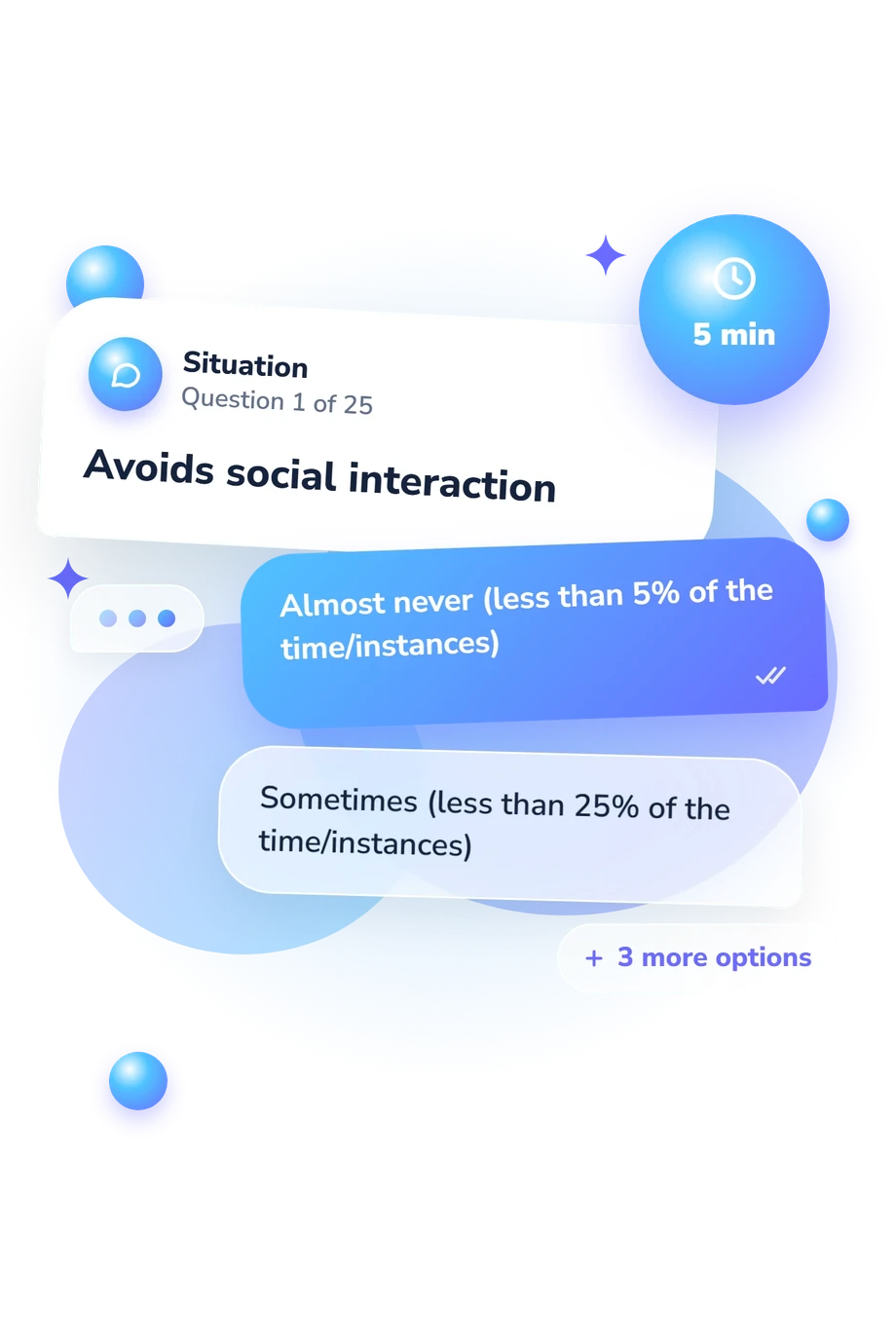
- Almost never (less than 5% of the time/instances)
- Sometimes (less than 25% of the time/instances)
- Often (less than 50% of the time/instances)
- Most of the time (more than 50% of the time/instances)
- Almost always (more than 95% of the time/instances)
- Almost never (less than 5% of the time/instances)
- Sometimes (less than 25% of the time/instances)
- Often (less than 50% of the time/instances)
- Most of the time (more than 50% of the time/instances)
- Almost always (more than 95% of the time/instances)
- Almost never (less than 5% of the time/instances)
- Sometimes (less than 25% of the time/instances)
- Often (less than 50% of the time/instances)
- Most of the time (more than 50% of the time/instances)
- Almost always (more than 95% of the time/instances)
Preschool Emotional Distress Scale Test - Description and methodology of the test
Caregivers, educators, and other adults who know a young child can use the Preschool Emotional Distress Scale Test to review a profile of mood, relationships, behavior, and self-regulation across everyday settings. Its frequency-based format is central to a preschool child behavior assessment: it records how often an adult observes a behavior rather than treating it as present or absent, helping guide discussion of patterns for monitoring or support.
What This Assessment Measures
Items cover social connection, anxiety, mood, activity, attention, aggression, repetitive behavior, and reactions to change. This preschool emotional assessment links observable signs with behavior.
Its six dimensions are:
- Hyperactivity/Disinhibition (0-20) measures excessive activity, impulsivity, and self-regulation difficulties: Low 0-4; Moderate 5-12; High 13-20.
- Maladaptive Behavior (0-20) measures behavior interfering with group adjustment: Low 0-7; Elevated 8-20.
- Depression (0-20) measures low mood, apathy, and reduced interest: Low 0-3; Moderate 4-8; High 9-20.
- Anxiety (0-20) measures worry, fears, and insecurity: Low 0-4; Moderate 5-11; High 12-20.
- Social Withdrawal (0-20) measures difficulty initiating and maintaining interaction: Low 0-3; Moderate 4-11; High 12-20.
- Emotional Distress and Atypical Behavior (0-100) measures emotional distress and atypical behavior: Low 0-13; Moderate 14-44; High 45-100.
Methodology and Evidence Base
Each item asks an observing adult how often a behavior occurs, using five choices from Almost never to Almost always. Approximate frequency anchors make responses about observed occurrence rather than a yes-or-no judgment. Items cover interaction, mood, routines, attention, activity, and regulation.
Scores are grouped into the dimensions and read through the displayed bands. The questionnaire reports displayed ranges and labels but does not establish universal norms or conversions to external scores. Results are best understood as a current profile of reported behavior, not a complete explanation of the child.
The questionnaire is conceptually consistent with the Emotional Distress and Atypical Behavior Scale described by Kazmin and colleagues (2014), but it should not be treated as identical to that research version. The TABS manual, Achenbach and Rescorla (2000), and Rescorla (2005) provide related developmental and multi-informant frameworks but do not establish norms for this form.
Interpretation depends on the observer's perspective and circumstances: an emotional distress scale for preschool children reflects reported behavior rather than direct clinical observation. A high band signals attention, not a diagnosis, and merits assessment when concerns persist.
- Kazmin, A.M., Konovko, N.A., Salnikova, O.G., Tupitsina, E.K., & Fedina, E.V. (2014). The Scale of Emotional Distress and Atypical Behavior of Preschool Children. Clinical Psychology and Special Education, 3(3), Article 6.
- Neisworth, J.T., Bagnato, S.J., Salvia, J., & Hunt, F.M. (1999). TABS Manual for the Temperament and Atypical Behavior Scale: Early Childhood Indicators of Developmental Dysfunction. Baltimore, MD: Paul H. Brookes Publishing Co.
- Achenbach, T.M., & Rescorla, L.A. (2000). Manual for the ASEBA Preschool Forms & Profiles: An Integrated System of Multi-informant Assessment. Burlington, VT: University of Vermont, Research Center for Children, Youth, & Families.
- Rescorla, L.A. (2005). Assessment of young children using the Achenbach System of Empirically Based Assessment (ASEBA). Mental Retardation and Developmental Disabilities Research Reviews, 11(3), 226-237. 10.1002/mrdd.20071
Updated: