
Multiple Stimulus Types Ambiguity Tolerance Scale-II (MSTAT-II) Test
How the Scales are Structured
Who Usually Takes This Test?
See How You Compare
Below is a preview of how scores are typically distributed across each scale.
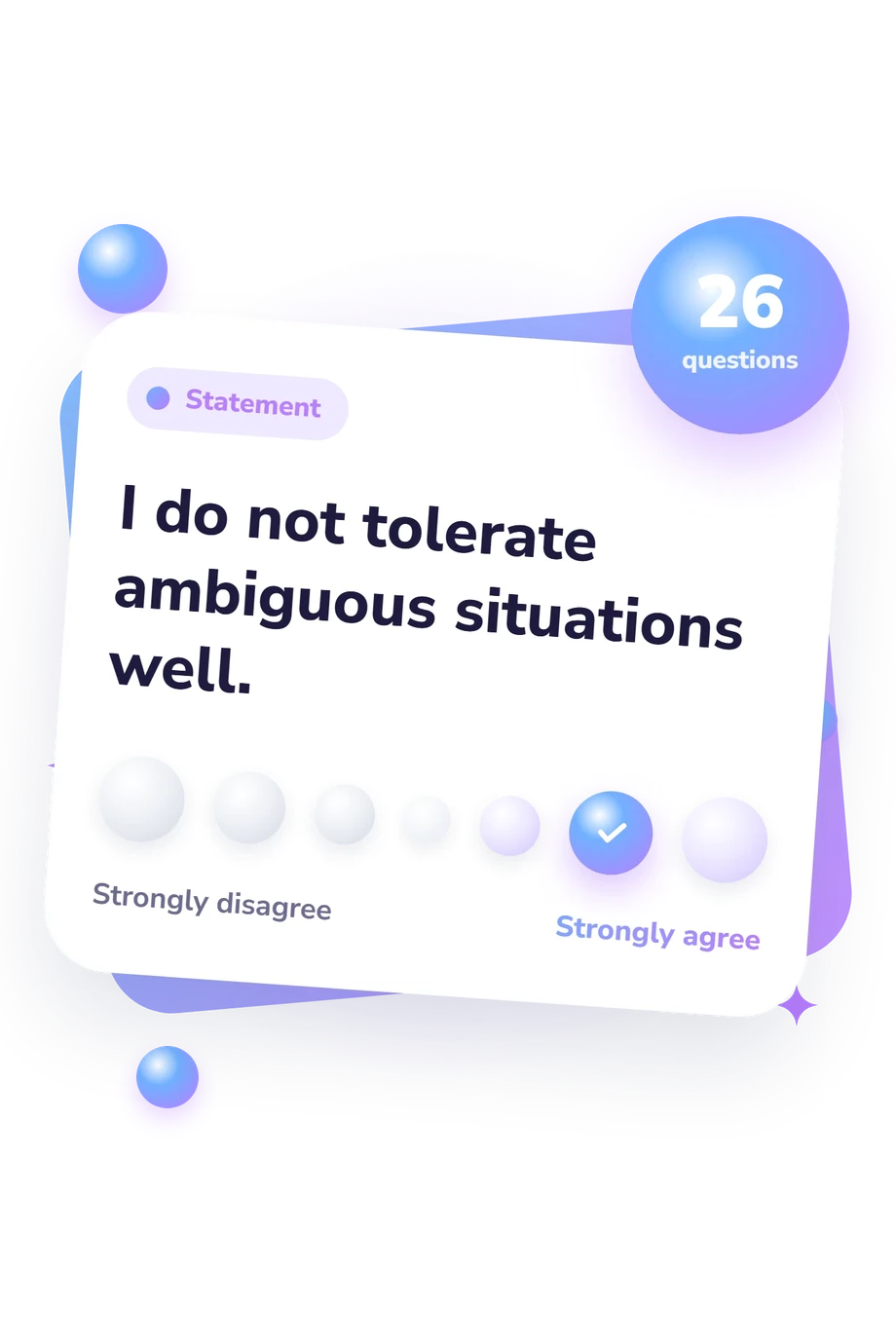
Example Questions From the Test
- Strongly disagree
- Disagree
- Somewhat disagree
- Neither agree nor disagree
- Somewhat agree
- Agree
- Strongly agree
- Strongly disagree
- Disagree
- Somewhat disagree
- Neither agree nor disagree
- Somewhat agree
- Agree
- Strongly agree
- Strongly disagree
- Disagree
- Somewhat disagree
- Neither agree nor disagree
- Somewhat agree
- Agree
- Strongly agree
Multiple Stimulus Types Ambiguity Tolerance Scale-II (MSTAT-II) Test - Description and methodology of the test
People who want to understand their comfort with uncertainty, novelty, and problems without a single clear answer may find the Multiple Stimulus Types Ambiguity Tolerance Scale-II (MSTAT-II) Test useful for focused self-reflection. As an ambiguity tolerance test, it describes a general response tendency rather than a fixed ability, helping readers consider how they approach unclear choices, competing viewpoints, and changing circumstances.
What This Assessment Explores
Ambiguity tolerance concerns responses to incomplete information, unfamiliar situations, and problems with several possible interpretations. The items cover avoidance of uncertainty, preference for familiar experiences, discomfort with multiple perspectives, and willingness to engage with complex problems. They also ask about novelty and unclear outcomes.
The reported result functions as a tolerance for ambiguity scale. Higher tolerance is associated with agency, optimism, risk-taking, faster movement from planning to action, and higher psychological well-being, with a moderate strength of association; these are tendencies, not promises.
The scale is Tolerance of Ambiguity: 13-91, reported as Low tolerance 13-41, Moderate tolerance 42-64, or High tolerance 65-91.
The item themes are:
- Avoiding uncertainty shows how strongly unclear situations may prompt retreat.
- Familiarity preference reflects comfort with known settings over novelty.
- Complexity tolerance captures willingness to consider competing viewpoints.
- Unclear-choice openness reflects readiness to act without a single best outcome.
Methodology and Evidence Base
Each statement uses a seven-point agreement format from Strongly disagree to Strongly agree. The 13-item set combines statements about avoiding or disliking ambiguity with items about novelty, complex problem-solving, multiple viewpoints, and uncertain choices, including preferences for familiar situations and difficulty choosing when outcomes are unclear. The questionnaire reports one overall Tolerance of Ambiguity result; no separate topic scores are presented.
The questionnaire is conceptually consistent with the published MSTAT-II described by McLain in 2009. Evidence from the Spanish version applies to that version and should not be treated as validation of this online form’s reporting bands.
Interpret the result directionally: a higher score suggests greater comfort remaining engaged when circumstances are unclear, while a lower score suggests stronger preference for clarity, familiarity, or definite outcomes.
Because this is a self-report, answers may reflect current context and the respondent’s self-observation.
- McLain, D. L. (2009). Evidence of the Properties of an Ambiguity Tolerance Measure: The Multiple Stimulus Types Ambiguity Tolerance Scale-II (MSTAT-II). Psychological Reports, 105(3), 975-988. 10.2466/PR0.105.3.975-988
- Arquero, J. L., and McLain, D. L. (2010). Preliminary Validation of the Spanish Version of the Multiple Stimulus Types Ambiguity Tolerance Scale (MSTAT-II). The Spanish Journal of Psychology, 13(1), 476-484. 10.1017/S1138741600004029
- McLain, D. L. (1993). The MSTAT-I: A New Measure of an Individual's Tolerance for Ambiguity. Educational and Psychological Measurement, 53(1), 183-189. 10.1177/0013164493053001020
Updated: