
Schizophrenia Test

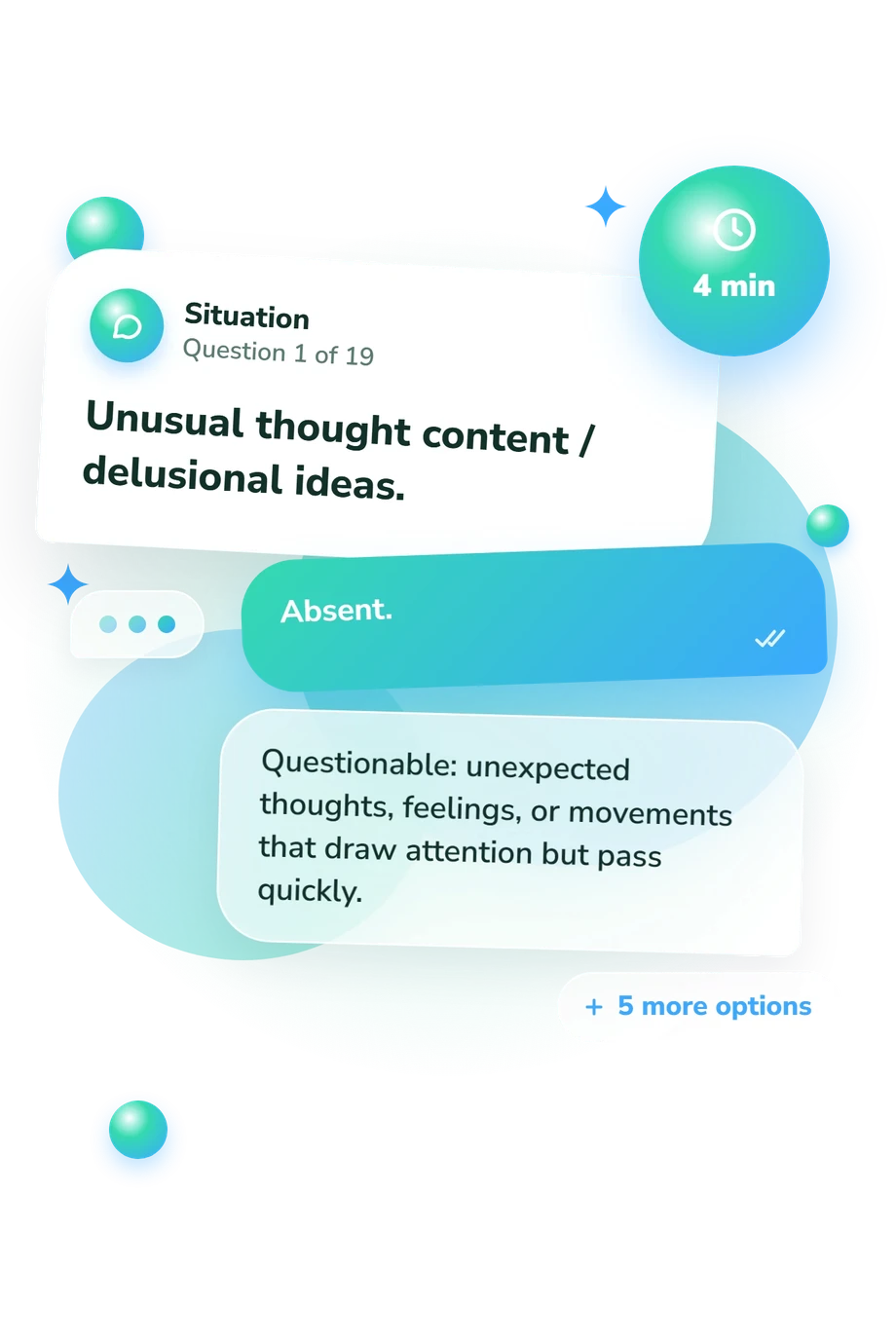
In about 4 minutes, this test clarifies early warning signs linked to schizophrenia risk across thoughts, mood, motivation, and daily functioning. Take this Schizophrenia Test — a validated 19-item SOPS scale — to get a reliable severity rating and clear guidance on next steps.
Start Online Test
Questions194 minutes
Hi! My name is Freudly, i am an AI therapist, I will give you an interpretation of the test after you complete it.
08:30
October 2, 2025
October 2, 2025
Material has been updated
17,436 views
1,266 completions
1,001 likes
Verified by Daniel Hall
Psychologist with 25 years of experience
Share
Scale Explorer

How the Scales are Structured

example score
22/24
General Symptoms (GS)
Assesses the severity of general, non-specific symptoms such as sleep disturbance, mood changes, anxiety, and stress-related reactions.
Low
Moderate
High
08Low916Moderate1724High
A score of 22 falls in the High range, indicating more pronounced general symptoms such as sleep or mood disturbance and stress-related complaints.
example score
11/24
Degree of Disorganization (DoD)
Measures the severity of disorganization-related difficulties in thinking, behavior, and concentration that can interfere with daily functioning.
Low
Moderate
High
07Low815Moderate1624High
A score of 11 falls in the Moderate range, indicating noticeable disorganization symptoms that may intermittently affect clarity of thought, organization, or attention.
example score
5/36
Negative Symptoms (NS)
Assesses reductions in emotional expression, social engagement, motivation, and overall activity that can impact functioning.
Minimal
Moderate
High
012Minimal1324Moderate2536High
A score of 5 falls in the Minimal range, indicating few or mild negative-symptom features at the time of assessment.
example score
17/30
Positive Symptoms (PS)
Measures the severity of attenuated positive psychotic-like experiences such as unusual thoughts, perceptual changes, and emerging suspiciousness.
Low
Moderate
High
010Low1120Moderate2130High
A score of 17 falls in the Moderate range, indicating a noticeable level of positive symptom experiences compared with lower scores.
example score
56/114
Total Score (TS)
The total score reflects the overall severity of prodromal symptoms across positive, negative, disorganization, and general domains.
Low
Moderate
High
038Low3976Moderate77114High
A total score of 56 falls in the Moderate range, indicating a mid-level overall severity of prodromal symptoms.
example score
2/4
General Symptoms (GS)
Assesses the severity of nonspecific general symptoms such as sleep disturbance, mood changes, motor issues, and reduced stress tolerance.
Low
Moderate
High
01Low23Moderate4High
A score of 2 indicates a moderate level of general symptoms with noticeable but not extreme impact.
example score
2/4
Severity of Disorganization (SoD)
Assesses the severity of disorganization symptoms affecting thinking, speech/behavior, and ability to concentrate and structure daily activities.
Low
Moderate
High
01Low23Moderate4High
A score of 2 falls in the Moderate range, suggesting noticeable but not severe difficulties with organization, attention, or coherent thinking/behavior.
example score
3/6
Negative Symptoms (NS)
Assesses reductions in motivation, social engagement, and emotional expressiveness that can reflect functional impact.
Low
Moderate
High
02Low34Moderate56High
A score of 3 falls in the Moderate range, indicating noticeable decreases in motivation and emotional or social responsiveness.
example score
1/5
Positive Symptoms (PS)
Assesses the severity of attenuated positive psychotic-like experiences such as unusual thoughts, suspiciousness, perceptual changes, and thought disturbance.
None/Minimal
Mild
Moderate–Severe
0None/Minimal12Mild35Moderate–Severe
A score of 1 falls in the Mild range, indicating subtle or infrequent positive-symptom experiences with low intensity.
Start Online Test
just completed the test
DATA-BASED USER COHORTS

Who Usually Takes This Test?

Early psychosis clinicians
41%OF USERS
Psychiatrists, psychologists, and early-intervention teams use it to quickly rate attenuated symptoms and decide on next steps or referrals.
At-risk young people
34%OF USERS
Teens and young adults with recent changes in thinking, perception, motivation, or functioning take it as part of an evaluation to clarify risk and severity.
Concerned families and caregivers
25%OF USERS
Parents or partners seek an assessment when they notice withdrawal, unusual beliefs, odd behavior, or worsening anxiety and sleep in someone close to them.
BASED ON AGGREGATED, ANONYMIZED DATA FROM TENS OF THOUSANDS OF FREUDLY USERS.
Benchmarking

See How You Compare

Once you complete the test, your results are compared with real-world data from people in your country.
Below is a preview of how scores are typically distributed across each scale.
General Symptoms (GS)
Average
7.5
Normal range
4.610.4
min.
0
max.
24
Majority
This curve shows how scores are typically distributed.
Once you complete the test, your result will appear on the scale so you can see how you compare.
Degree of disorganization (Dod)
Average
17.8
Normal range
13.622
min.
0
max.
24
Majority
This curve shows how scores are typically distributed.
Once you complete the test, your result will appear on the scale so you can see how you compare.
Negative Symptoms (NS)
Average
11.5
Normal range
6.816.2
min.
0
max.
36
Majority
This curve shows how scores are typically distributed.
Once you complete the test, your result will appear on the scale so you can see how you compare.
Positive symptoms (Ps)
Average
18.7
Normal range
14.123.2
min.
0
max.
30
Majority
This curve shows how scores are typically distributed.
Once you complete the test, your result will appear on the scale so you can see how you compare.
Total score (Ts)
Average
85
Normal range
66.2103.9
min.
0
max.
114
Majority
This curve shows how scores are typically distributed.
Once you complete the test, your result will appear on the scale so you can see how you compare.
General Symptoms (GS)
Average
2.8
Normal range
2.33.3
min.
0
max.
4
Majority
This curve shows how scores are typically distributed.
Once you complete the test, your result will appear on the scale so you can see how you compare.
Degree of disorganization (Dod)
Average
2.6
Normal range
2.13.1
min.
0
max.
4
Majority
This curve shows how scores are typically distributed.
Once you complete the test, your result will appear on the scale so you can see how you compare.
Negative symptoms (Ns)
Average
1.9
Normal range
0.92.9
min.
0
max.
6
Majority
This curve shows how scores are typically distributed.
Once you complete the test, your result will appear on the scale so you can see how you compare.
Positive symptoms (Ps)
Average
3.2
Normal range
2.53.8
min.
0
max.
5
Majority
This curve shows how scores are typically distributed.
Once you complete the test, your result will appear on the scale so you can see how you compare.
Featured On
CLEAR ANSWERS TO COMMON QUESTIONS

Frequently Asked Questions

What does this Schizophrenia Test measure?
It screens for early, subthreshold psychotic-like symptoms across four domains: positive symptoms (unusual thoughts, paranoid ideation, perceptual changes), negative symptoms (reduced motivation and social withdrawal), disorganization (unclear thinking and poor concentration), and general symptoms (sleep disturbance, mood changes, anxiety). Results describe current symptom severity and support clinical risk assessment for schizophrenia spectrum conditions.
Who should take this assessment?
It is appropriate for adolescents and adults who have noticed recent, unexplained changes in thinking, perception, motivation, or social functioning. It is also used by families concerned about a young person showing unusual beliefs, withdrawal, or deteriorating performance. Early psychosis clinicians use it as a standard intake and monitoring measure in clinical high-risk programs.
How long does it take and how many items are included?
Estimated completion time is about 4 minutes. The scale includes 19 items across four symptom domains. The SOPS is typically administered by a trained clinician using a structured interview format, with severity ratings based on reported experiences and observed behavior during the past month.
Is this the same as an 'am I schizophrenic' quiz?
This is a clinically validated schizophrenic quiz — not a casual online quiz. The SOPS was developed specifically to identify and rate prodromal symptoms that precede schizophrenia and related psychotic disorders. It does not ask whether you are schizophrenic; it rates whether early warning signs linked to psychosis risk are currently present and how severe they are. This makes it significantly more precise and clinically meaningful than a general schizophrenia quiz.
Is this Schizophrenia Test a diagnostic tool?
No. The SOPS is a symptom severity and risk screening measure — it does not diagnose schizophrenia, schizoaffective disorder, or any psychotic condition. Elevated scores indicate that prodromal symptoms are present at a clinically significant level and that further evaluation is warranted. Formal diagnosis requires a comprehensive psychiatric assessment by a qualified clinician.
How are results interpreted?
Scores across each domain reflect the current severity of prodromal symptoms. Higher scores in the positive symptoms domain — unusual thoughts, emerging paranoid ideation, or perceptual changes — are particularly associated with elevated risk for psychosis. Results should always be interpreted by a trained clinician alongside full clinical history, functional assessment, and relevant collateral information.
What should I do if my Schizophrenia Test score is elevated?
We strongly recommend discussing your results with a psychiatrist or psychologist experienced in early psychosis and clinical high-risk assessment. A test for schizophrenia risk like the SOPS is a structured starting point — not a verdict. Early intervention in prodromal states is associated with significantly better long-term outcomes, so acting on elevated scores promptly is important.
WHAT THE TEST MEASURES
About This Assessment
Scale for the Assessment of Prodromal Symptoms, SOPS Test

This measure is used to assess early, subthreshold psychotic-like experiences and related symptoms that may indicate risk for developing a schizophrenia spectrum disorder. Developed by Scott W. Woods and Thomas H. McGlashan, the Schizophrenia Test uses the Scale of Prodromal Symptoms (SOPS) to provide a standardized rating of symptom presence and severity in individuals for whom an attenuated psychosis-risk presentation is being considered. It consists of 19 items across four symptom domains and typically takes about 4 minutes to administer.

Why Take a Schizophrenia Test

Schizophrenia and related psychotic disorders rarely appear without warning. In most cases, a prodromal phase precedes the first psychotic episode by months or even years — a period during which subthreshold symptoms such as unusual perceptual experiences, paranoid thoughts, social withdrawal, reduced motivation, and disorganized thinking begin to emerge at low intensity. Early identification of this prodromal phase is clinically critical: the earlier the intervention, the better the long-term outcome.

Most people searching for a schizophrenia quiz or wondering "am I schizophrenic?" are experiencing exactly these kinds of early, difficult-to-name changes — in how they think, what they perceive, how they feel around others, or how well they function day-to-day. A structured test for schizophrenia risk like the SOPS provides a validated, symptom-specific framework for quantifying these experiences rather than relying on vague self-impressions. It translates subjective distress into a clinical profile that can inform timely referral and monitoring.

For families and caregivers who have noticed concerning changes in a young person — unusual beliefs, increasing withdrawal, deteriorating school or work performance — this assessment provides a structured starting point for a clinical conversation rather than prolonged uncertainty.

What the Assessment Measures

The SOPS rates symptom severity across four domains, each covering experiences associated with early psychosis risk:

  • Positive symptoms — attenuated positive psychotic-like experiences such as unusual or magical thinking, emerging paranoid ideation, perceptual disturbances, and thought disturbance; these are subthreshold versions of the hallmark symptoms of schizophrenia
  • Negative symptoms — reductions in emotional expression, social engagement, motivation, and goal-directed activity that can reflect early functional decline associated with schizophrenia spectrum conditions
  • Disorganization symptoms — difficulties in thinking clearly, maintaining coherent speech or behavior, and concentrating on tasks; impaired organization that interferes with daily functioning
  • General symptoms — non-specific indicators including sleep disturbance, mood changes, anxiety, and reduced stress tolerance that frequently accompany early psychosis risk states

Each item is rated on a severity scale, yielding subscale scores and a total score. Higher scores across positive and disorganization domains are particularly associated with elevated clinical high-risk status for psychosis.

Who This Assessment Is For

This Schizophrenia Test is appropriate for adolescents and adults who have noticed recent changes in thinking, perception, motivation, or social functioning and want to understand whether these changes may reflect early psychosis risk. It is also relevant for families and caregivers concerned about a young person showing signs of withdrawal, unusual beliefs, or functional decline. Early psychosis clinicians, psychiatrists, and clinical high-risk teams use the SOPS as a standard intake and monitoring measure in first-episode and prodromal psychosis programs.

Clinical Validity and Use in Practice

The SOPS has been validated in multiple peer-reviewed studies and is widely used in clinical high-risk research and early intervention programs internationally. Results from this schizophrenia screening tool should be interpreted in the context of a full clinical evaluation — they rate symptom severity and support risk formulation, but do not establish a diagnosis of schizophrenia or any psychotic disorder. Formal diagnosis requires a comprehensive clinical interview conducted by a qualified psychiatrist or psychologist. Where scores indicate moderate-to-high symptom severity, prompt referral to an early psychosis or clinical high-risk service is strongly recommended.

Author: Scott W. Woods, Thomas H. McGlashan
Literature: Yung, A. R., McGorry, P. D., McFarlane, C. A., Jackson, H. J., Patton, G. C., & Rakkar, A. Threshold psychosis and prodromal features: a prospective epidemiological study. Schizophrenia Bulletin. 1996.; Miller, T. J., McGlashan, T. H., Woods, S. W., Stein, K., Driesen, N., Corcoran, C. M., Hoffman, R., & Davidson, L. Symptom assessment in schizophrenic prodromal states. Psychiatric Quarterly. 1999.
Test Question Form
You Might Also Like
Prodromal Questionnaire–Brief Version (PQ-B)
This brief self-report screener is used to identify possible early signs as…
Start Test
Scale for the Assessment of Negative Symptoms (SANS)
In clinical evaluation of psychotic-spectrum conditions, negative symptoms…
Start Test
Scale for the Assessment of Positive Symptoms (SAPS)
This clinician-rated instrument is used to quantify the severity of positiv…
Start Test
Popular tests
Narcissistic Personality Inventory (NPI)
This self-report measure is used to assess narcissism as a personality trai…
Start Test
Yale-Brown Obsessive Compulsive Scale (Y-BOCS)
This measure is used to rapidly quantify the current severity of obsessive…
Start Test
CRAFFT Screening Test (CRAFFT 2.1)
This brief screening measure is designed to identify potential alcohol and…
Start Test
Patient Health Questionnaire-9 (PHQ-9)
This measure is commonly used to quickly screen for the presence and severi…
Start Test
Maslach Burnout Inventory (MBI)
This self-report measure is used to assess occupational burnout symptoms in…
Start Test
Adolescent Anxiety Questionnaire
This measure is designed to support a brief appraisal of anxiety symptoms a…
Start Test
Emotional Creativity Inventory (ECI)
This self-report measure assesses individual differences in the originality…
Start Test
Horne–Ostberg Morningness–Eveningness Questionnaire (MEQ)
Circadian preferences influence typical patterns of alertness and sleep tim…
Start Test
Ambivalent Sexism Inventory (ASI)
This measure is designed to assess attitudes toward women, including both o…
Start Test
Internalized Misogyny Scale (IMS)
This measure is designed to assess internalized negative beliefs and stereo…
Start Test
Perceived Stress Scale (PSS-10)
This self-report measure assesses the degree to which individuals appraise…
Start Test
Impulsive Behavior Scale (SUPPS-P)
Impulsivity is a multidimensional construct that is often assessed with bri…
Start Test
Clinical Institute Withdrawal Assessment for Alcohol, Revised (CIWA-Ar)
This rating scale is used to rapidly assess the severity of alcohol withdra…
Start Test
Positive and Negative Affect Schedule (PANAS)
This measure provides a brief self-report assessment of current or typical…
Start Test
Light Triad Scale (LTS)
This self-report measure assesses prosocial personality tendencies and orie…
Start Test
Suicidal Ideation Scale
In clinical settings, the Suicidal Ideation Scale is used to structure an i…
Start Test
Body Dysmorphic Disorder Scale (BDD-D)
This brief self-report measure is designed to screen for and quantify distr…
Start Test
Beck Anxiety Inventory (BAI)
This measure is a brief self-report inventory used to screen for anxiety sy…
Start Test
Differential Test of Perfectionism
This instrument is used to screen for perfectionism-related attitudes and t…
Start Test
Locus of Control Scale
This measure assesses generalized expectancies regarding the degree to whic…
Start Test
New Apathy Scale
This brief self-report measure is used to screen for apathy-related symptom…
Start Test
Perth Alexithymia Questionnaire (PAQ)
This measure assesses individual differences in alexithymia, including diff…
Start Test
Social Intelligence Scale
This brief self-report measure is designed to support rapid screening of in…
Start Test
Fear Test
This measure is designed to evaluate individual differences in fear-related…
Start Test
Neuroticism Level Scale
The measure is intended for brief screening of an individual’s propensity t…
Start Test
Aggressiveness Indicators Screening Questionnaire
This screening tool is designed to quickly identify behavioral indicators a…
Start Test
Comments
Leave a Comment