
Physical Appearance Comparison Scale-Revised (PACS-R) Test
How the Scales are Structured
Who Usually Takes This Test?
See How You Compare
Below is a preview of how scores are typically distributed across each scale.
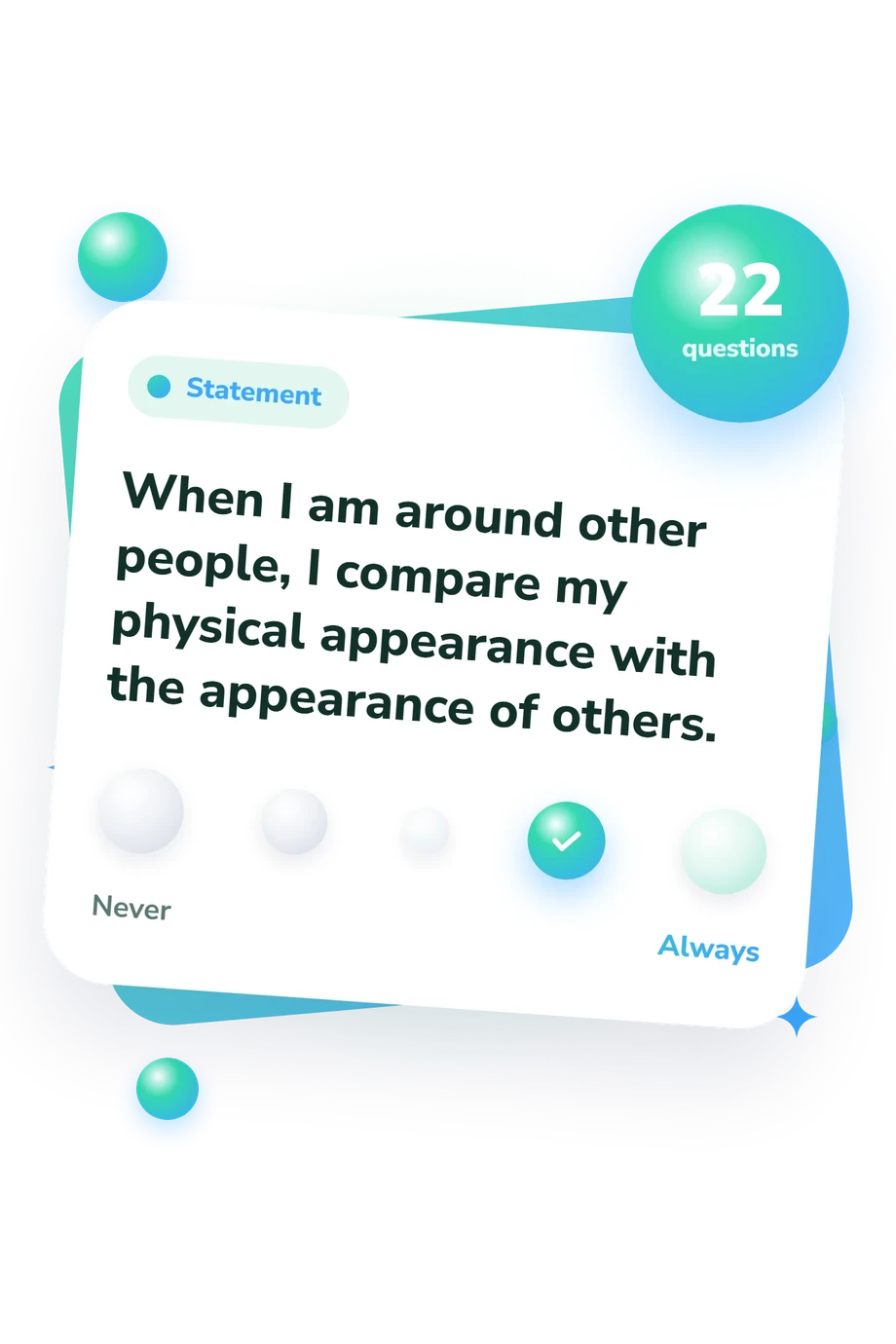
Example Questions From the Test
- Never
- Rarely
- Sometimes
- Often
- Always
- Never
- Rarely
- Sometimes
- Often
- Always
- Never
- Rarely
- Sometimes
- Often
- Always
Physical Appearance Comparison Scale-Revised (PACS-R) Test - Description and methodology of the test
People who notice themselves evaluating their body against others may use the Physical Appearance Comparison Scale-Revised (PACS-R) Test to examine that pattern more deliberately. It is intended for self-reflection about appearance-related attention in ordinary social settings, including interactions with friends, work or school, shopping, eating out, parties, and exercise. As a body image comparison test, it describes a recurring tendency rather than judging attractiveness or appearance itself.
What This Assessment Explores
Across its situations, the physical appearance comparison questionnaire asks about comparing body size, shape, fat, weight, or overall appearance with other people. The settings include meeting someone new, being with friends, work or school, shopping for clothes, eating out, parties, and exercise. This helps a respondent notice where comparison enters everyday attention.
The assessment reports one dimension, Physical Appearance Comparison, on a 0-44 range. The result bands are:
- Low comparison (0-14) indicates relatively infrequent appearance comparison.
- Moderate comparison (15-29) indicates an intermediate comparison tendency.
- High comparison (30-44) indicates more frequent comparison. Higher comparison is associated with greater eating disturbance, stronger internalization of appearance ideals, and greater peer or media influence; lower comparison is typically associated with greater body satisfaction and higher self-esteem.
The score describes the strength of comparison, not attractiveness or conformity to an ideal.
Methodology and Scientific Basis
The method follows the construct measured by the Physical Appearance Comparison Scale-Revised (PACS-R), a published self-report measure described by Schaefer and Thompson (2014). As a body image assessment, it presents 11 statements about recognizable comparison situations, with responses running from Never through Always. The questionnaire presents one displayed score across the response range, while its item-level weighting is not specified for this format.
Its evidence base also connects with the earlier Physical Appearance Comparison Scale described by Thompson, Heinberg, and Tantleff-Dunn (1991), and with the body-image framework developed by Thompson, Heinberg, Altabe, and Tantleff-Dunn (1999). The online questionnaire is conceptually consistent with this work, but separate norms or a new validation study for this version are not established, so its result has no norm-based reference.
Interpretation is strongest when the result is considered with the respondent's current mood, social environment, and reasons for comparing. Self-report depends on memory, honesty, and self-awareness, so a score can shift across contexts. It may signal a pattern for reflection, but it cannot by itself identify the cause, severity, or clinical meaning of body-image concerns.
- Schaefer, Lauren M., and J. Kevin Thompson. "The development and validation of the Physical Appearance Comparison Scale-Revised (PACS-R)." Eating Behaviors 15, no. 2 (2014): 209-217. 10.1016/j.eatbeh.2014.01.001
- Thompson, Joel Kevin, L. Heinberg, and S. Tantleff-Dunn. "The Physical Appearance Comparison Scale." The Behavior Therapist 14 (1991): 174.
- Thompson, J. Kevin, Leslie J. Heinberg, Madeline Altabe, and Stacey Tantleff-Dunn. Exacting Beauty: Theory, Assessment, and Treatment of Body Image Disturbance. Washington, DC: American Psychological Association, 1999. 10.1037/10312-000
Updated: