
Feminism Test

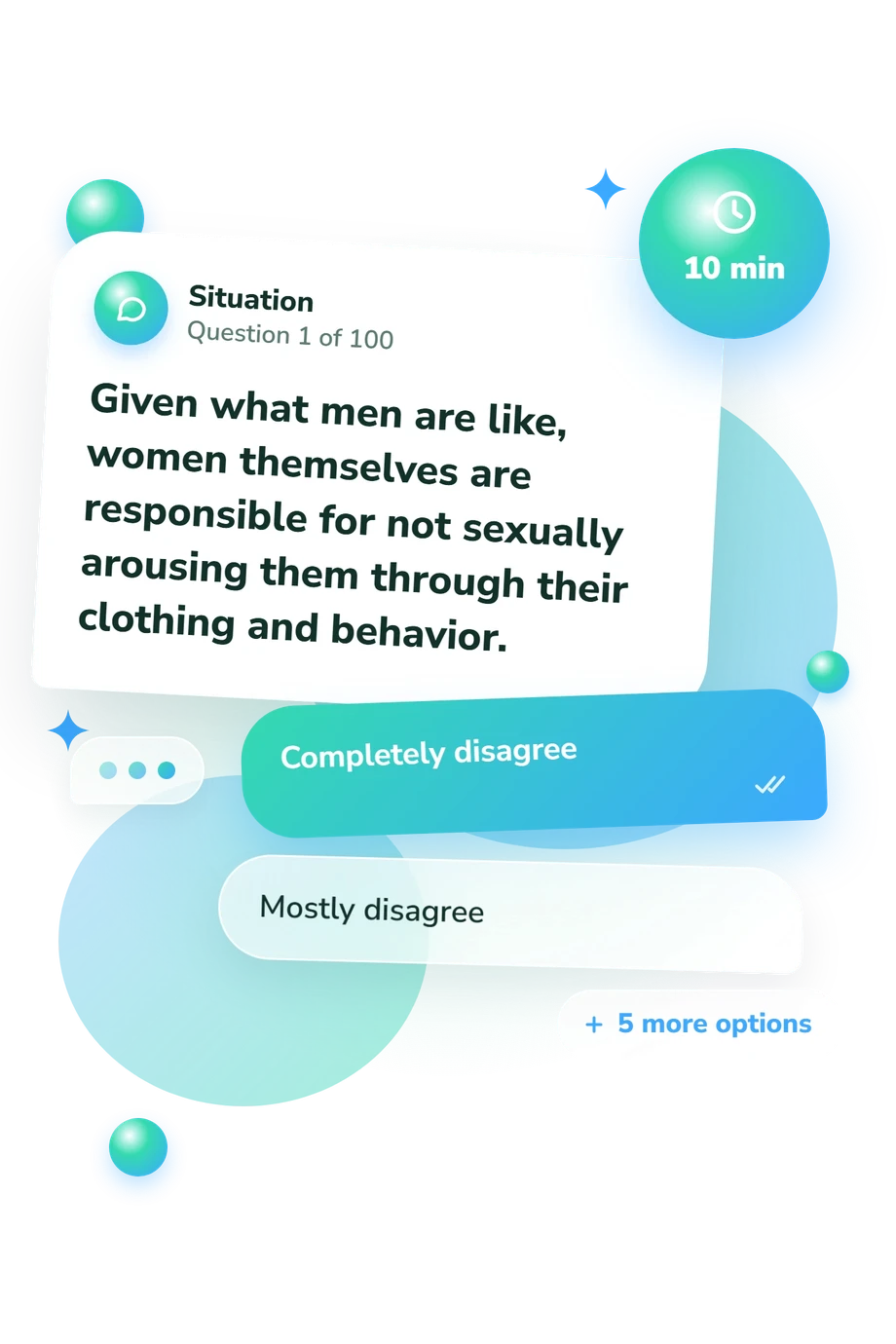
This 50-item questionnaire maps your beliefs about gender equality and women's rights across six scored dimensions — from liberal and cultural to radical and socialist feminist perspectives — and takes about 10 minutes. Take this feminism test to get a research-based profile of where your views fall along the full spectrum of feminist ideology.
Start Online Test
Questions5010 minutes
Hi! My name is Freudly, i am an AI therapist, I will give you an interpretation of the test after you complete it.
08:30
October 2, 2025
October 2, 2025
Material has been updated
28,027 views
1,707 completions
1,355 likes
Verified by Daniel Hall
Psychologist with 25 years of experience
Share
Scale Explorer

How the Scales are Structured

example score
46/70
Cultural Feminism (CF)
Measures the extent to which a person supports cultural feminist ideas that emphasize distinct women’s values, experiences, and the development of women’s culture.
Low endorsement
Moderate endorsement
High endorsement
1029Low endorsement3050Moderate endorsement5170High endorsement
A score of 46 indicates a moderate endorsement of cultural feminism, suggesting you generally value women’s distinct experiences and cultural contributions while not strongly aligning with all related positions.
example score
63/100
Socialist Feminism (SF)
Measures agreement with socialist feminist views that link gender inequality to broader social and economic structures and support systemic societal change.
Low alignment
Moderate alignment
High alignment
033Low alignment3466Moderate alignment67100High alignment
A score of 63 indicates moderate alignment, suggesting you often connect gender inequality with wider social and economic inequality while expressing some reservations about the scope or means of societal change.
example score
53/100
Radical Feminism (RF)
Measures the degree of support for feminist views that call for fundamental cultural and structural change to dismantle patriarchal systems.
Low endorsement
Moderate endorsement
High endorsement
033Low endorsement3466Moderate endorsement67100High endorsement
A score of 53 indicates moderate endorsement of radical feminist ideas, suggesting general support for systemic change while not fully aligning with the most far-reaching positions.
example score
28/100
Liberal Feminism (LF)
This scale measures agreement with liberal feminist views that emphasize equal rights and opportunities through reform within existing institutions.
Low endorsement
Moderate endorsement
High endorsement
033Low endorsement3466Moderate endorsement67100High endorsement
A score of 28 indicates low endorsement of liberal feminist ideas, suggesting limited agreement with equality-focused reforms within current social and legal systems.
example score
215/280
Feminist Orientation (FO)
Measures how strongly a person endorses feminist viewpoints, including support for gender equality and societal change to achieve it.
Low endorsement
Moderate endorsement
High endorsement
40119Low endorsement120199Moderate endorsement200280High endorsement
A score of 215 falls in the High endorsement range, suggesting strong support for feminist perspectives and the need for societal changes to advance gender equality.
example score
43/70
Conservative Position (CP)
Measures the degree to which a person endorses traditional gender roles and is skeptical of feminist ideas.
Low conservative stance
Moderate conservative stance
High conservative stance
1029Low conservative stance3049Moderate conservative stance5070High conservative stance
A score of 43 falls in the Moderate conservative stance range, suggesting a mixed or situational preference for traditional gender-role views with some openness to feminist positions.
Start Online Test
just completed the test
DATA-BASED USER COHORTS

Who Usually Takes This Test?

Curious self-explorers
41%OF USERS
People who want a clear snapshot of where their beliefs about gender equality fall on a traditional-to-modern feminism spectrum.
Students and educators
34%OF USERS
Learners and teachers in psychology, sociology, or gender studies using the questionnaire to support discussion, reflection, or coursework.
Counseling and workshop participants
25%OF USERS
People in coaching, counseling, or diversity training who want a structured way to surface assumptions and talk about gender roles and fairness.
BASED ON AGGREGATED, ANONYMIZED DATA FROM TENS OF THOUSANDS OF FREUDLY USERS.
Benchmarking

See How You Compare

Once you complete the test, your results are compared with real-world data from people in your country.
Below is a preview of how scores are typically distributed across each scale.
Cultural Feminism (CF)
Average
50.9
Normal range
40.461.4
min.
10
max.
70
Majority
This curve shows how scores are typically distributed.
Once you complete the test, your result will appear on the scale so you can see how you compare.
Socialist Feminism (SF)
Average
47.2
Normal range
32.861.7
min.
0
max.
100
Majority
This curve shows how scores are typically distributed.
Once you complete the test, your result will appear on the scale so you can see how you compare.
Radical Feminism (RF)
Average
58.6
Normal range
40.676.5
min.
0
max.
100
Majority
This curve shows how scores are typically distributed.
Once you complete the test, your result will appear on the scale so you can see how you compare.
Liberal Feminism (LF)
Average
56.3
Normal range
43.569
min.
0
max.
100
Majority
This curve shows how scores are typically distributed.
Once you complete the test, your result will appear on the scale so you can see how you compare.
The feminist standpoint (Tfs)
Average
105.5
Normal range
64.8146.2
min.
40
max.
280
Majority
This curve shows how scores are typically distributed.
Once you complete the test, your result will appear on the scale so you can see how you compare.
Conservative stance (Cs)
Average
38.4
Normal range
29.147.6
min.
10
max.
70
Majority
This curve shows how scores are typically distributed.
Once you complete the test, your result will appear on the scale so you can see how you compare.
Featured On
CLEAR ANSWERS TO COMMON QUESTIONS

Frequently Asked Questions

What does this feminism test measure?
This feminism test measures how closely your beliefs align with four feminist traditions — liberal, cultural, radical, and socialist feminism — plus an overall feminist orientation score and a separate conservative position subscale. Each dimension is scored independently, giving a multidimensional profile of your gender attitudes.
How long does it take and how many items are included?
The questionnaire includes 50 items and typically takes about 10 minutes to complete. Rate each statement based on your genuine level of agreement rather than what seems socially desirable.
Who should take a feminism test?
Anyone curious about their own gender attitudes can take it — no prior knowledge of feminist theory is needed. It is also commonly used by students and educators in gender studies and psychology courses, and by counselors or facilitators who want a structured way to explore assumptions about gender equality and gender roles.
How are results of a feminism assessment interpreted?
Each subscale score indicates the strength of alignment with that particular feminist perspective. Higher scores on Liberal Feminism or Radical Feminism subscales reflect stronger endorsement of those positions; higher scores on the Conservative Position subscale reflect greater support for traditional gender roles. Results are attitudinal indicators, not a diagnosis or evaluation of character.
What is the difference between the four feminist subscales?
Liberal feminism focuses on equal rights through institutional reform. Cultural feminism emphasizes the value of women's distinct experiences. Radical feminism calls for dismantling patriarchal systems at a fundamental level. Socialist feminism links gender inequality to economic and class structures. Each tradition represents a different theory of why gender inequality exists and how it should be addressed.
Can this test be used in counseling or educational settings?
Yes. A feminism questionnaire is regularly used in diversity training, counseling intake, and gender studies courses to surface and discuss assumptions about sexism and gender roles. Results give facilitators and clients a shared, evidence-based reference point for structured conversation.
Why was a section on racial minority women removed from this version?
That section was omitted because it did not fit the cultural context in which this version is used. The remaining items cover core attitudes toward gender equality, feminist ideology, and related social issues, and have been validated across a range of Western cultural contexts.
WHAT THE TEST MEASURES
About This Assessment
Scale of Feminist Views Test

The feminism test is a 50-item self-report instrument that measures how closely a person's beliefs align with core feminist positions — including liberal, cultural, radical, and socialist feminism — as well as the degree of endorsement of traditional gender roles on a Conservative Position subscale. Each subscale produces a separate score, giving a multidimensional profile of gender attitudes rather than a single summary label.

Why Take a Feminism Test

Gender attitudes shape how people respond to workplace inequality, relationship dynamics, political issues, and social change — yet most individuals have never examined their beliefs systematically. Taking this assessment gives you a structured, research-based map of where your feminist orientation sits across multiple dimensions, making it easier to understand what you believe and why.

A feminism questionnaire like this one is regularly used in educational settings, counseling intake, and diversity training to open evidence-based conversations about gender equality and sexism. Results provide a concrete starting point for reflection rather than a value judgment.

What the Assessment Measures

  • Liberal Feminism (LF) — agreement with views that emphasize equal rights and opportunities for women through reform within existing legal and social institutions.
  • Cultural Feminism (CF) — endorsement of feminist ideas that highlight distinct women's values, experiences, and the development of women's culture as a source of social change.
  • Radical Feminism (RF) — support for fundamental restructuring of society to dismantle patriarchal systems that reproduce gender inequality at every level.
  • Socialist Feminism (SF) — alignment with views that connect gender inequality to broader economic and class structures and call for systemic social change.
  • Feminist Orientation (FO) — an overall composite score reflecting total endorsement of feminist perspectives across all subscales.
  • Conservative Position (CP) — the degree of support for traditional gender roles and skepticism toward feminist beliefs, measured as a distinct dimension rather than simply the absence of feminist views.

Who This Assessment Is For

The feminism test is appropriate for adults who want to understand their own gender attitudes more precisely, whether out of personal curiosity or as part of counseling, coaching, or academic work. Students and educators in psychology, sociology, and gender studies use it to anchor classroom discussions in self-reported data. Counselors and workshop facilitators use the feminism assessment to surface implicit assumptions about gender roles and sexism before beginning structured dialogue. No prior knowledge of feminist theory is required — items describe concrete attitudes and respondents simply rate their level of agreement.

Clinical Validity and Use in Practice

The scale was developed and validated by Henley and colleagues to capture the diversity of feminist perspectives across distinct theoretical traditions rather than treating feminist orientation as a single dimension. Each subscale has demonstrated adequate internal consistency and correlates with related measures of gender attitudes and sexism in expected directions. Results should be interpreted as indicators of attitudinal alignment, not as a diagnosis or a measure of knowledge. Because women's rights norms and cultural contexts vary, scores are most informative when discussed in relation to the specific setting — educational, clinical, or research — in which the assessment is used.

Author: psytests.org (2023)
Literature: Henley, N. M., Meng, K., O’Brien, D., McCarthy, W. J., & Sockloskie, R. J. Developing a scale to measure the diversity of feminist attitudes. Psychology of Women Quarterly. 1998.
Test Question Form
You Might Also Like
Assessment of Potentially Extremist Attitudes
This self-report measure is designed to screen for attitudinal themes that…
Start Test
Administrative Style Assessment
This brief measure is designed to characterize an individual’s predominant…
Start Test
Constructivist Epistemological Beliefs Scale (CEAS)
This self-report measure is designed to assess individual differences in be…
Start Test
Popular tests
Narcissistic Personality Inventory (NPI)
This self-report measure is used to assess narcissism as a personality trai…
Start Test
Yale-Brown Obsessive Compulsive Scale (Y-BOCS)
This measure is used to rapidly quantify the current severity of obsessive…
Start Test
CRAFFT Screening Test (CRAFFT 2.1)
This brief screening measure is designed to identify potential alcohol and…
Start Test
Patient Health Questionnaire-9 (PHQ-9)
This measure is commonly used to quickly screen for the presence and severi…
Start Test
Maslach Burnout Inventory (MBI)
This self-report measure is used to assess occupational burnout symptoms in…
Start Test
Adolescent Anxiety Questionnaire
This measure is designed to support a brief appraisal of anxiety symptoms a…
Start Test
Emotional Creativity Inventory (ECI)
This self-report measure assesses individual differences in the originality…
Start Test
Horne–Ostberg Morningness–Eveningness Questionnaire (MEQ)
Circadian preferences influence typical patterns of alertness and sleep tim…
Start Test
Ambivalent Sexism Inventory (ASI)
This measure is designed to assess attitudes toward women, including both o…
Start Test
Internalized Misogyny Scale (IMS)
This measure is designed to assess internalized negative beliefs and stereo…
Start Test
Perceived Stress Scale (PSS-10)
This self-report measure assesses the degree to which individuals appraise…
Start Test
Impulsive Behavior Scale (SUPPS-P)
Impulsivity is a multidimensional construct that is often assessed with bri…
Start Test
Clinical Institute Withdrawal Assessment for Alcohol, Revised (CIWA-Ar)
This rating scale is used to rapidly assess the severity of alcohol withdra…
Start Test
Positive and Negative Affect Schedule (PANAS)
This measure provides a brief self-report assessment of current or typical…
Start Test
Light Triad Scale (LTS)
This self-report measure assesses prosocial personality tendencies and orie…
Start Test
Suicidal Ideation Scale
In clinical settings, the Suicidal Ideation Scale is used to structure an i…
Start Test
Body Dysmorphic Disorder Scale (BDD-D)
This brief self-report measure is designed to screen for and quantify distr…
Start Test
Beck Anxiety Inventory (BAI)
This measure is a brief self-report inventory used to screen for anxiety sy…
Start Test
Differential Test of Perfectionism
This instrument is used to screen for perfectionism-related attitudes and t…
Start Test
Locus of Control Scale
This measure assesses generalized expectancies regarding the degree to whic…
Start Test
New Apathy Scale
This brief self-report measure is used to screen for apathy-related symptom…
Start Test
Perth Alexithymia Questionnaire (PAQ)
This measure assesses individual differences in alexithymia, including diff…
Start Test
Social Intelligence Scale
This brief self-report measure is designed to support rapid screening of in…
Start Test
Fear Test
This measure is designed to evaluate individual differences in fear-related…
Start Test
Neuroticism Level Scale
The measure is intended for brief screening of an individual’s propensity t…
Start Test
Aggressiveness Indicators Screening Questionnaire
This screening tool is designed to quickly identify behavioral indicators a…
Start Test
Comments
Leave a Comment