
Extra-Role Work Behavior Scale Test
How the Scales are Structured
Who Usually Takes This Test?
See How You Compare
Below is a preview of how scores are typically distributed across each scale.
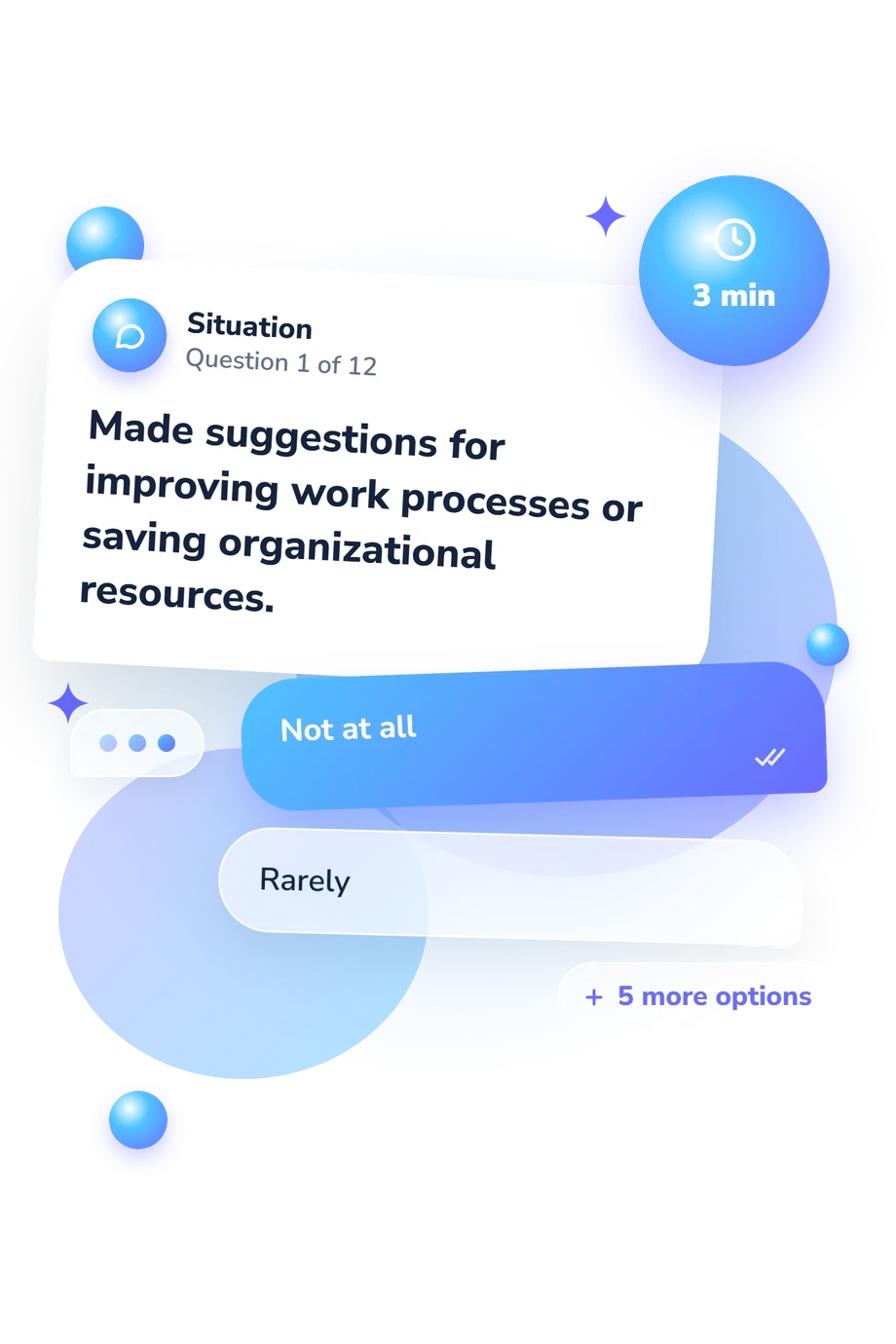
Example Questions From the Test
- Not at all
- Rarely
- Quite rarely
- Sometimes
- Quite often
- Often
- Consistently
- Not at all
- Rarely
- Quite rarely
- Sometimes
- Quite often
- Often
- Constantly
- Not at all
- Rarely
- Quite rarely
- Sometimes
- Quite often
- Often
- Constantly
Extra-Role Work Behavior Scale Test - Description and methodology of the test
Employees who want to understand their discretionary contribution at work can use the Extra-Role Work Behavior Scale Test to reflect on how their work habits affect a team. An extra-role work behavior profile can support personal reflection, career conversations, or decisions about future work habits. The result describes a pattern of voluntary contribution rather than judging overall job performance.
What This Assessment Explores
Workplace contributions may involve improving procedures, covering for colleagues, sharing expertise, or extending effort. The assessment suits employees reflecting on conduct across roles; scores describe reported patterns, not an ideal worker. The result offers an employee extra-role behavior profile.
Four dimensions make up the profile:
- Performance Improvement (1-7) measures process, condition, unit, and organizational improvement: Low 1-1.9, Moderate 2-4.9, High 5-7.
- Helping Coworkers (1-7) measures involvement in solving colleagues’ problems: Low helping 1-3.5, Moderate helping 3.6-5.7, High helping 5.8-7.
- Overtime Work (1-7) measures duties beyond scheduled hours and added initiative: Low overtime 1-2.4, Moderate overtime 2.5-4.9, High overtime 5-7.
- Extra-Role Work Behavior (1-7) measures voluntary initiative beyond formal duties: Low extra-role 1-2.9, Moderate extra-role 3-4.9, High extra-role 5-7.
Methodology and Evidence Base
Each item presents a workplace action and asks how often it occurs on seven ordered choices, ranging from absence or rarity to frequent or constant behavior. The examples cover process suggestions, assistance, covering workloads, work outside scheduled hours, and initiative under pressure.
Results appear for each of the four scales, with the corresponding ranges and level bands shown on screen. The displayed results describe a workplace behavior profile; interpretation should consider the respondent’s role, workload, and opportunities to act.
The methodology is conceptually consistent with the Extra-Role Work Behavior Scale (Rebzuev, 2009), which defines this conduct as voluntary behavior beyond formal requirements. Klimov (2014) applies a related perspective to teachers, and Podsakoff, MacKenzie, Paine, and Bachrach (2000) connect voluntary assistance and initiative with organizational citizenship behavior. These sources support the construct, but do not establish that this online questionnaire is a standardized reproduction of a published instrument or that its displayed scoring has population norms.
Self-report also makes results sensitive to current circumstances, memory, self-awareness, and response style. They can support reflection and discussion, but do not establish a diagnosis or a definitive judgment of job performance.
- Rebzuev, Boris G. (2009). Elaboration of the Construct of Work Behavior and Development of Extra-Role Work Behavior Scale. The Psychology. Journal of Higher School of Economics, 6(1), 3-57.
- Klimov, Alexey Aleksandrovich. (2014). Extra-Role Performance Behavior of Teachers: The Role of Identification with the Team, of Experience and of the School as an Educational Organization. Economic and Social Changes: Facts, Trends, Forecast, 6(36), 253-269. 10.15838/esc/2014.6.36.19
- Podsakoff, Philip M., MacKenzie, Scott B., Paine, Julie Beth, and Bachrach, Daniel G. (2000). Organizational Citizenship Behaviors: A Critical Review of the Theoretical and Empirical Literature and Suggestions for Future Research. Journal of Management, 26(3), 513-563. 10.1177/014920630002600307
Updated: