
Body Appreciation Scale (BAS) Test
How the Scales are Structured
Who Usually Takes This Test?
See How You Compare
Below is a preview of how scores are typically distributed across each scale.
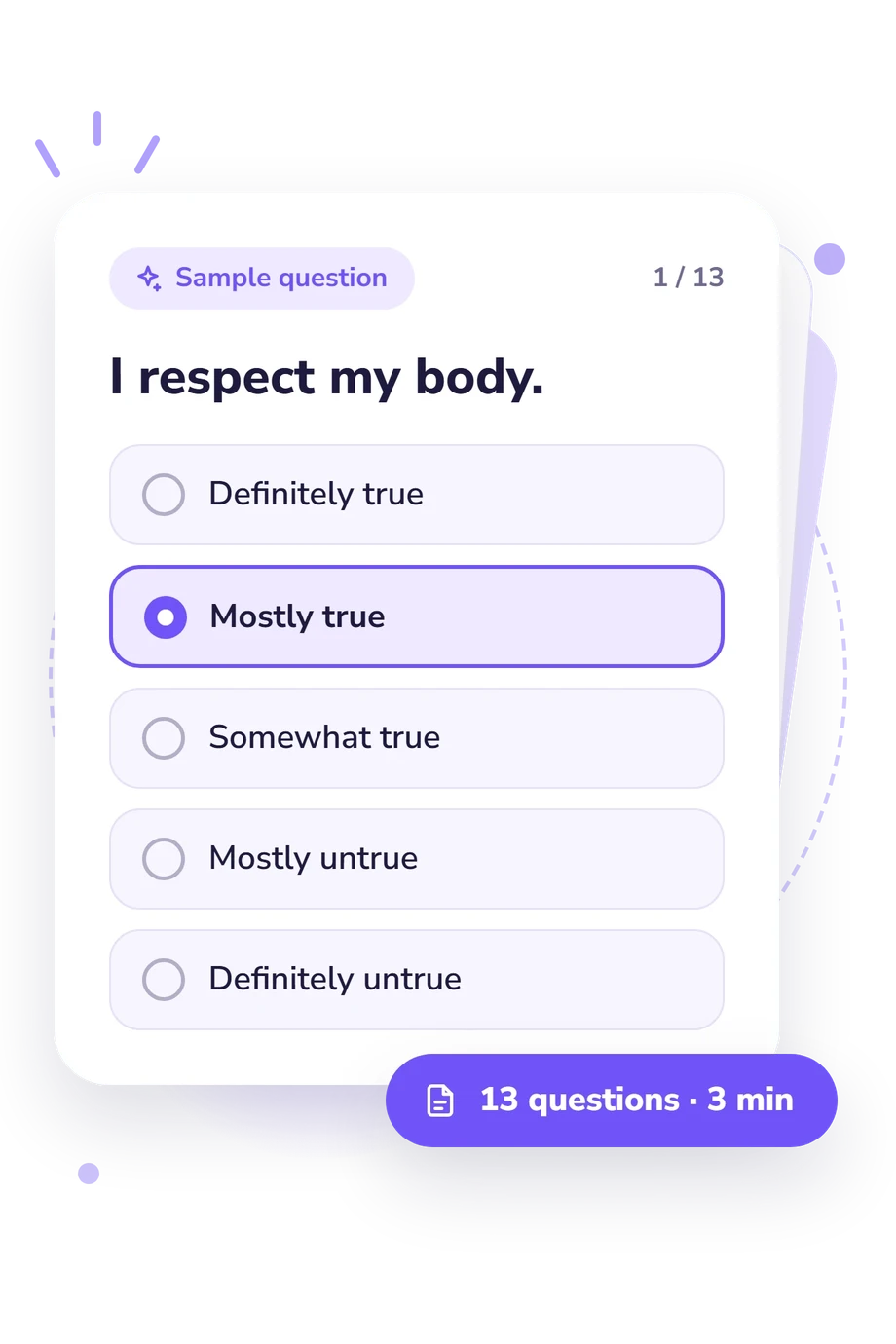
Example Questions From the Test
- Definitely true
- Mostly true
- Somewhat true
- Mostly untrue
- Definitely untrue
- Absolutely true
- Mostly true
- Partly true
- Mostly untrue
- Absolutely untrue
- Definitely true
- Mostly true
- Somewhat true
- Mostly untrue
- Definitely untrue
Body Appreciation Scale (BAS) Test - Description and methodology of the test
People who want a clearer picture of their relationship with appearance can use the Body Appreciation Scale (BAS) Test to examine acceptance, respect, and care for the body. As a body appreciation questionnaire, it helps a respondent consider whether self-respect remains separate from shape, weight, and media ideals. The result offers a focused profile of current body-related attitudes rather than a judgment of worth.
What This Assessment Explores
The items examine how someone relates to the body as it is, covering acceptance of imperfections, positive feelings, physical needs, self-respect independent of shape or weight, and resistance to unrealistic media ideals. This wording suits anyone using a positive body image assessment for self-reflection.
These themes contribute to one overall result:
- Acceptance and respect show how someone values the body while acknowledging imperfections.
- Positive feelings describe comfort, approval, or satisfaction toward the body.
- Care and media responses show attention to bodily needs and resistance to unrealistic appearance pressure.
Results are reported on the Body Satisfaction scale (13-65), measuring positive attitude toward the body, acceptance of its individual features, and satisfaction with one’s own body. Bands are Low satisfaction (13-30), Moderate satisfaction (31-47), and High satisfaction (48-65); higher scores indicate greater satisfaction, while lower scores reflect dissatisfaction or critical attitudes.
Methodology and Scientific Basis
The published Body Appreciation Scale provides the closest reference for this construct. This body image self-assessment is conceptually consistent with that instrument, but it should not be treated as the published instrument or as independently validated by studies of that instrument. It uses 13 statements with five response options moving from true to untrue; each asks the respondent to judge an attitude or behavior.
Research on the published instrument found similar results across college women and men, but that finding does not standardize online presentations or populations. The displayed interpretation reports higher scores as greater satisfaction with one’s own body and lower scores as dissatisfaction or critical attitudes toward appearance. Published evidence supports the source instrument, not independent norms or validation for this online version.
Answers can shift with mood, recent comments, health changes, appearance pressure, and willingness to answer candidly. A single self-report score captures the questionnaire’s body-attitude construct but not every aspect of body image or wellbeing, so it is most useful as a starting point for noticing patterns and deciding what aspects of body-related wellbeing deserve further reflection.
- Avalos, L., Tylka, T. L., & Wood-Barcalow, N. L. (2005). The Body Appreciation Scale: Development and psychometric evaluation. Body Image, 2(3), 285-297. 10.1016/j.bodyim.2005.06.002
- Tylka, T. L. (2013). Evidence for the Body Appreciation Scale’s measurement equivalence/invariance between U.S. college women and men. Body Image, 10(3), 415-418. 10.1016/j.bodyim.2013.02.006
- Smolak, L., & Cash, T. F. (2011). Future challenges for body image science, practice, and prevention. In T. F. Cash & L. Smolak (Eds.), Body image: A handbook of science, practice, and prevention (2nd ed., pp. 471-478). Guilford Press.
Updated: