
Innovative Personality Traits Self-Assessment Scale Test
How the Scales are Structured
Who Usually Takes This Test?
See How You Compare
Below is a preview of how scores are typically distributed across each scale.
Example Questions From the Test
- Not at all like me
- A little like me
- Somewhat like me
- Like me
- Very much like me
- Not at all like me
- Not much like me
- A little like me
- Like me
- Very much like me
- Not at all like me
- Not much like me
- Somewhat like me
- Like me
- Very much like me
Innovative Personality Traits Self-Assessment Scale Test - Description and methodology of the test
People who want to understand how they approach novelty, uncertainty, and opportunity can use the Innovative Personality Traits Self-Assessment Scale Test to examine innovation-related tendencies. The questionnaire is intended for anyone seeking a personality innovativeness assessment and a clearer view of how they respond to new possibilities. Its profile can help readers notice patterns in initiative and adaptation without treating any one score as a fixed ability.
What This Assessment Explores
The questionnaire looks at how someone creates, pursues, and implements new possibilities. Items cover originality, curiosity, variety, mistakes, opportunity-seeking, unstable conditions, and investment in innovation. This innovative personality traits assessment describes tendencies in thinking and decisions, rather than creative achievement.
The displayed dimensions are:
- Creativity (1-5) reflects idea generation, divergent thinking, and original solutions; bands: Lower creativity 1-2.4, Moderate creativity 2.5-3.6, Higher creativity 3.7-5.
- Future Orientation (1-5) reflects planning and pursuing opportunities; bands: Low future focus 1-2.4, Moderate future focus 2.5-3.6, High future focus 3.7-5.
- Risk for Success (1-5) reflects calculated risk under uncertainty; bands: Cautious 1-2.3, Balanced 2.4-3.6, Risk-inclined 3.7-5.
- Personal Innovativeness Index (1-5) reflects accepting and implementing ideas; bands: Low innovativeness 1-2.4, Moderate innovativeness 2.5-3.6, High innovativeness 3.7-5.
Methodology and Scientific Basis
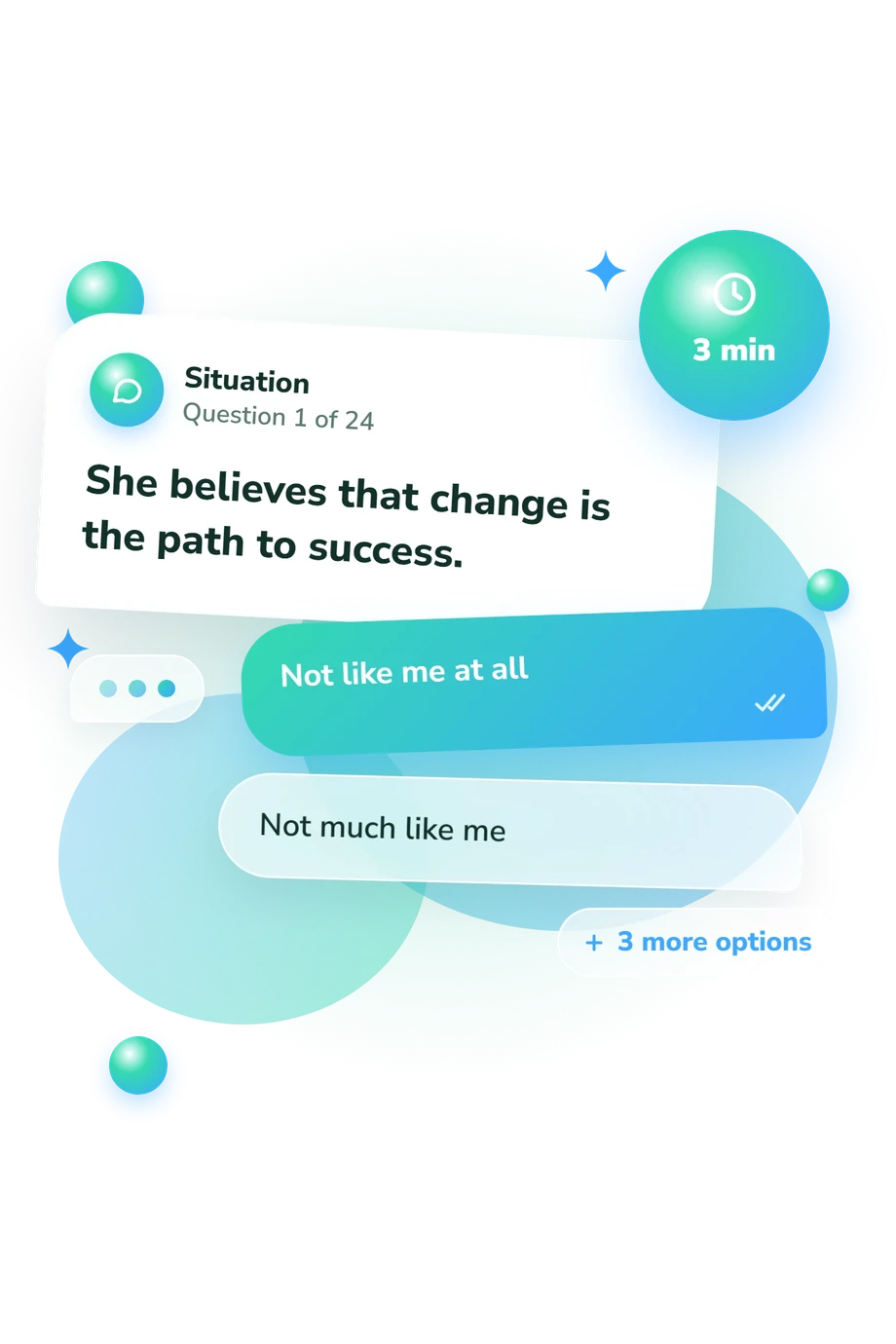
Each item uses a five-point self-rating from "not at all like me" to "very much like me." First- and third-person statements ask how closely each description fits. Items cover curiosity, responses to mistakes, unfamiliar situations, opportunity-seeking, and risk-taking. This format captures perceived tendencies.
The questionnaire is conceptually consistent with the Innovative Qualities of a Person scale (Lebedeva & Tatarko, 2009), which also uses person descriptions and five-point judgments about innovation. This online innovativeness self-assessment is a separate self-reflection format, not a documented adaptation of that instrument.
The Lebedeva-Tatarko instrument is the relevant published reference for these innovation-related dimensions; this online questionnaire has no established norms or reported validation for its version.
Higher scores indicate stronger expression of the measured tendencies, while the overall index provides a broad summary of the profile. The questionnaire does not state item weighting or reverse-scoring, so no further formula should be inferred. Self-perception, current context, and honesty can affect the profile, which is best used as a structured starting point for reflection rather than a clinical conclusion.
- Lebedeva, N. M., & Tatarko, A. N. (2009). A scale for assessment of individuals' attitudes towards innovations. Almanac of Contemporary Science and Education, 23(4), 89-96.
- Mikhailova, O. V. (2015). The value-motivational structure of the innovativeness of young students. Psychology in Russia: State of the Art, 8(1), 112-124. 10.11621/pir.2015.0110
- Skipor, S. I., & Vorobieva, A. E. (2021). Psychological characteristics of psychologists' adaptation to online counseling during the COVID-19 pandemic. Russian Psychological Journal, 18(1), 61-73. 10.21702/rpj.2021.1.5
Updated: