
Paranoia Scale (PS) Test
How the Scales are Structured
Who Usually Takes This Test?
See How You Compare
Below is a preview of how scores are typically distributed across each scale.
Example Questions From the Test
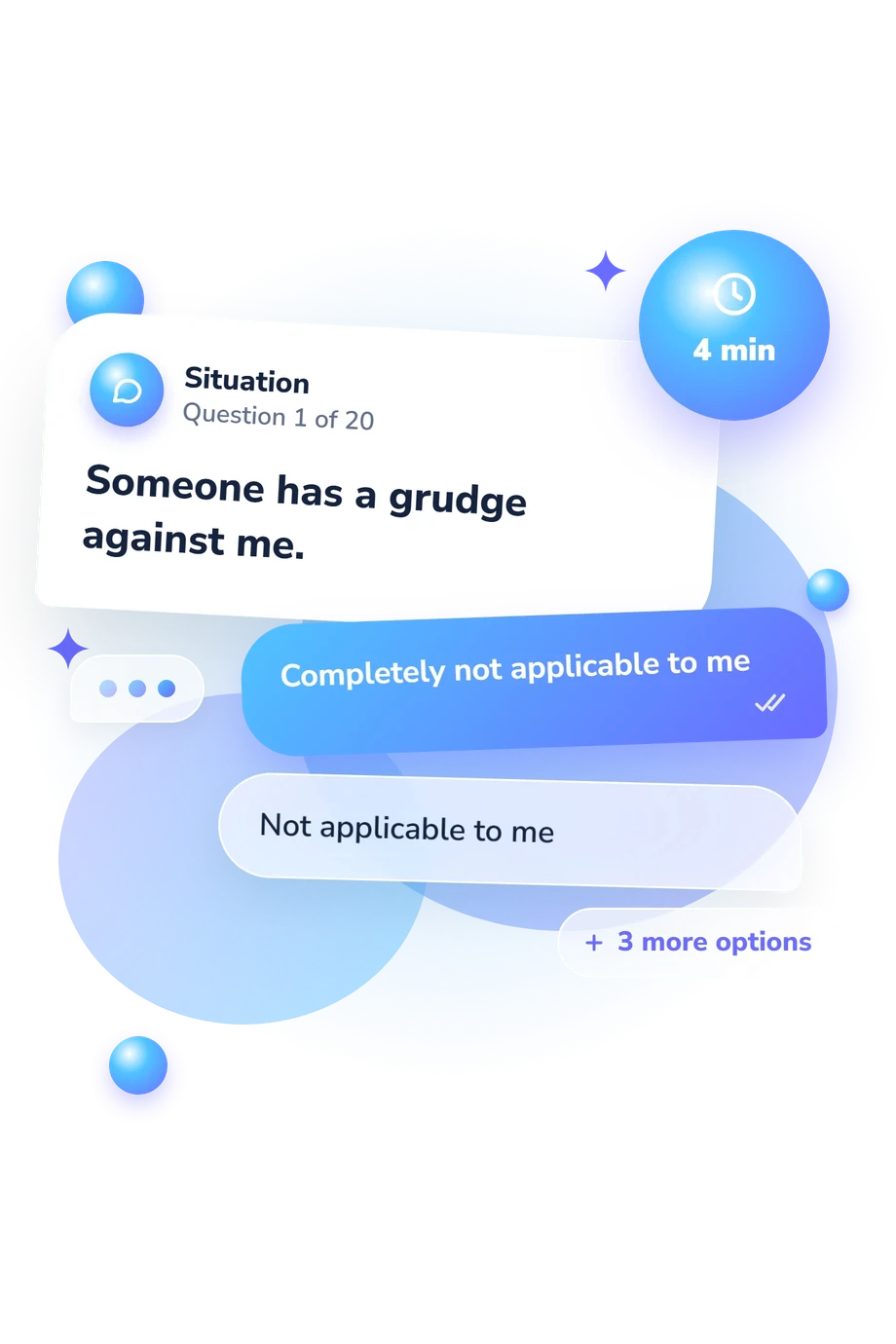
- Completely not applicable to me
- Not applicable to me
- Neither applicable nor not applicable
- Applicable to me
- Definitely applicable to me
- Not at all applicable to me
- Not applicable to me
- Neither applicable nor inapplicable
- Applicable to me
- Definitely applicable to me
- Not at all applicable to me
- Not applicable to me
- Neither applicable nor inapplicable
- Applicable to me
- Completely applicable to me
Paranoia Scale (PS) Test - Description and methodology of the test
People who notice recurring mistrust, heightened sensitivity to others’ intentions, or uneasy interpretations of ordinary encounters may use the Paranoia Scale (PS) Test to organize those experiences. As a paranoia test, it offers a structured snapshot of patterns that can be difficult to evaluate while they are happening and may help a respondent decide what deserves closer reflection.
What This Assessment Explores
The questionnaire examines distrust, perceived threat, hidden motives, criticism, unfair treatment, and feeling watched. Its items span personal encounters and broader beliefs about whether others are honest, helpful, or likely to exploit people. As a paranoia questionnaire, it helps readers consider how suspicious interpretations may influence daily relationships and public situations.
The result displays one Paranoia scale with scores from 20 to 100: Low (20-31), Moderate (32-53), and Elevated (54-100). Higher scores indicate greater subclinical paranoia, marked by persistent mistrust and threatening interpretations of others’ actions. The result describes a tendency, not the truth of a particular suspicion.
The questionnaire groups attention around these recurring areas:
- Mistrust and guardedness show how readily the respondent expects deception, exploitation, or disappointment.
- Perceived scrutiny covers concerns about being watched, judged, or discussed by others.
- Unfairness and hidden motives capture suspicion about criticism, punishment, hostility, or kindness.
Methodology and Scientific Basis
This online paranoia assessment uses self-report rather than an interview or behavioral task. Each statement has five ordered choices from not applicable to definitely applicable; the middle option allows uncertainty or a mixed experience. The wording concerns beliefs and interpretations, so the result reflects endorsement of a recurring pattern.
The questionnaire produces one displayed result, but scoring for this online version has not been standardized. Current stress, recent conflict, self-awareness, and candor can affect answers; the items capture personal interpretations rather than independently checked events.
Its reference is the Paranoia Scale (Fenigstein & Vanable, 1992), a measure of subclinical paranoid thinking. The items reproduce that instrument as an online adaptation. Combs, Penn, and Fenigstein (2002) expanded its normative work; Freeman and colleagues (2005) examined paranoid thinking in a non-clinical population. These studies contextualize the construct but do not establish version-specific validation, norms, or result bands. Interpret the result as a self-report indicator of suspicious cognitive and interpersonal tendencies, not a diagnosis; a high score may identify a pattern worth exploring, while a lower score does not rule out situational distress.
- Fenigstein, A., & Vanable, P. A. (1992). Paranoia and self-consciousness. Journal of Personality and Social Psychology, 62(1), 129-138. 10.1037/0022-3514.62.1.129
- Combs, D. R., Penn, D. L., & Fenigstein, A. (2002). Ethnic differences in subclinical paranoia: An expansion of norms of the Paranoia Scale. Cultural Diversity and Ethnic Minority Psychology, 8(3), 248-256. 10.1037/1099-9809.8.3.248
- Freeman, D., Garety, P. A., Bebbington, P. E., Smith, B., Rollinson, R., Fowler, D., Kuipers, E., Ray, K., & Dunn, G. (2005). Psychological investigation of the structure of paranoia in a non-clinical population. British Journal of Psychiatry, 186(5), 427-435. 10.1192/bjp.186.5.427
Updated: