
Psychological Essentialism Scale Test
How the Scales are Structured
Who Usually Takes This Test?
See How You Compare
Below is a preview of how scores are typically distributed across each scale.
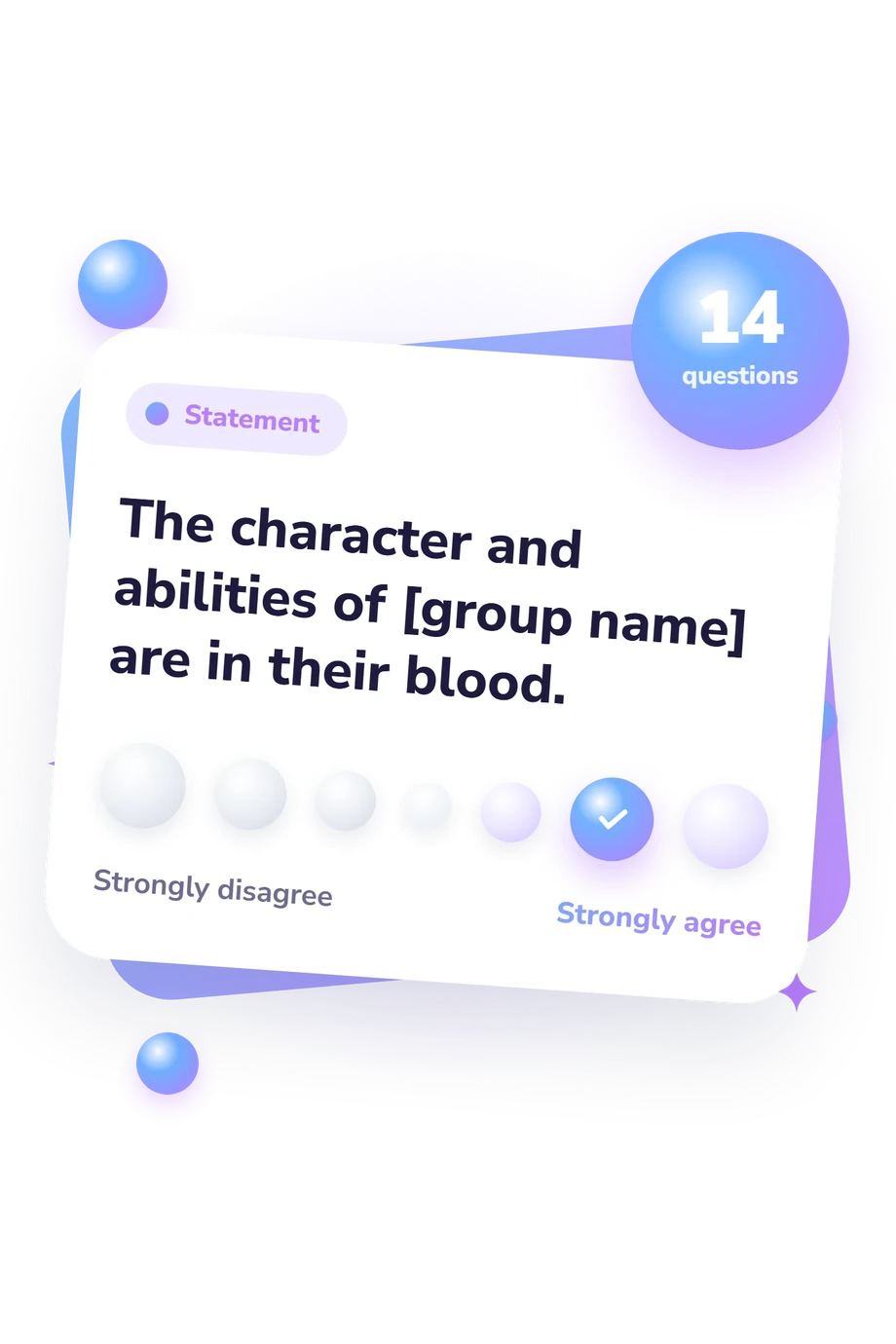
Example Questions From the Test
- Strongly disagree
- Disagree
- Somewhat disagree
- Neither agree nor disagree
- Somewhat agree
- Agree
- Strongly agree
- Strongly disagree
- Disagree
- Somewhat disagree
- Neither agree nor disagree
- Somewhat agree
- Agree
- Strongly agree
- Strongly disagree
- Disagree
- Somewhat disagree
- Neither agree nor disagree
- Somewhat agree
- Agree
- Strongly agree
Psychological Essentialism Scale Test - Description and methodology of the test
For structured self-reflection, this psychological essentialism test helps readers examine how they classify and explain social groups. The Psychological Essentialism Scale Test focuses on whether group membership is understood as rooted in an inherent, stable quality rather than shaped by context or variation. It can help people notice assumptions about identity, boundaries, biological explanations, and the apparent predictability of group members.
What This Assessment Explores
This assessment examines whether social categories seem to have a shared essence rather than reflect only individual variation. Its statements cover deep or biological causes, visible differences, fixed membership, within-group similarity, and the inferences drawn from knowing a category. Together, the items show how strongly this orientation appears in the essentialism questionnaire.
Four themes organize the result:
- Inherent basis: this indicates whether group traits seem rooted in biology or another deep property.
- Within-group similarity: this shows whether members are expected to share important traits.
- Category boundaries: this reflects whether belonging appears fixed, all-or-nothing, and resistant to middle positions.
- Category-based inference: this indicates how much knowing a category is believed to reveal about a person.
Psychological Essentialism spans 7-49: Low essentialism (7-20), Moderate essentialism (21-34), and High essentialism (35-49). Higher scores indicate stronger belief in innate, immutable group membership.
Methodology and Evidence Base
Each statement uses a seven-point agreement scale from strongly disagree to strongly agree. The overall result summarizes the selected responses, with greater endorsement indicating a stronger essentialist tendency. This keeps the score tied to the respondent’s pattern of agreement rather than to a single item.
Because it examines beliefs about social categories, the questionnaire is conceptually consistent with Psychological Essentialism Scale (Agadullina & Chumakova, 2017), a published measure of psychological essentialism, but it is neither an adaptation nor a psychometrically equivalent copy. Haslam, Rothschild, and Ernst provide a complementary account of essentialist beliefs about social categories, while Gelman and Hirschfeld explain how biological and non-biological ideas can support essentialist reasoning.
The cited sources define the construct, but do not establish psychometric norms for this online version. The three bands are descriptive categories for this online questionnaire, not population norms. Self-report results can also shift with current context, interpretation of the group label, self-awareness, and the wish to answer consistently.
- Agadullina, E. R., & Chumakova, M. A. (2017). Psychological essentialism: Development and validation of a scale. Social Psychology and Society, 8(3), 147-162. 10.17759/sps.2017080311
- Haslam, N., Rothschild, L., & Ernst, D. (2000). Essentialist beliefs about social categories. British Journal of Social Psychology, 39(1), 113-127. 10.1348/014466600164363
- Gelman, S. A., & Hirschfeld, L. A. (1999). How biological is essentialism? In Folkbiology, edited by D. L. Medin and S. Atran, MIT Press, 403-446. 10.7551/mitpress/3042.003.0013
Updated: