
Psychophysiological Stress Response Rating Scale Test
How the Scales are Structured
Who Usually Takes This Test?
See How You Compare
Below is a preview of how scores are typically distributed across each scale.
Example Questions From the Test
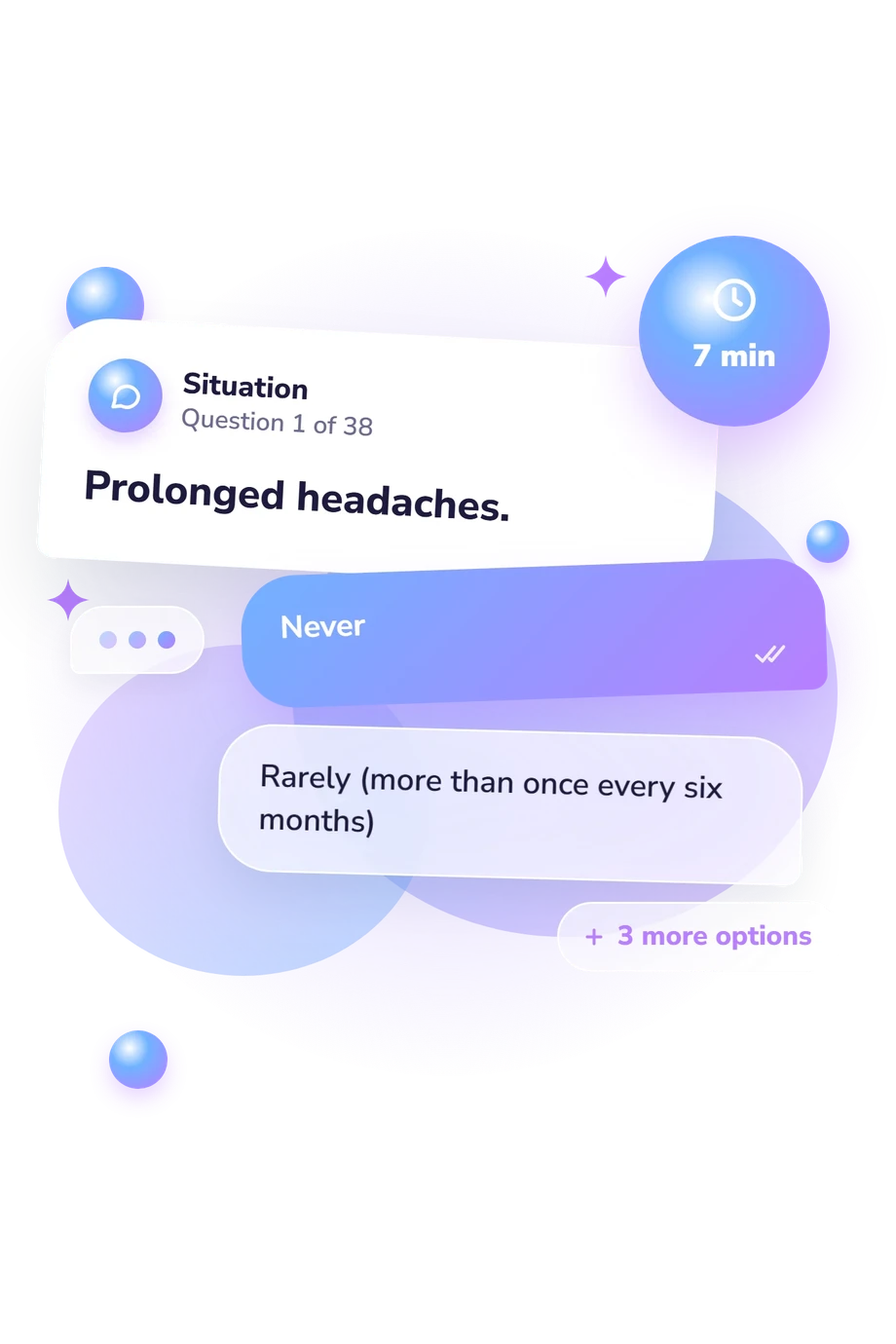
- Never
- Rarely (more than once every six months)
- Sometimes (more than once a month)
- Often (more than once a week)
- Constantly
- Never
- Rarely (more than once every six months)
- Sometimes (more than once a month)
- Often (more than once a week)
- Constantly
- Never
- Rarely (more than once every six months)
- Sometimes (more than once a month)
- Often (more than once a week)
- Constantly
Psychophysiological Stress Response Rating Scale Test - Description and methodology of the test
For people who notice recurring bodily experiences and want to examine their relationship with stress, the Psychophysiological Stress Response Rating Scale Test helps review whether those experiences form a stress pattern. It suits self-reflection by people who want to organize observations about the body and consider what their responses may suggest. Its structured format makes this stress response assessment useful for organizing observations and reviewing recurring patterns.
What This Assessment Explores
The questionnaire examines bodily experiences that may accompany stress, including headaches, cardiovascular and breathing sensations, sweating, fatigue, pain, digestive and skin changes, jaw tension and menstrual irregularity. It treats them as an overall pattern, showing how they may relate to stress impact on health. As a psychophysiological stress test, it organizes this pattern for self-reflection.
The thematic groups are:
- Heart and breathing experiences show how often heartbeat, chest, blood-pressure and breathing sensations occur.
- Head, neck and jaw experiences show whether headaches, pain, tremor, teeth grinding or related tension recur.
- Digestive, skin and other bodily changes show whether nausea, bowel symptoms, skin reactions, fatigue or menstrual irregularity add to the overall pattern.
The catalogue reports one scale, Psychophysiological Stress Response (38-190), with Low 38-75, Moderate 76-100 and High 101-190 bands. Together, these bands indicate the overall impact of stress on health.
Methodology and Scientific Basis
Each item uses five ordered frequency choices: Never, Rarely, Sometimes, Often and Constantly. The options are anchored by time examples such as more than once every six months, more than once a month and more than once a week. The conversion of responses into the displayed score is not specified, so no item-weighting formula can be inferred. The questionnaire functions as a stress response scale that organizes recurring bodily signs.
Protasenko (2024) and the Daily Stress Response Scale, or DSRS, described by Debowska and colleagues (2022), provide contextual background on stress responses, not evidence that this questionnaire is an adaptation or validated version of either source.
Interpretation follows the catalogue's construct: low scores indicate a minimal likelihood of stress-related illness, higher scores reflect increasing risk of stress-related conditions, and scores at the upper end may indicate that stress is already adversely affecting health. Recall, current context and non-stress medical factors can influence self-reports; the result does not establish a medical cause or diagnosis.
- Protasenko, O., & Mykhailova, E. (2024). Life Safety and Labour Protection: Practicum on the Training Course for Bachelor's (First) Degree Applicants of All Specialities. Kharkiv: Simon Kuznets Kharkiv National University of Economics.
- Debowska, A., Horeczy, B., Boduszek, D., Dolinski, D., & von Bastian, C. C. (2022). Development and validation of a stress response measure: the Daily Stress Response Scale (DSRS). Health Psychology Report, 10(3), 238-248. 10.5114/hpr.2022.116812
Updated: