
Value Attitude Toward Children Scale Test
How the Scales are Structured
Who Usually Takes This Test?
See How You Compare
Below is a preview of how scores are typically distributed across each scale.
Example Questions From the Test
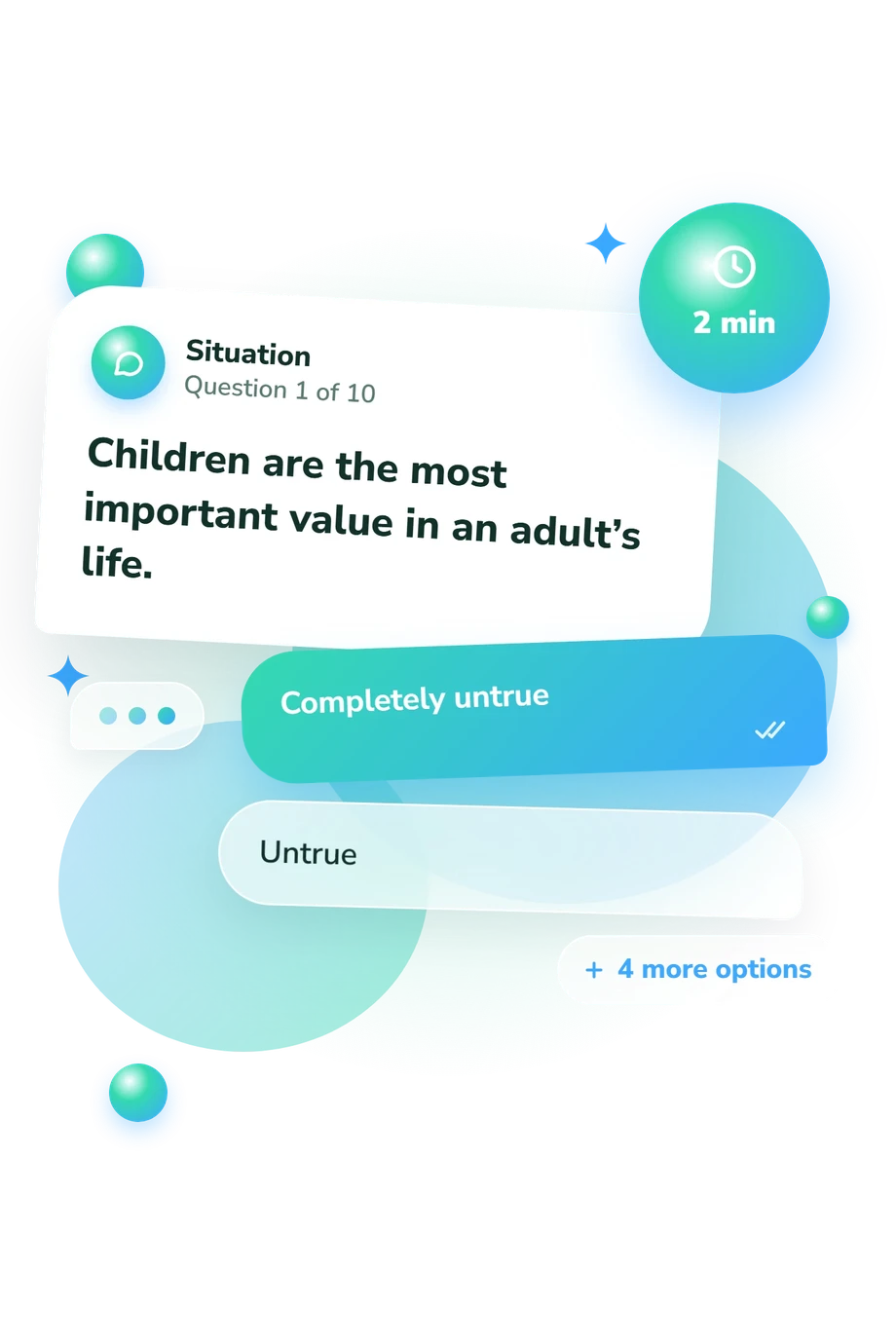
- Completely untrue
- Untrue
- Rather untrue
- Rather true
- True
- Completely true
- Completely untrue
- Untrue
- Rather untrue
- Rather true
- True
- Completely true
- Completely false
- False
- Probably false
- Probably true
- True
- Completely true
Value Attitude Toward Children Scale Test - Description and methodology of the test
People examining inherited expectations or personal beliefs about parenthood may use the Value Attitude Toward Children Scale Test when deciding which ideas about family life genuinely fit them. The attitude toward children test helps distinguish personal endorsement from social pressure, especially around claims that children are central to adulthood, fulfilment, or a meaningful future.
What This Assessment Explores
Questions examine children’s importance in adult life and meanings attached to having or not having them. They address maturity, self-realization, success, happiness, purpose, future direction, and the idea that parenthood completes a person. This makes the questionnaire relevant to adults examining value attitudes toward children and social expectations. The focus is values, not competence: items concern parenthood beliefs, while the scale includes positive valuation, attention, care, respect, and recognition of children’s needs and individuality. These describe valued attitudes, not observed caregiving behavior.
The result is presented as one score, Value Attitude Toward Children (0-50), with these bands:
- Lower value attitude (0-15) indicates lower positive valuation of children and less emphasis on their importance in adult life.
- Moderate value attitude (16-39) reflects a balanced attitude without excessive strictness or permissiveness.
- Higher value attitude (40-50) indicates greater positive valuation, attention, care, respect, and recognition of children’s needs and individuality.
Methodology and Evidence Base
Each item uses a six-point agreement response, from complete untruth to complete truth, with wording changes across statements. The declarative prompts ask respondents to judge claims about adult maturity, fulfilment, and life direction. Responses form the displayed score, but each answer’s contribution is unspecified, so the range does not justify an inferred scoring rule.
The closest comparison is Karpinski’s Value of Children Scale (2024), whose normative focus on what children mean in adult life matches these items; this is a conceptual comparison, not evidence of adaptation. Kluckhohn’s value-orientation theory and Rokeach’s work on human values provide context for the registered attribution, but do not establish authorship for this online wording. The published scale has its own development and standardization; no norms or validation studies are documented for this version.
Results from this children and parenthood assessment can reflect current relationships, cultural expectations, reproductive circumstances, and self-presentation. A score is useful alongside reflection and lived behavior because it summarizes stated beliefs at one moment, not a person’s whole relationship with children.
- Karpinski, K. V. (2024). The Value of Children Scale: Development, validation and standardization. Psychology in Education, 6(4), 543-567. 10.33910/2686-9527-2024-6-4-543-567
- Karpinski, K. V. (2025). Children as agents of adults’ psychological well-being. Psychology in Education, 7(1), 40-58. 10.33910/2686-9527-2025-7-1-40-58
- Karpinski, K. V. (2023). Personal meaning of a child: What children mean for adults. Grodno: Yanka Kupala State University of Grodno, 515 pp. ISBN 978-985-582-590-7
Updated: