
Gratitude Questionnaire-6 (GQ-6) Test
How the Scales are Structured
Who Usually Takes This Test?
See How You Compare
Below is a preview of how scores are typically distributed across each scale.
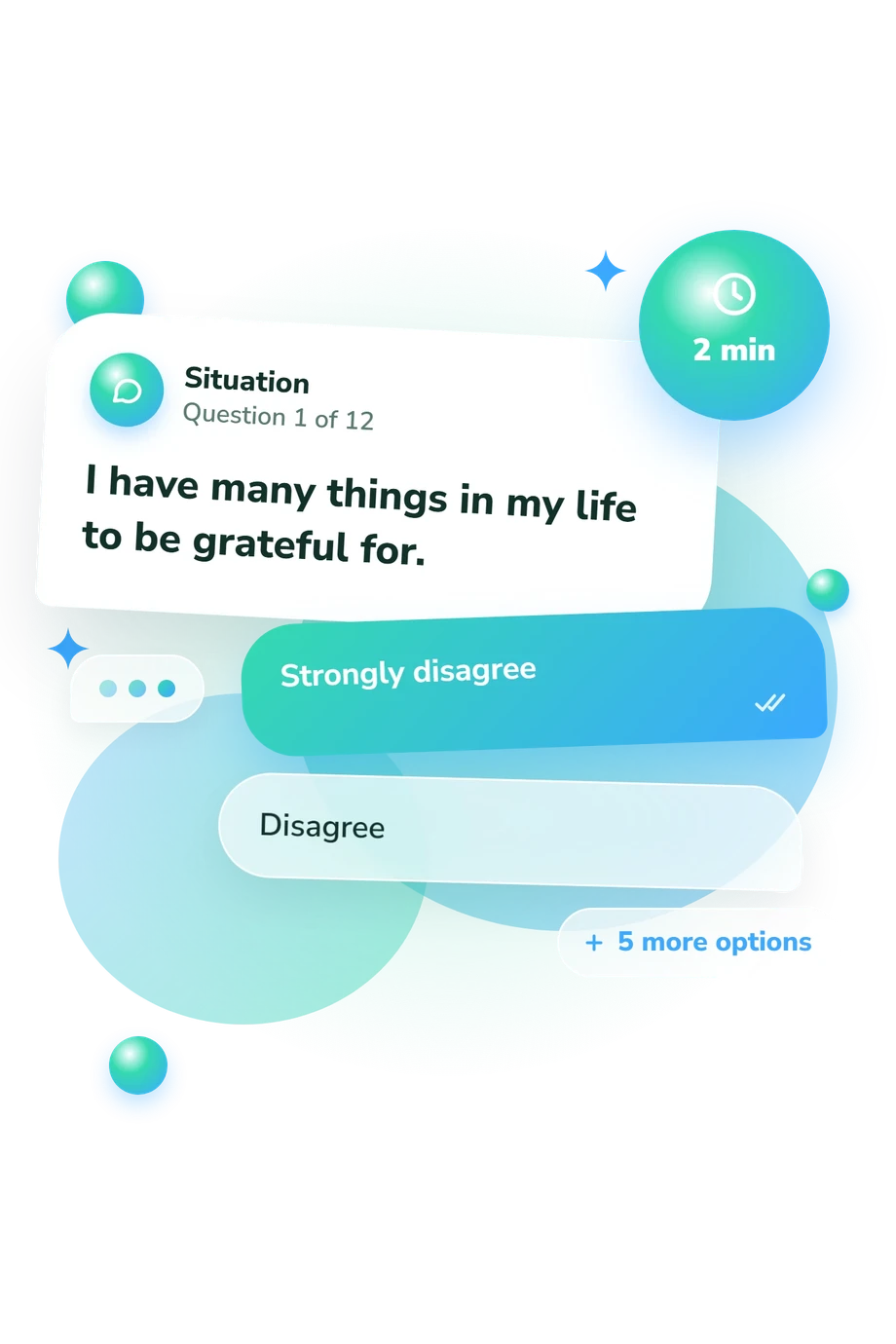
Example Questions From the Test
- Strongly disagree
- Disagree
- Somewhat disagree
- Neither agree nor disagree (neutral)
- Somewhat agree
- Agree
- Strongly agree
- Strongly disagree
- Disagree
- Probably disagree
- Neither agree nor disagree (neutral)
- Probably agree
- Agree
- Strongly agree
- Strongly disagree
- Disagree
- Somewhat disagree
- Neither agree nor disagree (neutral)
- Somewhat agree
- Agree
- Strongly agree
Gratitude Questionnaire-6 (GQ-6) Test - Description and methodology of the test
People who want to examine their general tendency to experience and express gratitude may find this questionnaire useful for focused self-reflection. The Gratitude Questionnaire-6 (GQ-6) Test summarizes dispositional gratitude rather than a single grateful mood or recent event. As a gratitude questionnaire, it helps readers consider the situations addressed by the items-appreciation of people, circumstances, and life as a whole-while interpreting the result as an overall tendency, not separate dimensions.
What This Assessment Explores
This assessment examines a person's general tendency to notice and express appreciation, not a single emotional episode.
Readers considering benefits, relationships, memories, and circumstances can use this gratitude assessment to explore themes in the items: gratitude across life, toward different people, and when appreciation takes time to arise. The result represents one dispositional level-the tendency to experience and express gratitude-not separate measures of breadth, consistency, or speed.
It yields one scale, Gratitude (25-42), for dispositional gratitude; higher scores indicate a greater tendency to experience and express it. Result bands are:
- Lower gratitude (25-35) indicates a less pronounced tendency to notice or express appreciation.
- Moderate gratitude (36-38) indicates an intermediate level of the tendency measured here.
- Higher gratitude (39-42) indicates a stronger tendency to experience and express gratitude.
Adult reference samples established these ranges; women and older adults typically score higher.
Methodology and Scientific Basis
Each statement uses a seven-point agreement format from strongly disagree to strongly agree, with a neutral midpoint. Items address abundance, gratitude toward different people, appreciation of life history, and how long gratitude may take to arise. The online GQ-6 questionnaire reports one overall scale rather than separate scores for these themes; its item-by-item scoring algorithm is not specified.
The source instrument is the GQ-6, introduced by McCullough, Emmons, and Tsang as a measure of grateful disposition. Hudecek et al. (2020) examined a German version, while Fung (2024) compared six- and five-item forms in a Chinese sample. The questions follow the published GQ-6 format; these studies provide evidence from German and Chinese versions, respectively, but do not validate this online presentation or establish norms for it.
Because answers are self-reported, scores can reflect current circumstances, self-awareness, interpretation, and a wish to present oneself positively. It is a profile rather than a diagnosis, and results may shift as context changes.
- McCullough, Michael E., Robert A. Emmons, and Jo-Ann Tsang. (2002). The Grateful Disposition: A Conceptual and Empirical Topography. Journal of Personality and Social Psychology, 82(1), 112-127. 10.1037/0022-3514.82.1.112
- Hudecek, Matthias F. C., Nicole Blabst, Blaire Morgan, and Eva Lermer. (2020). Measuring Gratitude in Germany: Validation Study of the German Version of the Gratitude Questionnaire-Six Item Form (GQ-6-G) and the Multi-Component Gratitude Measure (MCGM-G). Frontiers in Psychology, 11, 590108. 10.3389/fpsyg.2020.590108
- Fung, Sai-fu. (2024). Evaluating the Psychometric Properties of the Gratitude Questionnaire in a Chinese Sample: Comparing the 6-Item and 5-Item Versions. Mindfulness, 15, 2321-2329. 10.1007/s12671-024-02433-3
Updated: