
Sibling Rivalry Scale Test
How the Scales are Structured
Who Usually Takes This Test?
See How You Compare
Below is a preview of how scores are typically distributed across each scale.
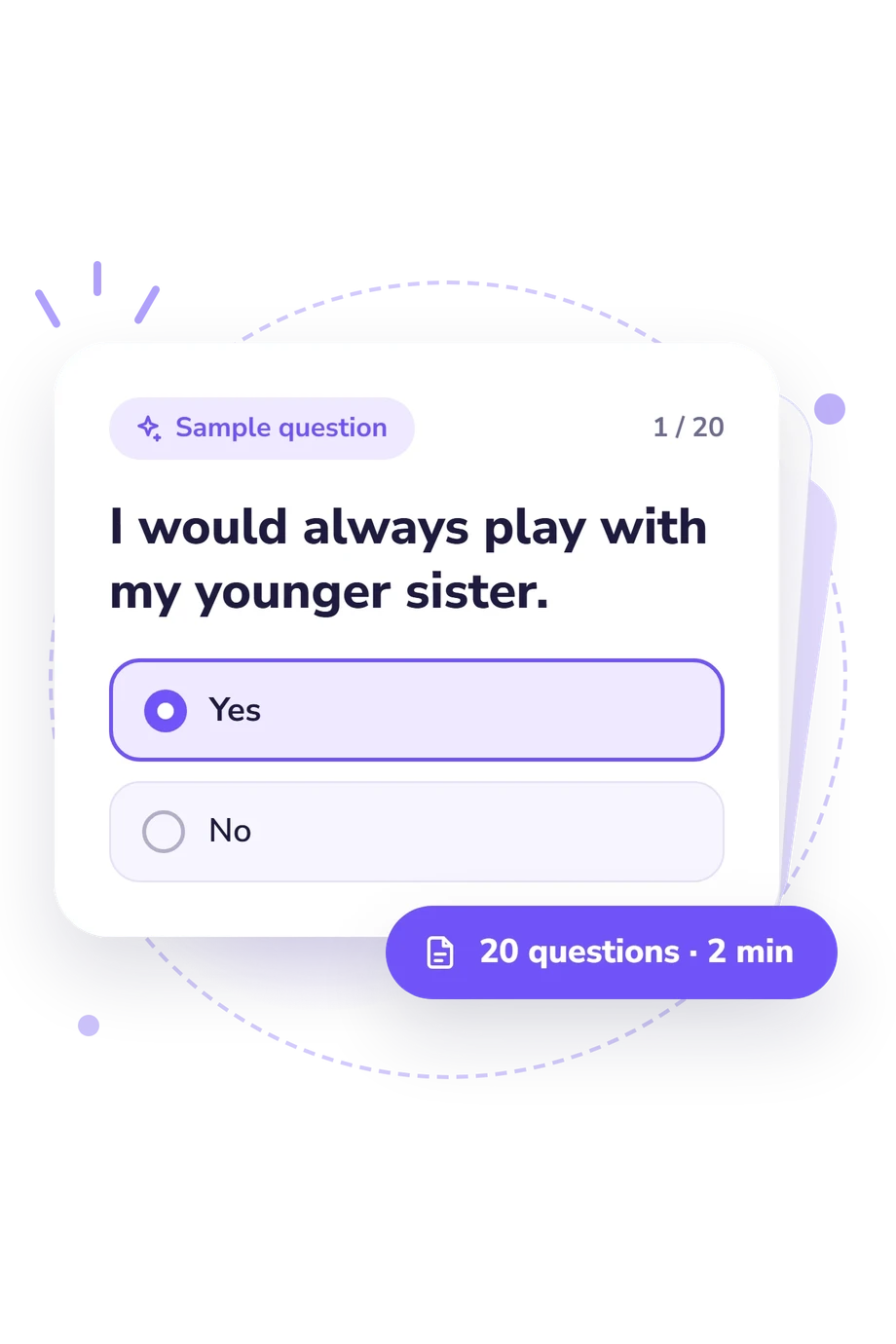
Example Questions From the Test
- Yes
- No
- Yes
- No
- Yes
- No
Sibling Rivalry Scale Test - Description and methodology of the test
For anyone reflecting on sibling relationships, the Sibling Rivalry Scale Test offers a focused way to consider how the respondent would imagine responding to a younger sister in everyday situations. This sibling rivalry assessment is especially relevant when you want to organize imagined responses about affection, inclusion, protection, and care, then use the result as a starting point for thoughtful discussion.
What This Assessment Measures
The prompts ask whether the respondent would play with, share with, include, protect, praise, stay with, read to, or care for a younger sister. These are hypothetical situations, not separate scores.
In sibling dynamics, this sibling rivalry questionnaire shows how the displayed scale reads imagined responses:
- Jealousy Toward Younger Sister, 0-100, interprets these imagined responses as jealousy intensity: Low 0-30, Moderate 31-60, and High 61-100.
- Shared play and inclusion describe imagined involvement in ordinary activities.
- Protection and care describe imagined support and attention.
- Praise and acceptance describe imagined positive responses to the younger sister.
Higher scores indicate greater intensity of jealousy toward the younger sister. Scores above 60% are considered particularly unfavorable and may indicate significant difficulties between the children. A high result invites attention to relationship context, not a fixed judgment about the respondent or sibling.
Methodology and Evidence Base
Each item uses a Yes/No response about a sibling situation rather than a graded frequency rating. Answers are combined into the displayed result, but the score range does not reveal how responses are weighted, so no rule should be inferred.
The questionnaire’s construct suits a sibling jealousy assessment and is conceptually consistent with the Preschool Children Sibling Rivalry Scale by Ata-Aktürk and Demircan, the closest published source for this focus. It is not presented as that instrument and does not automatically carry its validation, norms, or reliability estimates. Kolak and Volling link jealousy with sibling relationship quality; Furman and Buhrmester distinguish warmth, conflict, and involvement; Adler adds context for sibling position and competition.
Interpret the result through its jealousy definition, because the items describe caring or inclusive actions while the scale reads jealousy. The online questionnaire uses Yes/No items and displays result bands, but no population norms or point-conversion rule are stated. The respondent’s current view of the relationship and a wish to appear caring can shape answers, so the result is best considered alongside broader observation rather than as a diagnosis.
- Ata-Aktürk, A. A., & Demircan, H. Ö. (2018). Development of Preschool Children Sibling Rivalry Scale (PSRS). Child Indicators Research, 11(1), 117-136. 10.1007/s12187-016-9425-8
- Kolak, A. M., & Volling, B. L. (2011). Sibling jealousy in early childhood: Longitudinal links to sibling relationship quality. Infant and Child Development, 20(2), 213-226. 10.1002/icd.690
- Furman, W., & Buhrmester, D. (1985). Children’s perceptions of the qualities of sibling relationships. Child Development, 56(2), 448-461. 10.2307/1129733
- Adler, A. (1927). Understanding Human Nature. New York: Greenberg.
Updated: