
Parental Stress Scale (PSS) Test
How the Scales are Structured
Who Usually Takes This Test?
See How You Compare
Below is a preview of how scores are typically distributed across each scale.
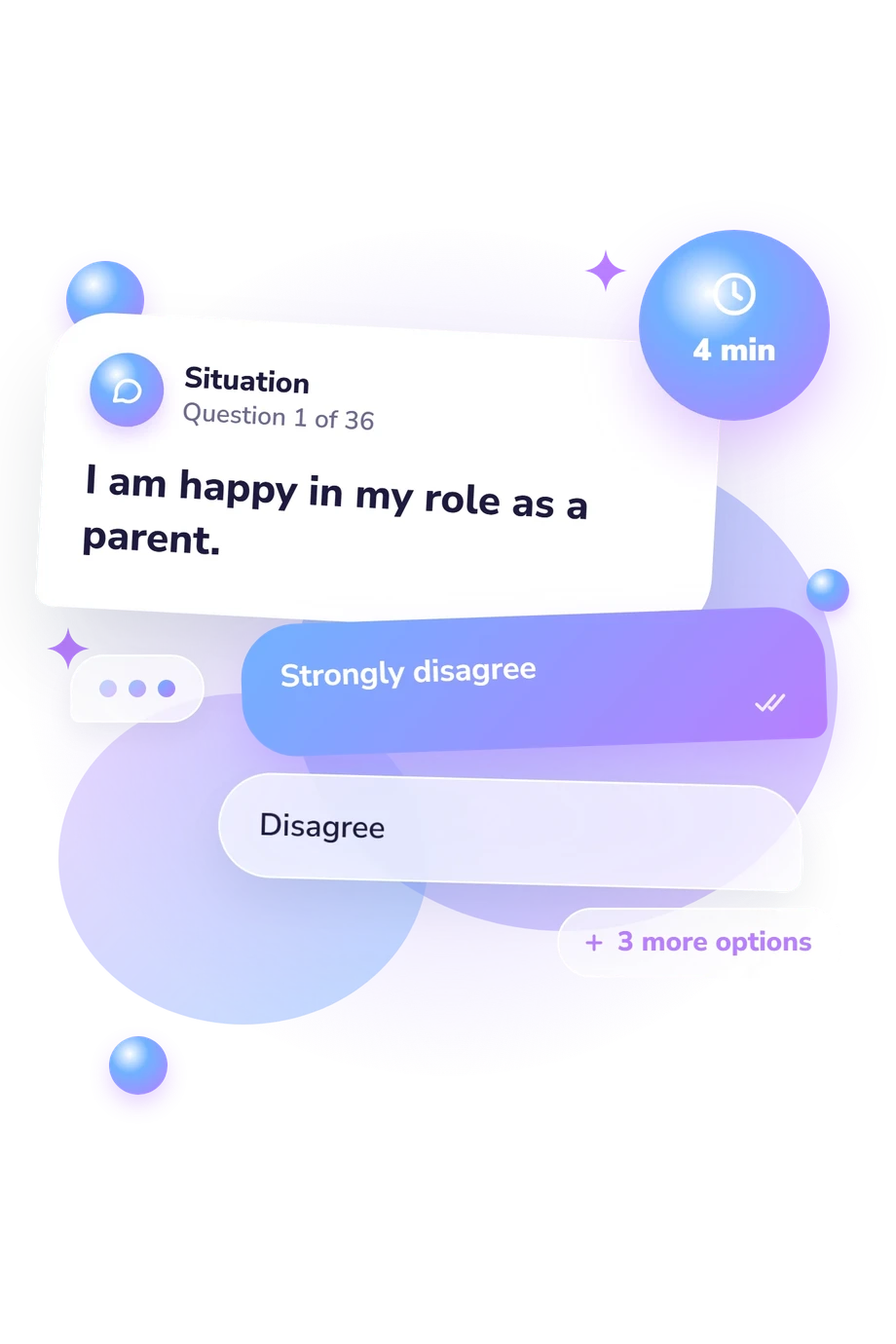
Example Questions From the Test
- Strongly disagree
- Disagree
- Not sure
- Agree
- Strongly agree
- Strongly disagree
- Disagree
- Not sure
- Agree
- Strongly agree
- Strongly disagree
- Disagree
- Not sure
- Agree
- Strongly agree
Parental Stress Scale (PSS) Test - Description and methodology of the test
Parents who want to understand how rewarding, demanding, or overwhelming their role feels may use the Parental Stress Scale (PSS) Test as a structured starting point. This parental stress assessment is for parents reflecting on how raising children affects emotions, confidence, freedom, responsibilities, and perceived control. The result helps them consider which parts of parenting feel supportive and which may call for closer attention.
What This Assessment Explores
It examines rewards and pressures in parenting. Items cover closeness, joy, confidence, worries, freedom, duties, finances, difficult behavior, and overwhelm. This parental stress questionnaire contrasts enjoyment with strain and self-doubt.
Five dimensions are:
- Parental Rewards (5-25) measures enjoyment and positive emotions: Lower reward 5-13; Moderate reward 14-19; Higher reward 20-25.
- Parental Satisfaction (3-15) measures satisfaction with oneself as a parent, confidence, and positive self-perception: Low satisfaction 3-7; Moderate satisfaction 8-11; High satisfaction 12-15.
- Loss of Control (4-20) measures perceived loss of control over life after having a child: Low loss of control 4-9; Moderate loss of control 10-15; High loss of control 16-20.
- Parental Stressors (6-30) measures parenting demands and difficulties: Low stressors 6-13; Moderate stressors 14-22; High stressors 23-30.
- Parental Stress (18-90) measures overall stress and strain: Low stress 18-41; Moderate stress 42-65; High stress 66-90.
Methodology and Evidence Base
Responses use five-point agreement options from Strongly disagree to Strongly agree, with Not sure or Unsure in the middle. The statements cover rewards, demands, and frustrations, and each response records the respondent's own appraisal of the statement.
The questionnaire reports the displayed dimensions and an overall result. The results are best interpreted as a pattern: substantial rewards may coexist with high demands or reduced control. The bands describe levels for these scores, while no standardization or population norms are documented for this online questionnaire.
The assessment is conceptually consistent with the Parental Stress Scale (Berry & Jones, 1995), a published self-report instrument. Zelman and Ferro (2018) and Nærde and Hukkelberg (2020) examined psychometric properties of that original scale in families facing chronic health conditions and in a population-based Norwegian sample. Those studies provide evidence about the original scale in those studied populations.
Self-report results can shift with mood, sleep, support, finances, child behavior, and willingness to disclose difficult feelings. This parenting stress measure is a snapshot of perceived parenting strain, useful for reflection rather than diagnosis.
- Berry, J. O., & Jones, W. H. (1995). The Parental Stress Scale: Initial Psychometric Evidence. Journal of Social and Personal Relationships, 12(3), 463-472. 10.1177/0265407595123009
- Zelman, J. J., & Ferro, M. A. (2018). The Parental Stress Scale: Psychometric Properties in Families of Children With Chronic Health Conditions. Family Relations, 67(2), 240-252. 10.1111/fare.12306
- Nærde, A., & Hukkelberg, S. S. (2020). An examination of validity and reliability of the Parental Stress Scale in a population based sample of Norwegian parents. PLOS ONE, 15(12), e0242735. 10.1371/journal.pone.0242735
Updated: