
Sensation Seeking Scale (SSS-VI) Test
How the Scales are Structured
Who Usually Takes This Test?
See How You Compare
Below is a preview of how scores are typically distributed across each scale.
Example Questions From the Test
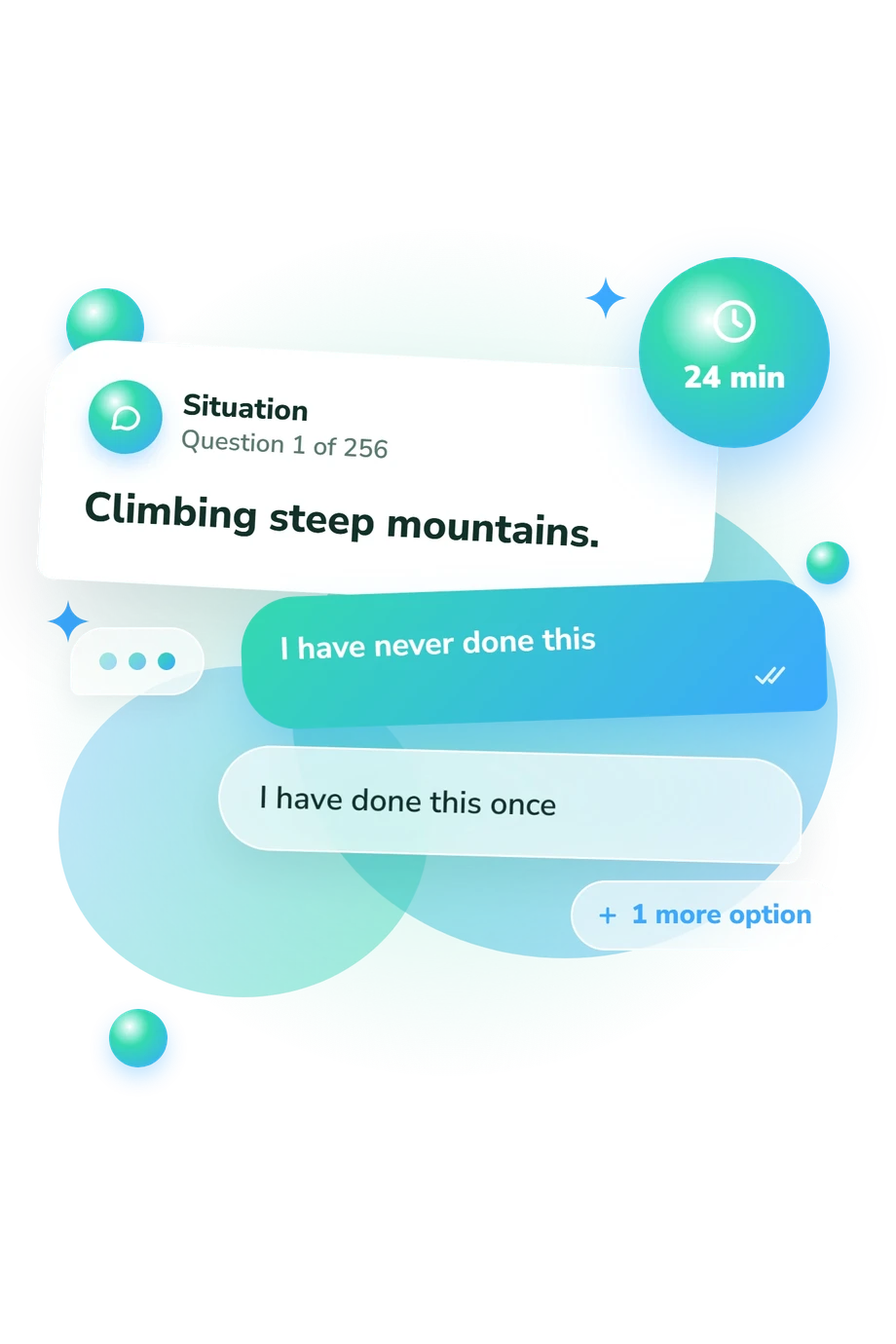
- I have never done this
- I have done this once
- I have done this more than once
- I have never done this
- I have done this once
- I have done this more than once
- I have never done this
- I have done this once
- I have done this more than once
Sensation Seeking Scale (SSS-VI) Test - Description and methodology of the test
People who wonder why novelty, speed, unfamiliar settings, or social boundary-pushing feel attractive can use this self-report tool to examine patterns of choice and intention. The Sensation Seeking Scale (SSS-VI) Test offers a structured view of appetite for intensity and variety, making it useful for personal reflection and discussion of risk-taking preferences. This sensation seeking questionnaire focuses on tendencies rather than isolated events.
What This Assessment Explores
The assessment examines novelty, intensity, and risk as connected preferences. It is intended for people reflecting on their attraction to adventure, stimulation, variety, or predictability, rather than for judging one isolated decision. The sample items fall into four practical themes:
- Physical adventure reflects interest in speed, demanding activity, travel, and endurance.
- Unusual experience reflects attraction to unfamiliar settings, nonconformity, and breaks from routine.
- Social and sexual disinhibition reflects willingness to pursue stimulating parties, relationships, or intimate experiences.
- Risk and provocation reflect comfort with danger, defiance, rule-breaking, or startling reactions.
The catalogue reports Sensation Seeking on a 0-100 scale, with Low (0-33), Moderate (34-66), and High (67-100) bands. Higher results indicate a stronger preference for variety, novelty, and adventure, with greater willingness to accept related risks; lower results point toward stability and predictability. As an SSS-VI assessment, it describes a general orientation, not whether any particular behavior is safe or typical.
Methodology and Scientific Basis
Items use two ordered self-report formats. Experience prompts distinguish never, once, and more than once; intention prompts distinguish no desire, hesitation, and willingness if an opportunity arises. The structure therefore compares past behavior with prospective choice, and works best when answers reflect the respondent's own past experiences or likely choices rather than anticipated social approval.
The questionnaire is conceptually consistent with Sensation Seeking Scale Form VI (Zuckerman, 1984), which connects the construct with behavioral expressions and intentions involving intense or unconventional experiences. It is not presented as an adaptation of that published instrument. Zuckerman and Aluja (2015) place these measures within personality assessment.
The questionnaire displays one combined result, giving a sensation seeking profile rather than separate scores for these four practical themes. The questionnaire does not state how many points each option contributes, so the composite cannot be reconstructed from the response wording. The displayed bands are catalogue result categories and should not be treated as clinical cutoffs.
Current mood, memory, opportunity, and social judgment can shape self-report. A high result does not predict every listed behavior, and a low result does not rule out occasional adventure; it summarizes a tendency across these responses.
- Zuckerman, Marvin. "Experience and desire: A new format for Sensation Seeking Scales." Journal of Behavioral Assessment, 6(2), 101-114, 1984. 10.1007/BF01350166
- Zuckerman, Marvin, and Anton Aluja. "Measures of Sensation Seeking." In Measures of Personality and Social Psychological Constructs, edited by Gregory J. Boyle, Donald H. Saklofske, and Gerald Matthews, 352-380. Academic Press, 2015. 10.1016/B978-0-12-386915-9.00013-9
Updated: