
Freudly+971 508685814hello@freudly.ai
Freudly
body image

Body Investment Scale (BIS) Test
Take the online Body Investment Scale (BIS) Test - AI psychologist FreudlyYou can take Body Investment Scale (BIS) Testhere. Online version of a simple and accurate psychological test with interpretation.en
Understand your emotional connection to your body and self-care in about 5 minutes. With 24 quick items, it offers clear insights that can flag risk and guide support fast.
Start Online Test
Questions: 245 minutes
08:30
October 2, 2025
October 2, 2025
Material has been updated
October 2, 2025
Material has been published
27,078 views
2,453 completions
2,028 likes
Verified by Daniel Hall
Psychologist with 25 years of experience
Share
Scale Explorer

How the Scales are Structured

example score
12/15
Boundary Control (BC)
Measures the tendency to maintain interpersonal distance and protect personal boundaries versus seeking closer, informal interaction.
Close/Informal
Balanced
Boundary-Focused
37: Close/Informal | 811: Balanced | 1215: Boundary-Focused
A score of 12 falls in the Boundary-Focused range, suggesting a stronger preference for social autonomy and clear personal boundaries in communication.
example score
10/20
Tactile Comfort (TC)
Measures comfort with physical touch and the degree of need for closeness, warmth, and supportive contact.
Low comfort
Moderate comfort
High need for touch
49: Low comfort | 1014: Moderate comfort | 1520: High need for touch
A score of 10 falls in the Moderate comfort range, suggesting generally mixed feelings about physical contact with a situational need for closeness and support.
example score
4/10
Risk-Taking Tendency (RTT)
Measures how inclined a person is to engage in and enjoy risk-taking behavior.
Low risk-taking
Moderate risk-taking
High risk-taking
24: Low risk-taking | 57: Moderate risk-taking | 810: High risk-taking
A score of 4 falls in the Low risk-taking range, suggesting a preference for caution and possible discomfort when situations feel risky.
example score
15/20
Body Hostility (BH)
Measures the degree of dissatisfaction, resentment, or aggression directed toward one’s own body and appearance.
Low hostility
Moderate hostility
High hostility
49: Low hostility | 1014: Moderate hostility | 1520: High hostility
A score of 15 falls in the High hostility range, suggesting pronounced dissatisfaction with the body and a more adversarial, self-directed stance toward one’s physical self.
example score
12/15
Self-Acceptance (SA)
Measures how unconditionally a person accepts their body, appearance, and physical abilities as part of their sense of self.
Low
Moderate
High
37: Low | 811: Moderate | 1215: High
A score of 12 falls in the High range, suggesting a generally strong, accepting relationship with one’s body and appearance.
example score
19/25
Body Care (BC)
Measures how much a person attends to and enjoys caring for their body and appearance beyond basic hygiene.
Low body care
Moderate body care
High body care
512: Low body care | 1318: Moderate body care | 1925: High body care
A score of 19 falls in the High body care range, suggesting a strong tendency to look after appearance and engage in self-care activities.
example score
7/15
Body Protection (BP)
Measures how consistently a person takes precautions to protect their physical safety and bodily condition when facing potential threats.
Low protection
Moderate protection
High protection
37: Low protection | 811: Moderate protection | 1215: High protection
A score of 7 falls in the Low protection range, suggesting fewer or less consistent physical safety precautions in potentially risky situations.
Start Online Test
just completed the test
DATA-BASED USER COHORTS

Who Usually Takes This Test?

Stress, anxiety, or low mood
41%OF USERS
People feeling anxious, depressed, or emotionally numb take it to understand how connected and caring they feel toward their body.
Recovery and self-harm concerns
34%OF USERS
People worried about self-harm urges or past risky behaviors use it to spot warning signs and gaps in self-protection.
Therapy and progress tracking
25%OF USERS
Clients in counseling or trauma work take it to track changes in self-acceptance, body care, and emotional integration over time.
BASED ON AGGREGATED, ANONYMIZED DATA FROM TENS OF THOUSANDS OF FREUDLY USERS.
Benchmarking

See How You Compare

Once you complete the test, your results are compared with real-world data from people in your country.
Below is a preview of how scores are typically distributed across each scale.
Distance Control (DC)
Average
9.5
Normal range
7.311.8
min.
3
max.
15
This curve shows how scores are typically distributed.
Once you complete the test, your result will appear on the scale so you can see how you compare.
Tactile Comfort (TC)
Average
15.3
Normal range
12.418.2
min.
4
max.
20
This curve shows how scores are typically distributed.
Once you complete the test, your result will appear on the scale so you can see how you compare.
Risk Tendency (RT)
Risk Tendency (RT)
Average
5.3
Normal range
3.96.8
min.
2
max.
10
This curve shows how scores are typically distributed.
Once you complete the test, your result will appear on the scale so you can see how you compare.
Hostility Toward the Body (HTtB)
Average
8.2
Normal range
5.510.9
min.
4
max.
20
This curve shows how scores are typically distributed.
Once you complete the test, your result will appear on the scale so you can see how you compare.
Self-Acceptance (S)
Self-Acceptance (S)
Average
9.4
Normal range
7.811
min.
3
max.
15
This curve shows how scores are typically distributed.
Once you complete the test, your result will appear on the scale so you can see how you compare.
Body Care (BC)
Body Care (BC)
Average
13.1
Normal range
10.315.9
min.
5
max.
25
This curve shows how scores are typically distributed.
Once you complete the test, your result will appear on the scale so you can see how you compare.
Body Protection (BP)
Average
10.7
Normal range
8.812.5
min.
3
max.
15
This curve shows how scores are typically distributed.
Once you complete the test, your result will appear on the scale so you can see how you compare.
Featured On
SAMPLE QUESTIONS

Example Questions From the Test

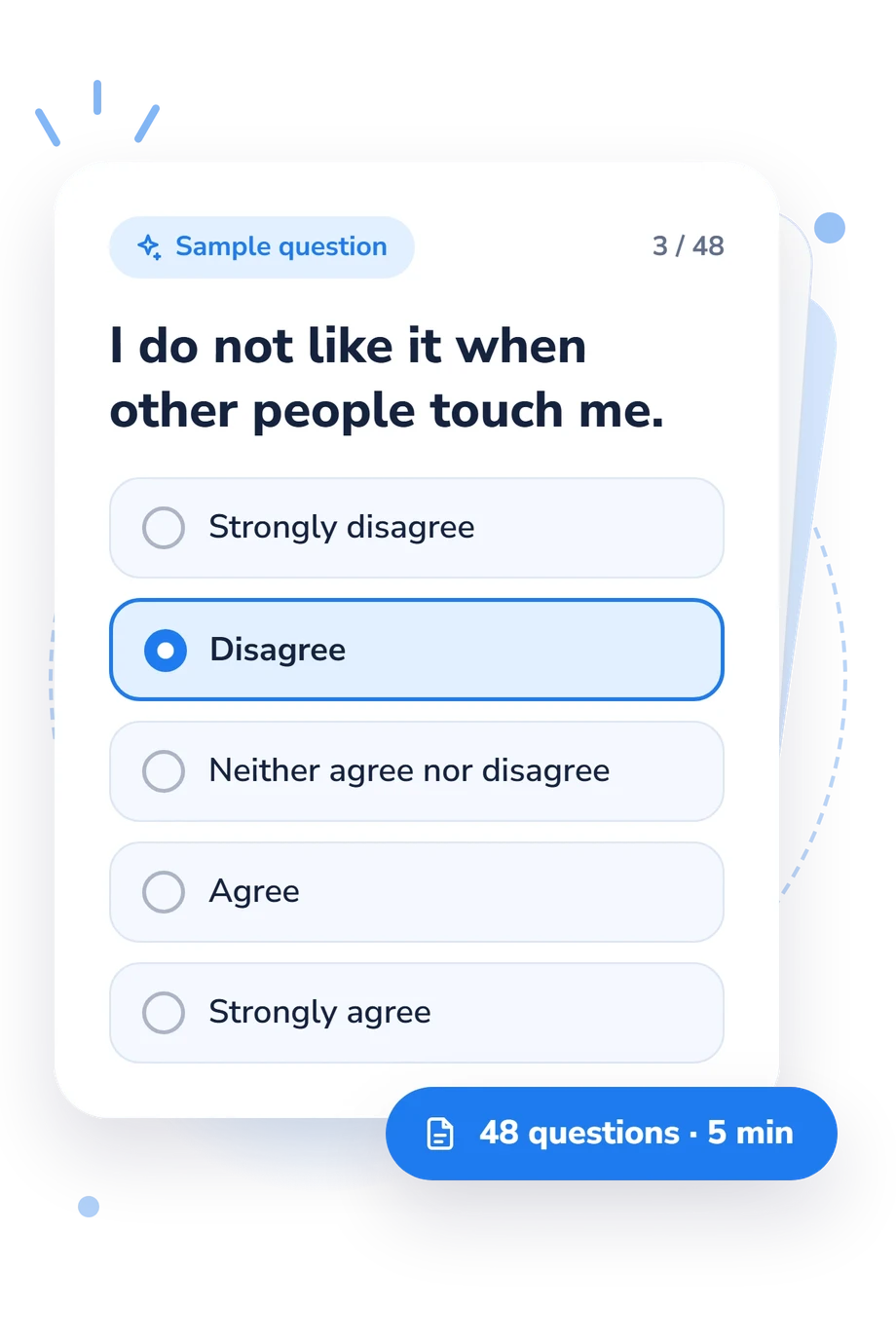
The statements below refer to your experiences, feelings, and attitudes toward your body. There are no right or wrong answers; what matters is what you feel. Please read each statement carefully and indicate the extent to which you agree with each one.
    • Strongly disagree
    • Disagree
    • Neither agree nor disagree
    • Agree
    • Strongly agree
    • Strongly disagree
    • Disagree
    • Neither agree nor disagree
    • Agree
    • Strongly agree
    • Strongly disagree
    • Disagree
    • Neither agree nor disagree
    • Agree
    • Strongly agree
WHAT THE TEST MEASURES
About This Assessment
Emotional Investment in the Body Scale, BIS Test

Body Investment Scale (BIS) Test - Symptoms and Signs

body image

This measure assesses an individual’s attitudes and behaviors toward their body, including aspects of physical self-care and the emotional significance attributed to bodily experiences. The Body Investment Scale (BIS) is used to characterize body-related feelings and practices that may be clinically relevant in understanding distress and broader patterns of self-directed behavior.

It consists of 24 items and typically takes about 5 minutes to complete. Responses can support clinical formulation and monitoring by providing a brief snapshot of body-related investment that may inform risk screening and treatment planning. In research settings, the Body Investment Scale (BIS) may be used to examine change over time or associations with other psychological constructs.

Author: Thomas F. Cash
Literature: Cash, T. F. Body image: A handbook of science, practice, and prevention. Guilford Press. 2011.; Orbach, I., Mikulincer, M. The Body Investment Scale: Construction and validation of a body experience scale. Psychological Assessment. 1998.
Popular tests
Comments
Leave a Comment