
Zung Self-Rating Anxiety Scale (SAS) Test
How the Scales are Structured
Who Usually Takes This Test?
See How You Compare
Below is a preview of how scores are typically distributed across each scale.
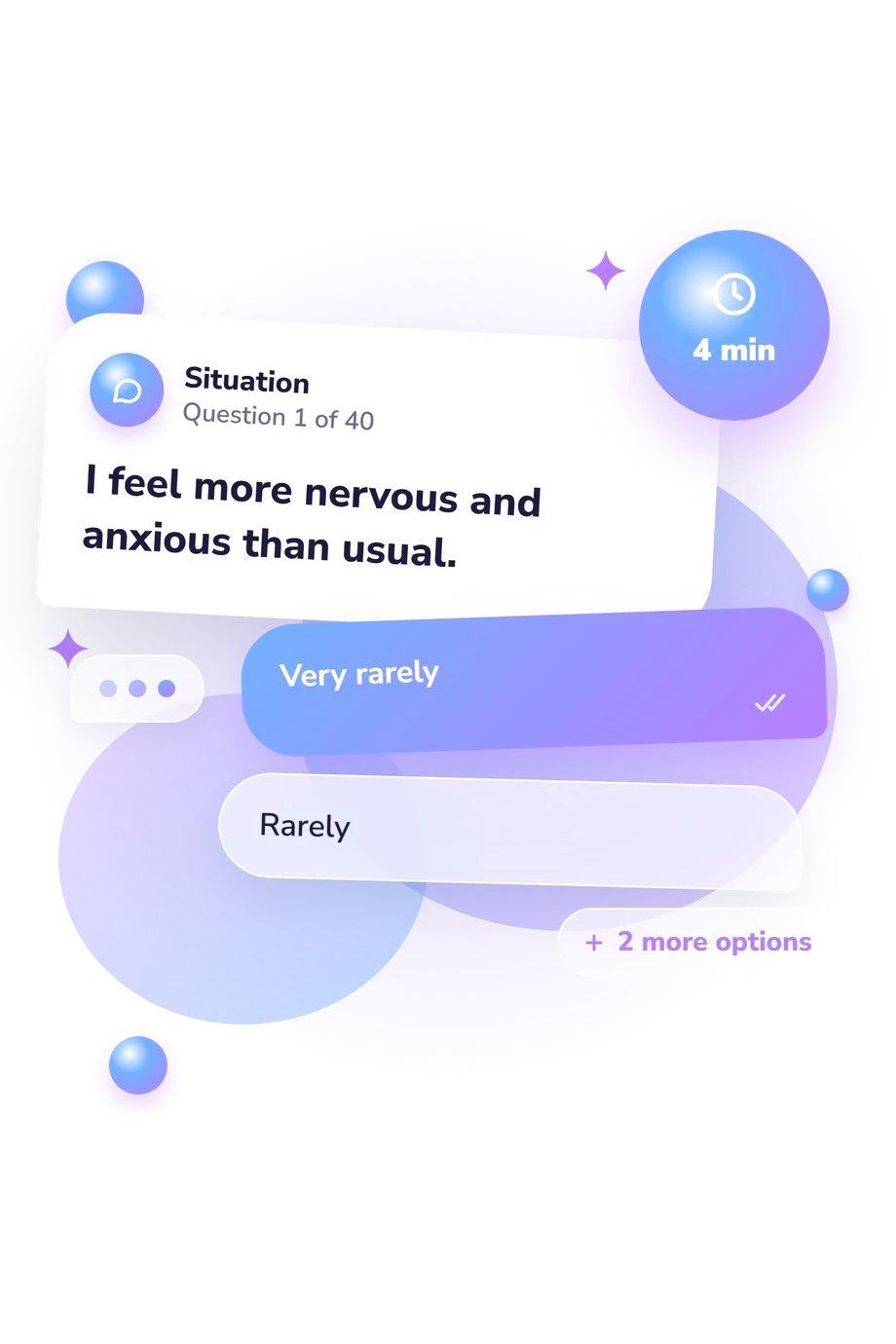
Example Questions From the Test
- Very rarely
- Rarely
- Often
- Most of the time or always
- Rarely or none of the time
- Sometimes
- Often
- Most of the time or all of the time
- Very rarely
- Rarely
- Often
- Most of the time or all of the time
Zung Self-Rating Anxiety Scale (SAS) Test - Description and methodology of the test
People who want to examine recurring worry, tension, or bodily signs of anxiety can use this questionnaire as a structured self-reflection tool. The Zung Self-Rating Anxiety Scale (SAS) Test organizes these experiences into a severity profile rather than a single impression. As an anxiety symptom assessment, it can help you recognize whether your recent responses suggest relatively few, moderate, or pronounced symptoms.
What This Assessment Explores
The questions connect emotional experiences with bodily signs of anxiety. They touch on nervousness, unexplained fear, panic-like upset, difficulty pulling yourself together, and calmness, alongside trembling, fatigue, heartbeat, dizziness, digestion, sleep, and breathing. It suits readers considering a recurring pattern rather than one isolated feeling.
The result is organized through two displayed scales:
- Raw Score Total, 20-80, sums item scores before conversion and is not interpreted directly; bands are Lower raw total 20-39, Mid raw total 40-59, and Higher raw total 60-80.
- Anxiety Index, 25-100, reflects converted severity; bands are Normal range 25-44, Mild-moderate anxiety 45-59, and Marked-extreme anxiety 60-100.
Emotional, physical, and sleep-related experiences remain themes of the items, not additional scored results. The Zung anxiety scale helps you notice whether these experiences are relatively infrequent or more persistent and intense.
Methodology and Evidence Base
The self-rating anxiety scale format uses 20 statements with four frequency choices, moving from very rarely or rarely to often and most of the time. Items cover distress and bodily activation as well as calmness, easy breathing, and restful sleep, so the response reflects reported experiences rather than abstract beliefs.
Each response contributes to a raw item total. The scoring method converts it by multiplying by 1.25; the raw total is therefore a calculation base, not a separate interpretation. This accounts for the different numerical ranges shown in the result.
The source instrument is the Zung Self-Rating Anxiety Scale (SAS), introduced by William W. K. Zung. Olatunji, Deacon, Abramowitz, and Tolin examined its factor structure and psychometric properties, while Dunstan and Scott reported normative work for Zung’s scale. These studies connect the questionnaire with a published instrument, but published findings should not automatically be transferred to every online version when wording, administration, or scoring differ.
Read the result as an indicator of the symptoms covered by the items. Self-report may be shaped by current stress, physical conditions, memory, and openness, so consider the score with the duration, context, and impact of your experiences rather than in isolation.
- Zung, William W. K. (1971). A rating instrument for anxiety disorders. Psychosomatics, 12(6), 371-379. 10.1016/S0033-3182(71)71479-0
- Olatunji, Bunmi O., Deacon, Brett J., Abramowitz, Jonathan S., & Tolin, David F. (2006). Dimensionality of somatic complaints: Factor structure and psychometric properties of the Self-Rating Anxiety Scale. Journal of Anxiety Disorders, 20(5), 543-561. 10.1016/j.janxdis.2005.08.002
- Dunstan, Debra A., & Scott, Ned. (2020). Norms for Zung’s Self-rating Anxiety Scale. BMC Psychiatry, 20, 90. 10.1186/s12888-019-2427-6
Updated: