
Adolescent Prosociality Scale Test
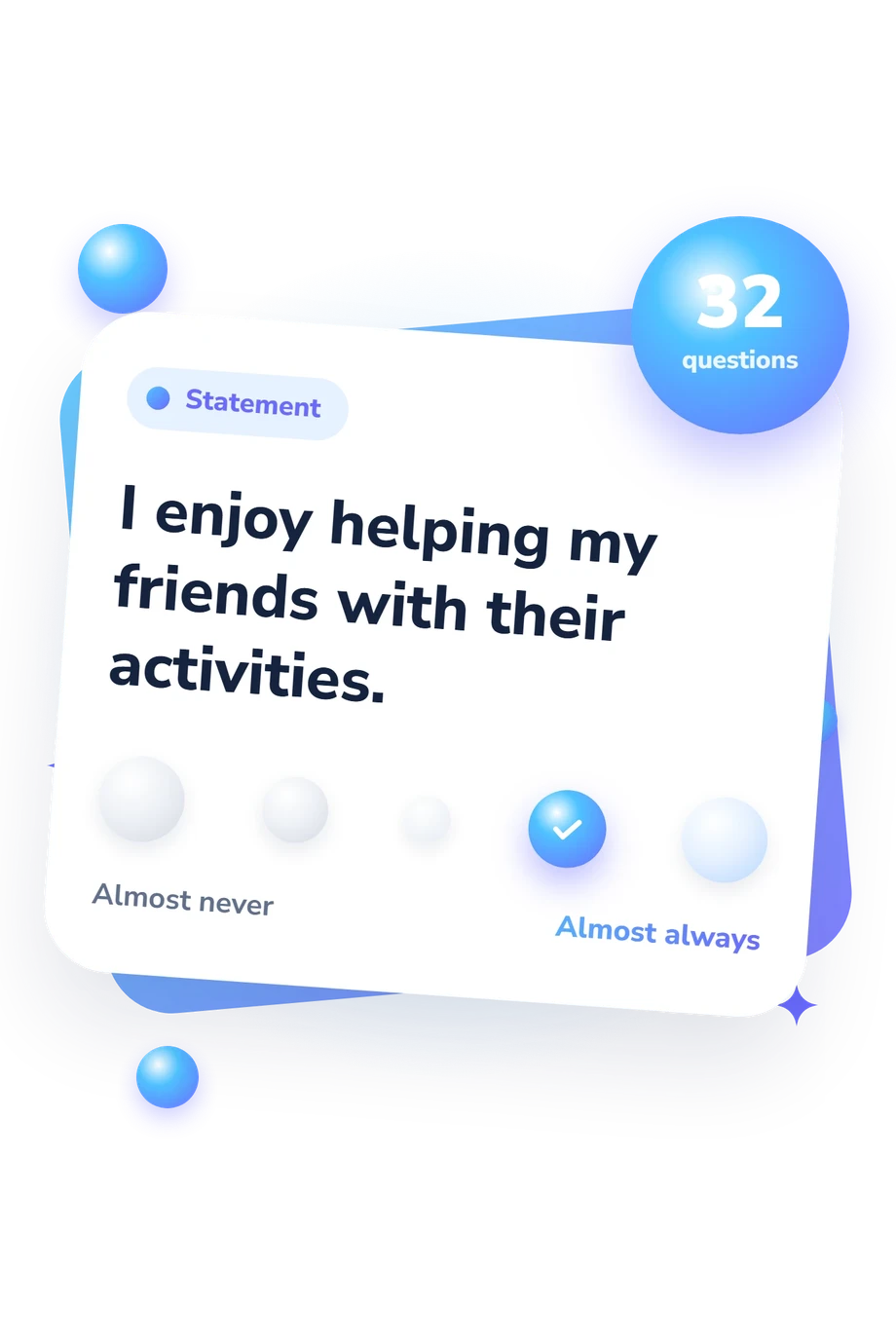
How the Scales are Structured
Who Usually Takes This Test?
See How You Compare
Below is a preview of how scores are typically distributed across each scale.
Example Questions From the Test
- Almost never
- Rarely
- Sometimes
- Often
- Almost always
- Almost never
- Rarely
- Sometimes
- Often
- Almost always
- Almost never
- Rarely
- Sometimes
- Often
- Almost always
Adolescent Prosociality Scale Test - Description and methodology of the test
As an adolescent prosociality assessment, this tool examines how compassion, perspective-taking, and practical support appear in everyday relationships. The Adolescent Prosociality Scale Test is intended for adolescents seeking a clearer picture of social strengths and areas for reflection; parents, educators, or counsellors may discuss the result as context. It distinguishes emotional responsiveness, helping behavior, and the broader global tendency toward prosociality.
What This Assessment Explores
The questionnaire treats prosociality as an emotional orientation expressed through behavior. Its situations include noticing discomfort, taking another perspective, feeling sympathy, sharing, comforting, volunteering, and staying available to people who need help. This makes the adolescent prosocial behavior scale relevant to relationships, cooperation, and support.
The three displayed dimensions are:
- Prosocial Feelings (4-20) measures affective and cognitive empathy and emotional responsiveness; higher scores indicate greater empathic understanding and emotional responsiveness, with Low 4-11, Moderate 12-15, and High 16-20 as the displayed bands.
- Prosocial Actions (12-60) measures helping across situations; higher scores indicate more frequent or ready helping, with Low 12-38, Moderate 39-47, and High 48-60 as the displayed bands.
- Prosociality (16-80) measures the broad tendency toward positive interaction, perspective-taking, and social connection; higher scores indicate a stronger orientation toward positive interaction and social connection, with Low 16-49, Moderate 50-61, and High 62-80 as the displayed bands.
Methodology and Scientific Basis
Each statement uses a five-point frequency response from Almost never to Almost always. Respondents receive results on the three displayed scales, with the questionnaire presenting each range and band as a descriptive level rather than a pass-fail judgment.
When interpreting this adolescent prosociality questionnaire, read the dimensions together. The profile can show whether reported feelings and actions appear similar or different, but differences alone do not establish motives, emotional quality, or consistency.
The questionnaire is conceptually consistent with the Prosocialness Scale and its adolescent validation by Gouveia and colleagues. Related work by Caprara and colleagues, and by Luengo Kanacri and colleagues, treats empathy, helping, perspective-taking, and positive social connection as related aspects of prosociality.
Self-report can be affected by mood, relationships, memory, social desirability, and self-awareness. The online questionnaire’s standardization and validation status is not established, and the displayed bands should therefore be read as descriptive levels rather than population norms.
- Gouveia, Ana; Cunha, Marina; Galhardo, Ana; Carreiras, Diogo. (2024). Prosociality and Mental Health Indicators in Portuguese Adolescents - Validation of Prosocialness Scale. Análisis y Modificación de Conducta, 50(183), 3-20. 10.33776/amc.v50i183.8187
- Caprara, Gian Vittorio; Steca, Patrizia; Zelli, Arnaldo; Capanna, Cristina. (2005). A New Scale for Measuring Adults’ Prosocialness. European Journal of Psychological Assessment, 21(2), 77-89. 10.1027/1015-5759.21.2.77
- Luengo Kanacri, Bernadette Paula; Eisenberg, Nancy; Tramontano, Carla; Zuffianò, Antonio; Caprara, Maria Giulia; Regner, Eliana; Zhu, Li; Pastorelli, Concetta; Caprara, Gian Vittorio. (2021). Measuring Prosocial Behaviors: Psychometric Properties and Cross-National Validation of the Prosociality Scale in Five Countries. Frontiers in Psychology, 12, 693174. 10.3389/fpsyg.2021.693174
Updated: