
Ruminative Responses Scale (RRS) Test
How the Scales are Structured
Who Usually Takes This Test?
See How You Compare
Below is a preview of how scores are typically distributed across each scale.
Example Questions From the Test
- Almost never
- Sometimes
- Often
- Almost always
- Almost never
- Sometimes
- Often
- Almost always
- Almost never
- Sometimes
- Often
- Almost always
Ruminative Responses Scale (RRS) Test - Description and methodology of the test
People who notice that difficult moods pull their attention inward can use the Ruminative Responses Scale (RRS) Test to examine that pattern more closely. It offers a structured way to examine rumination during difficult moods and distinguish problem-solving reflection from repetitive distress. The result from this rumination questionnaire describes tendencies, not a fixed identity.
What This Assessment Explores
This rumination self-assessment focuses on responses to sadness, anger, low motivation, loneliness, concentration problems, perceived failures, and difficult recent events. Some prompts ask about analyzing causes or writing thoughts down; others capture passive, gloomy, self-critical, or helpless mental loops. Together, they distinguish active reflection from distress-linked repetition.
The four displayed dimensions are:
- Reflective Pondering (5-20) measures deliberate self-reflection about causes and solutions; Low reflective thinking 5-9, Moderate reflective thinking 10-14, High reflective thinking 15-20.
- Brooding (5-20) captures passive, distressing repetition that can intensify hopelessness and limit active problem solving; Low 5-9, Moderate 10-14, High 15-20.
- Depressive Brooding (12-48) reflects gloomy comparisons with unattainable standards and negative depressive thinking; Low 12-23, Moderate 24-35, High 36-48.
- Rumination Scale (22-88) summarizes intrusive focus on feelings and problems; Low 22-43, Moderate 44-65, High 66-88.
Methodology and Scientific Basis
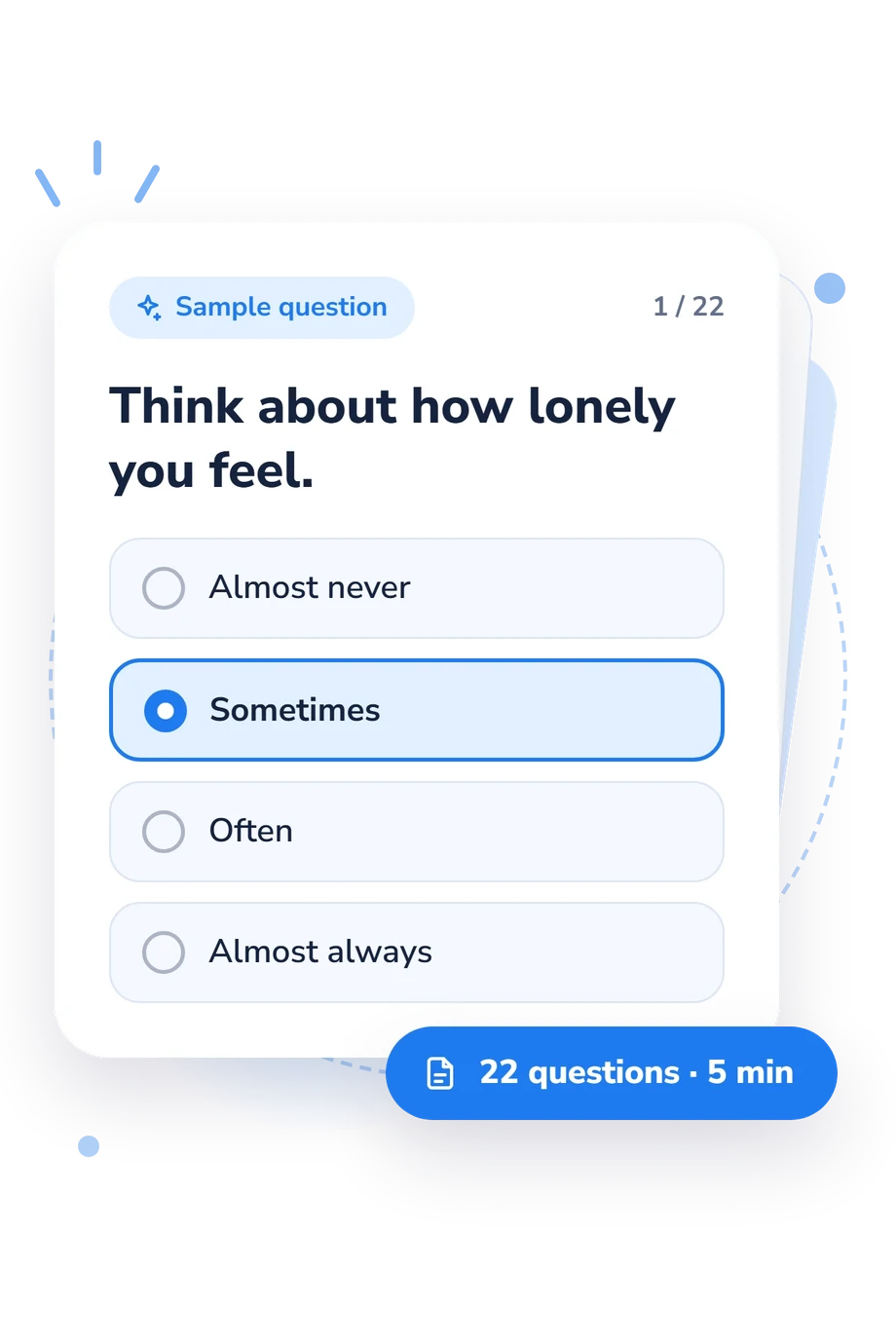
Each prompt uses four response options-Almost never, Sometimes, Often, and Almost always-to indicate how frequently the described thought or behavior occurs. The items address emotional states and mental habits, not factual knowledge. The questionnaire reports four scale scores with displayed interpretation bands, but it does not state how individual responses are weighted.
Conceptually, this rumination assessment aligns with the Ruminative Responses Scale (RRS), described by Treynor and colleagues in 2003, particularly its distinction between reflective pondering and brooding. It also relates to Nolen-Hoeksema’s response-styles account, where sustained rumination is a response to depressed mood. This questionnaire is consistent with those works, not a direct adaptation or re-standardization.
Interpretation should remain contextual. A high band suggests more frequent endorsement of relevant thoughts, but it does not show their cause, duration, functional impact, or clinical significance. No normative standardization is stated for this online version, so the bands are descriptive categories rather than population-based norms. Current mood, recall, response style, and self-awareness can shape self-report. Use the profile to notice repetitive thinking patterns and situations that strengthen or interrupt them.
- Treynor, Wendy, Richard Gonzalez, and Susan Nolen-Hoeksema. (2003). Rumination Reconsidered: A Psychometric Analysis. Cognitive Therapy and Research, 27(3), 247-259. DOI 10.1023/A:1023910315561
- Nolen-Hoeksema, Susan. (1991). Responses to Depression and Their Effects on the Duration of Depressive Episodes. Journal of Abnormal Psychology, 100(4), 569-582. DOI 10.1037/0021-843X.100.4.569
Updated: