
Impact of Event Scale–Revised (IES-R) Test
How the Scales are Structured
Who Usually Takes This Test?
See How You Compare
Below is a preview of how scores are typically distributed across each scale.
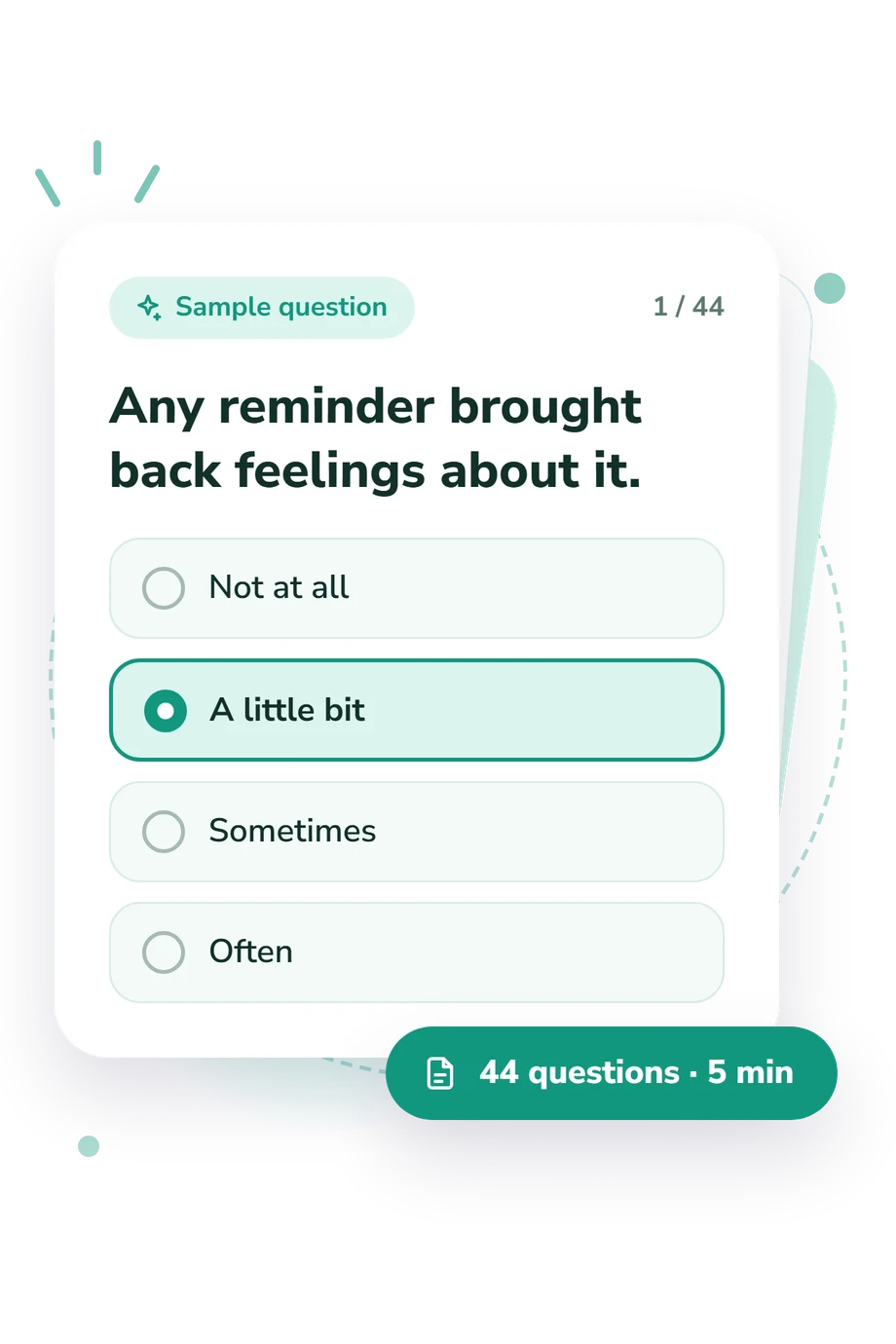
Example Questions From the Test
- Not at all
- A little bit
- Sometimes
- Often
- Never
- Rarely
- Sometimes
- Often
- Never
- Rarely
- Sometimes
- Often
Impact of Event Scale–Revised (IES-R) Test - Description and methodology of the test
For anyone trying to understand lingering reactions after a distressing or traumatic event, the Impact of Event Scale-Revised (IES-R) Test offers a structured review of post-event experiences. As a post-traumatic stress questionnaire, it focuses attention on memories, sleep, emotions, and alertness that may still feel disruptive. The result organizes these reactions into a readable profile for personal reflection.
What This Assessment Measures
This IES-R assessment examines current reactions to reminders of a distressing event. It covers re-experiencing, avoidance, numbing, sleep disruption, irritability, concentration, startle, vigilance, and physical distress. The profile shows which response patterns are most prominent. The result is organized into three symptom dimensions and one overall impact score:
- Hyperarousal (0-35) measures irritability, vigilance, and concentration difficulty; its band is Low 0-11, Moderate 12-23, or High 24-35.
- Avoidance (0-40) measures distancing from event-related thoughts, feelings, and situations; its band is Low 0-13, Moderate 14-26, or High 27-40.
- Intrusion (0-35) measures involuntary memories, dreams, images, and reminders; its band is Low 0-11, Moderate 12-23, or High 24-35.
- Impact of Event Scale (0-110) measures overall posttraumatic stress reactions and psychological impact; its band is Low impact 0-36, Moderate impact 37-73, or High impact 74-110.
Methodology and Evidence Base
The questionnaire presents statements about reactions to an event and uses graded frequency or intensity options, including not at all, rarely, sometimes, and often. The questionnaire produces four displayed scores: three component scale scores and one overall score; higher totals indicate more pronounced reported reactions, while displayed bands describe the ranges for this version.
The questionnaire is conceptually consistent with the published IES-R described by Weiss and Marmar (1997), while the cited instrument and research do not themselves validate this online presentation. The published IES-R separates intrusion, avoidance, and hyperarousal, allowing the trauma response scale to show whether distress centers on re-experiencing, withdrawal, or heightened activation.
Research by Creamer, Bell, and Failla (2003) examined psychometric properties of the published IES-R. That evidence supports the relevance of its construct and subscales, but does not establish separate norms or validation for this online presentation. This version is best read as a structured self-report profile: current mood, memory, self-awareness, and willingness to disclose can affect answers, so interpretation should consider the person’s circumstances and broader assessment.
- Weiss, D. S., & Marmar, C. R. (1997). The Impact of Event Scale-Revised. In J. P. Wilson & T. M. Keane (Eds.), Assessing Psychological Trauma and PTSD: A Practitioner’s Handbook (pp. 399-411). New York: Guilford Press.
- Creamer, M., Bell, R., & Failla, S. (2003). Psychometric properties of the Impact of Event Scale-Revised. Behaviour Research and Therapy, 41(12), 1489-1496. 10.1016/j.brat.2003.07.010
- Horowitz, M. J., Wilner, N., & Alvarez, W. (1979). Impact of Event Scale: A measure of subjective stress. Psychosomatic Medicine, 41(3), 209-218. 10.1097/00006842-197905000-00004
Updated: