
Preschool Anxiety Scale (PAS) Test
How the Scales are Structured
Who Usually Takes This Test?
See How You Compare
Below is a preview of how scores are typically distributed across each scale.
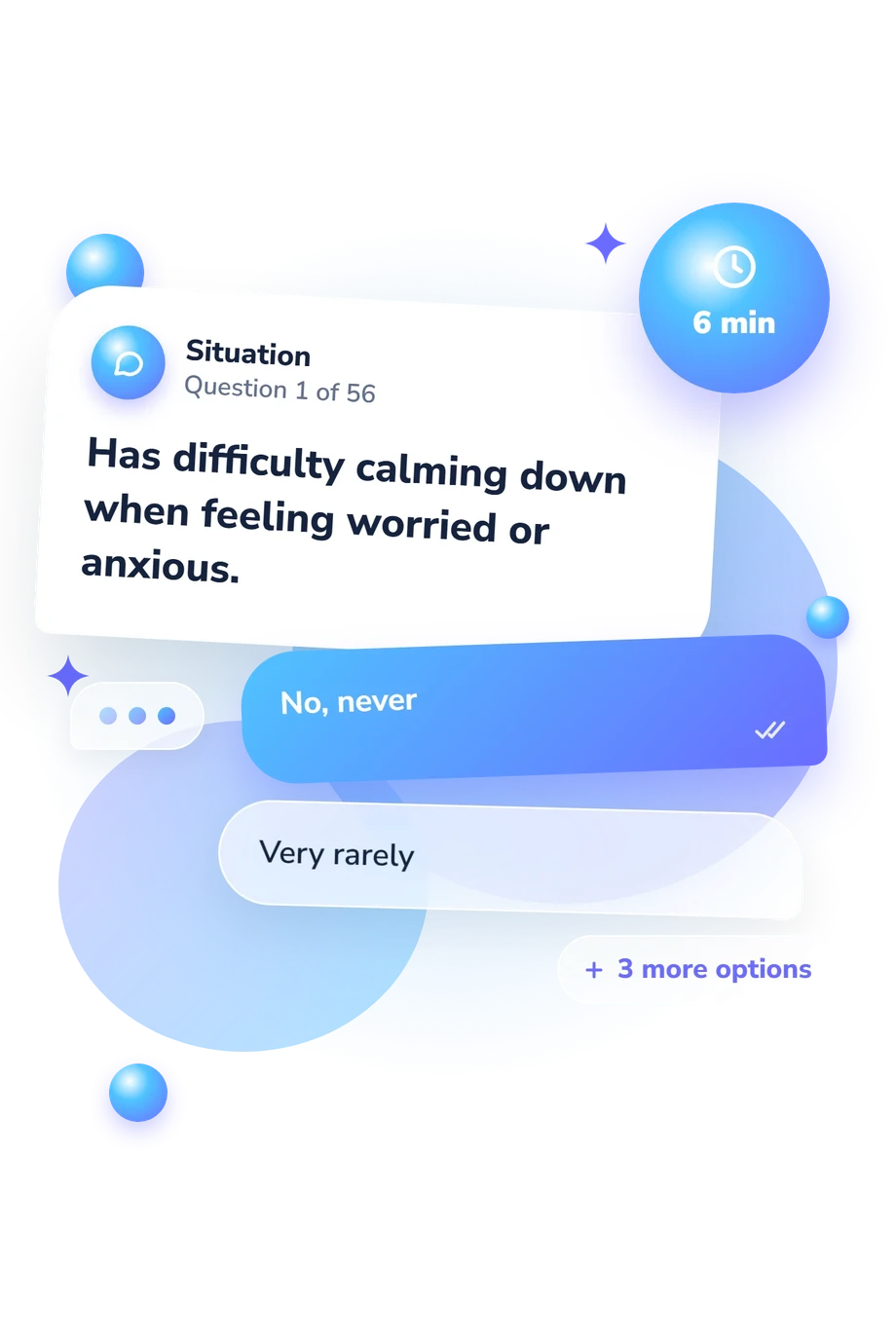
Example Questions From the Test
- No, never
- Very rarely
- Sometimes
- Quite often
- Yes, almost always
- No, never
- Very rarely
- Sometimes
- Quite often
- Yes, almost always
- No, never
- Very rarely
- Sometimes
- Quite often
- Yes, almost always
Preschool Anxiety Scale (PAS) Test - Description and methodology of the test
Parents, caregivers, and professionals who want to organize observations of a young child’s worries may use the Preschool Anxiety Scale (PAS) Test as a structured starting point. This preschool anxiety questionnaire organizes adult observations across separation, social contact, sleep, health fears, and repeated checking, helping them examine patterns in daily life.
What This Assessment Explores
The questions cover both observable behavior and internal experiences rather than asking a child to explain an abstract feeling. An adult rates anxiety symptoms in preschool children by noting worry, avoidance, distress, reassurance seeking, fears, and repetitive thoughts or actions, including signs observed or experiences reported by the child.
Together, the displayed result types describe these areas:
- Separation Anxiety (0-20) shows distress during caregiver separation; Low 0-5, Elevated 6-20.
- Obsessive-Compulsive Symptoms (0-20) shows intrusive thoughts or repetition; Low 0-3, Elevated 4-20.
- Social Anxiety (0-24) shows social discomfort; Low 0-8, Elevated 9-24.
- Generalized Anxiety (0-20) shows persistent worry; Low 0-4.8, Elevated 4.9-20.
- General Anxiety Level (0-112) shows overall anxiety severity; Low 0-5, Elevated 6-29, and High 30-112.
- Fear of Physical Injury (0-28) shows concern about injury or illness; Low 0-10, Elevated 11-28.
Methodology and Scientific Basis
Items sample preschool, bedtime, groups, unfamiliar people, weather, animals, illness, and safety. Their themes organize worries into patterns rather than treating every concern as identical.
Each statement uses five ordered choices, from never or not true at all to almost always. Wording varies, but the caregiver indicates how often the behavior occurs. The result screen presents scale scores with catalogue level labels.
The principal reference is the published Preschool Anxiety Scale, an instrument for organizing anxiety patterns in young children. A later PAS measurement-invariance study examined its higher-order structure across several demographic and contextual groups in England. The online child anxiety questionnaire is conceptually consistent with the instrument but is not an adaptation or independently revalidated version; the original study does not validate this implementation.
Results are best read as tendencies: a higher area identifies where attention may be useful, while a lower area does not prove absence. The displayed bands are catalogue labels; the profile should be considered alongside broader context and clinician evaluation when concerns persist. Adult recall and observer differences can affect answers.
- Spence, Susan H., Ronald M. Rapee, Casey McDonald, and Michelle Ingram. "The structure of anxiety symptoms among preschoolers." Behaviour Research and Therapy 39(11) (2001): 1293-1316. 10.1016/S0005-7967(00)00098-X
- Zhou, Siyu, Cathy Creswell, Susan H. Spence, and Tessa Reardon. "Measurement invariance of the higher-order model of Preschool Anxiety Scale (PAS) across child age, gender, parental anxiety, and pandemic period in England." Psychological Assessment 36(9) (2024): 526-537. 10.1037/pas0001325
Updated: