
Connor-Davidson Resilience Scale (CD-RISC) Test
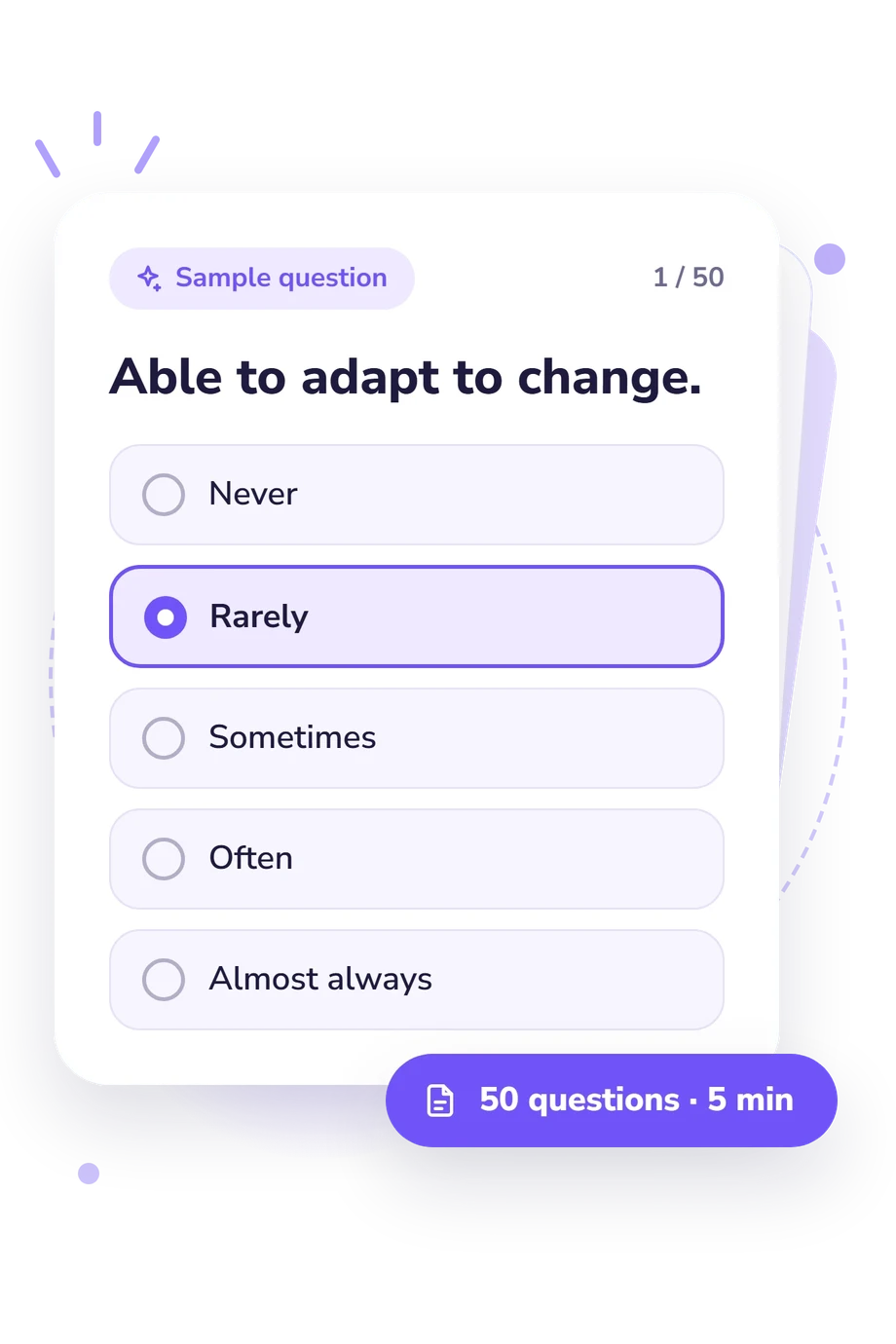
How the Scales are Structured
Who Usually Takes This Test?
See How You Compare
Below is a preview of how scores are typically distributed across each scale.
Example Questions From the Test
- Never
- Rarely
- Sometimes
- Often
- Almost always
- Never
- Rarely
- Sometimes
- Often
- Almost always
- Never
- Rarely
- Sometimes
- Often
- Almost always
Connor-Davidson Resilience Scale (CD-RISC) Test - Description and methodology of the test
People considering personal development, coaching, or a conversation about coping may use this resilience test as a structured self-reflection exercise. The Connor-Davidson Resilience Scale (CD-RISC) Test gives the respondent a framework for considering whether its themes fit their experience. The result can help organize reflection and identify topics worth exploring further. It is intended for anyone interested in understanding these tendencies.
What This Assessment Explores
Resilience is treated here as the ability to adapt, cope with stress, persist through obstacles, use support, and recover after hardship. Items also touch emotional control, focus under pressure, meaning, and perspective. As a resilience assessment, the result describes a broad coping pattern, not a single mood.
The main themes represented by the questions are:
- Adaptability and recovery show how a respondent adjusts and regains momentum after setbacks.
- Persistence and agency indicate effort, initiative, confidence, and continued goal-directed action.
- Emotional steadiness reflects handling painful feelings, pressure, fear, anger, and discouragement.
- Relationships and meaning describe how support, purpose, faith, humor, and perspective may aid coping.
Results are shown on the Resilience scale from 0 to 100, with higher scores indicating greater resilience. Averages can differ between community and clinical populations.
Methodology and Scientific Basis
Each statement uses a five-point response format, from Never or Not at all to Almost always. The online result is reported on that scale. This resilience questionnaire produces a structured self-report snapshot of how often the respondent recognizes these coping patterns.
The displayed bands are Low resilience (0-33), Moderate resilience (34-66), and High resilience (67-100).
The evidence base is the published Connor-Davidson Resilience Scale (CD-RISC), a research instrument assessing several related capacities. This questionnaire is conceptually consistent with that instrument, while its online presentation is distinct from the published research versions. Papini and colleagues' 2021 Rasch calibration examined the 25-item scale, and Faria Anjos and colleagues' 2019 validation study examined a Portuguese sample. These studies support the construct's research relevance, not universal interpretation of every online score.
Current stress, self-awareness, memory, and the wish to present oneself favourably can influence answers. The result can support reflection, but its score alone does not establish a diagnosis or explain the causes of difficulty.
- Connor, K. M., and Davidson, J. R. T. (2003). Development of a new resilience scale: The Connor-Davidson Resilience Scale (CD-RISC). Depression and Anxiety, 18(2), 76-82. 10.1002/da.10113
- Papini, N., Kang, M., Ryu, S., Griese, E., Wingert, T., and Herrmann, S. (2021). Rasch calibration of the 25-item Connor-Davidson Resilience Scale. Journal of Health Psychology, 26(11), 1976-1987. 10.1177/1359105320904769
- Faria Anjos, J., Heitor dos Santos, M. J., Ribeiro, M. T., and Moreira, S. (2019). Connor-Davidson Resilience Scale: Validation study in a Portuguese sample. BMJ Open, 9(6), e026836. 10.1136/bmjopen-2018-026836
Updated: