
Financial Anxiety Scale Test
How the Scales are Structured
Who Usually Takes This Test?
See How You Compare
Below is a preview of how scores are typically distributed across each scale.
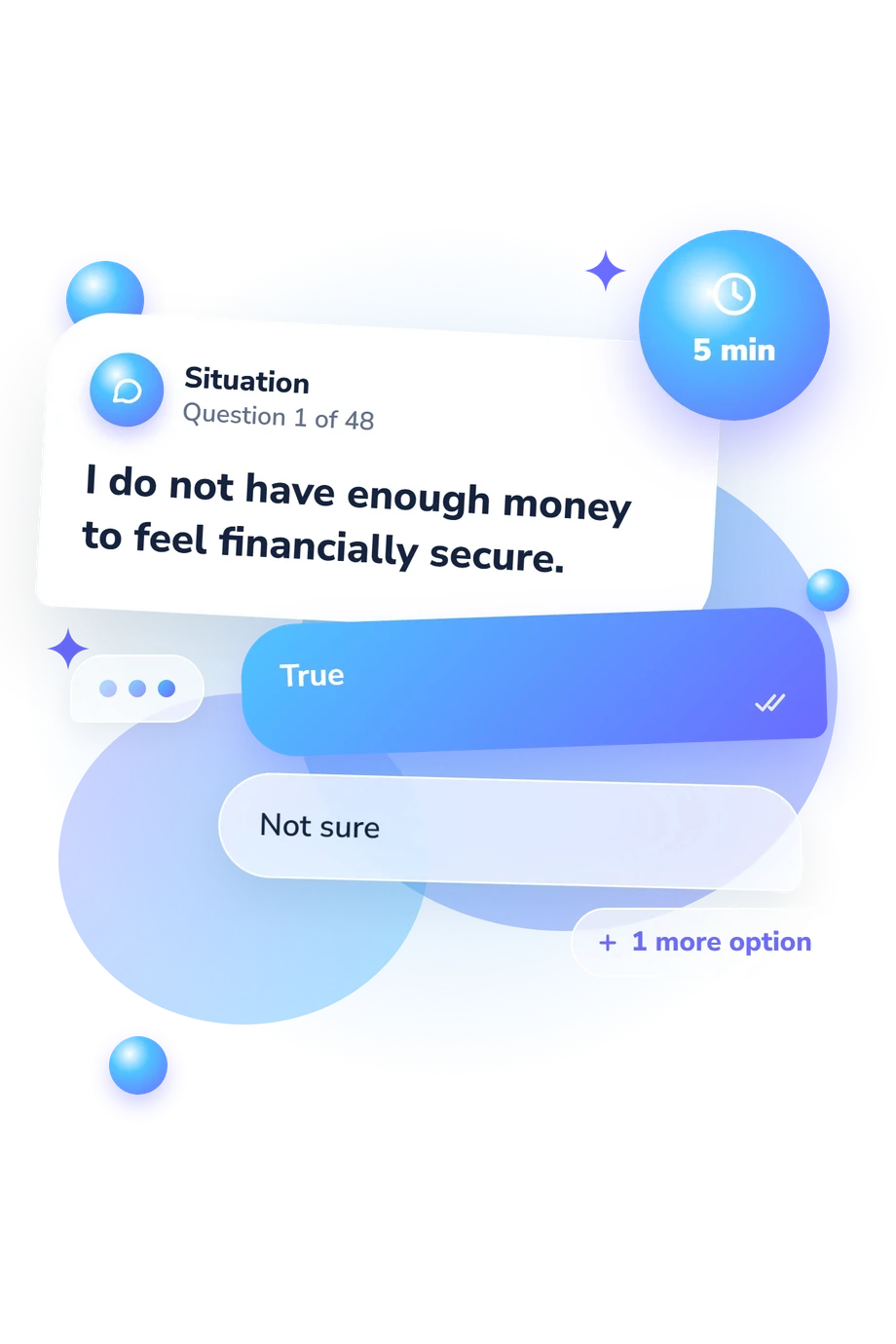
Example Questions From the Test
- True
- Not sure
- Not true
- True
- Not sure
- False
- True
- Not sure
- Not true
Financial Anxiety Scale Test - Description and methodology of the test
People preoccupied with earning, spending, saving, or keeping up financially may use the Financial Anxiety Scale Test to organize those concerns for self-reflection. It suits anyone examining how money-related thoughts relate to feelings, decisions, and interactions with other people. As a financial anxiety questionnaire, this test covers themes that can guide reflection without identifying separately scored areas.
What This Assessment Explores
The items examine worries about financial security, spending, income, comparison, dependence, and wealth. They suit people who want to see whether money concerns form a recurring pattern. In this money anxiety test, the prompts help respondents reflect on these themes without treating them as separately scored dimensions.
These four item themes contribute to one overall financial-anxiety result:
- Security worries show how shortages, job loss, and future income occupy attention.
- Spending tension reflects guilt, self-denial, or mood-related purchases.
- Comparison and status indicate whether others' income affects respect, envy, or self-worth.
- Interpersonal expectations capture dependence, generosity, indebtedness, and fear of judgment.
The sole displayed scale, Financial Anxiety Scale, ranges from 0-24. Higher scores indicate greater anxiety about financial situations; lower scores indicate a calmer attitude toward money. Bands are Low (0-6), Moderate (7-13), and High (14-24).
Methodology and Scientific Basis
Statements offer three choices: generally true, unsure, or false/not true. The result is reported on the single displayed scale, but the questionnaire does not document how individual responses contribute to it; the range alone cannot establish item weighting or how many points an answer adds.
The closest conceptual reference is the 2013 Financial Anxiety Scale developed by Archuleta and colleagues, linking financial anxiety with financial distress and satisfaction. This questionnaire is conceptually consistent with that instrument, not an adaptation of it. Furnham's work on money usage and Yamauchi and Templer's Money Attitude Scale provide conceptual comparisons for money's emotional, behavioral, and status meanings; neither validates this questionnaire, establishes its authorship, or proves it is an adaptation.
For this financial anxiety assessment, interpretation should consider current income, debt, employment, relationships, and self-report bias. Temporary stress or limited self-awareness can shift the profile. Elevated anxiety may signal concern about financial stress, while the displayed bands are interpretive categories, not population norms or clinical thresholds; read the result alongside lived circumstances.
- Archuleta, Kristy L., Anita Dale, and Scott M. Spann. "College Students and Financial Distress: Exploring Debt, Financial Satisfaction, and Financial Anxiety." Journal of Financial Counseling and Planning, 24(2), 50-62, 2013. 10.1037/t13109-000
- Furnham, Adrian. "Many Sides of the Coin: The Psychology of Money Usage." Personality and Individual Differences, 5(5), 501-509, 1984. 10.1016/0191-8869(84)90025-4
- Yamauchi, Kent T., and Donald J. Templer. "The Development of a Money Attitude Scale." Journal of Personality Assessment, 46(5), 522-528, 1982. 10.1207/s15327752jpa4605_14
Updated: