
Scratch Quiz
How the Scales are Structured
Who Usually Takes This Test?
See How You Compare
Below is a preview of how scores are typically distributed across each scale.
Example Questions From the Test
- A single variable
- A list
- A broadcast message
- A costume
- pick random 0 to 6
- pick random 1 to 5
- pick random 1 to 6
- pick random 1 to 6, then add 1
- when backdrop switches to
- when this sprite clicked
- when green flag clicked
- when I receive
Scratch Quiz - Description and methodology of the test
Designed for learners who want to judge how confidently they can read, select, and combine Scratch blocks, the Scratch Quiz offers a practical check of programming knowledge. It suits students, teachers, and independent makers who are building or troubleshooting projects. A Scratch programming assessment of this kind can show which concepts are secure and where further practice may improve project reasoning.
What This Assessment Measures
These scenarios ask you to choose how projects behave, not recall definitions. The Scratch coding questions cover events, control flow, variables, lists, operators, cloning, sensing, motion, costumes, broadcasts, pen actions, and custom blocks. They reflect decisions involved in building or debugging interactive projects.
The result is one knowledge profile, organized through this scale and thematic areas:
- Scratch Knowledge (0-16) shows how your answers reflect Scratch blocks, program flow, data, and applied project logic; Foundations to build covers 0-6, Developing knowledge covers 7-12, and Strong knowledge covers 13-16.
- Program logic and data show whether you can connect triggers and conditions with variables, lists, clones, and reusable blocks.
- Project interaction shows whether you can reason about movement, sensing, costumes, drawing, and sprite-Stage responses.
These dimensions form one result, pointing to topics worth revisiting rather than separate skill scores.
Methodology and Evidence Base
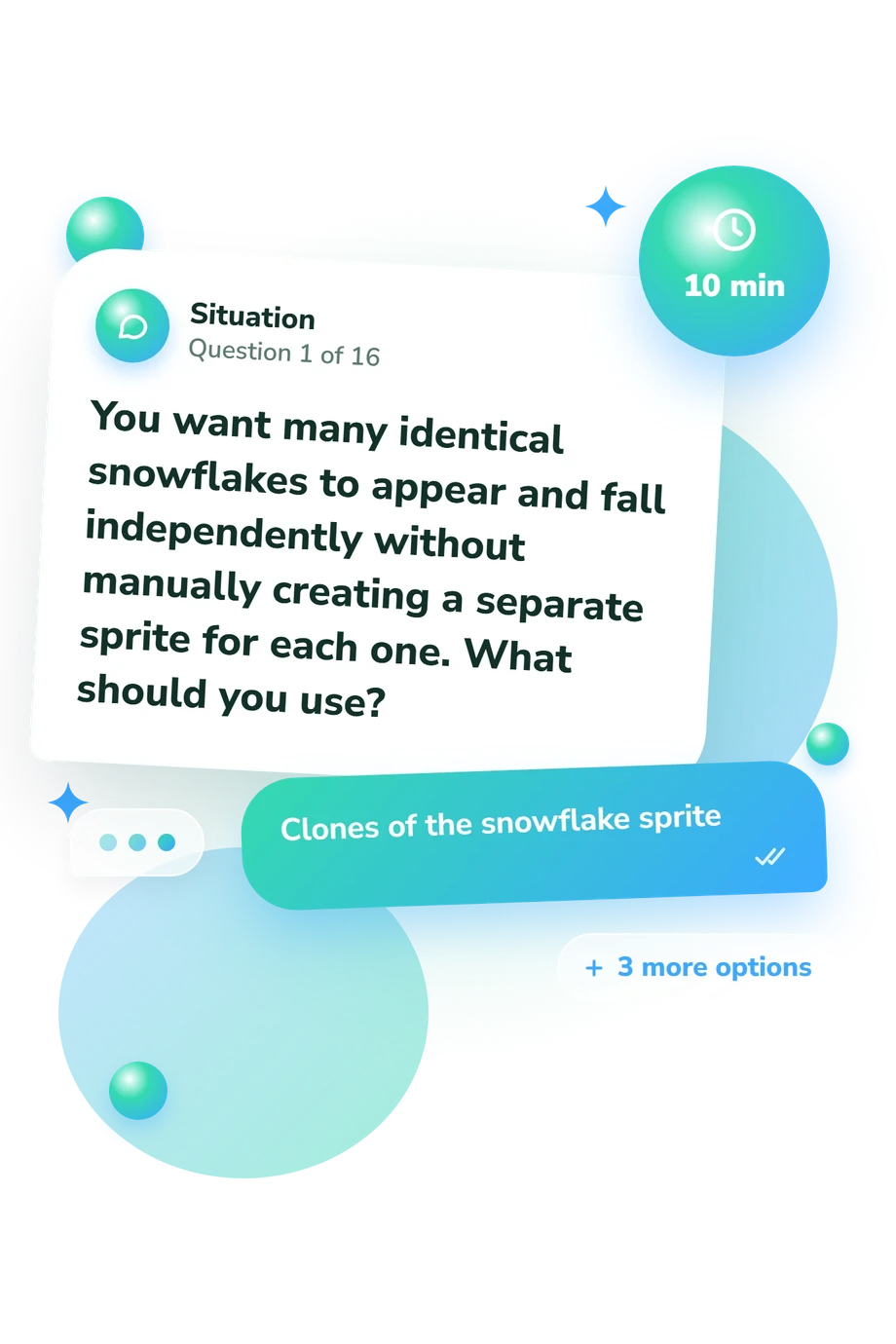
Each item presents a project situation with four answer choices. You select the block, value, event, or structure that best fits the requested behavior, making the format a selected-response achievement test of program reasoning rather than open-ended coding. The total is reported as one overall knowledge score; the questionnaire does not provide separate subscores for logic, data, or interaction.
As a Scratch knowledge test, it is conceptually consistent with the structured assessment approach described by Demir and Seferoğlu (2019), but it is not presented as an adaptation of that published instrument. Grover and Basu (2017) provide a close comparison for misconceptions involving loops, variables, and Boolean logic. Moreno-León, Robles, and Román-González (2015) offer a complementary computational-thinking perspective through automated analysis of Scratch projects; that method evaluates project artifacts, while this questionnaire evaluates selected answers.
This online questionnaire has no stated standardization, norms, reliability estimates, or independent validation. Scores can be affected by response accuracy, recent practice, and current familiarity with Scratch terminology, so interpretation is strongest when combined with project work, explanations, or teacher feedback. The result is a useful learning profile, but it should not be treated as a diagnosis.
- Demir, Ömer, & Seferoğlu, Süleyman Sadi. (2019). Developing a Scratch-based coding achievement test. Information and Learning Sciences, 120(5-6), 383-406. 10.1108/ILS-08-2018-0078
- Grover, Shuchi, & Basu, Satabdi. (2017). Measuring Student Learning in Introductory Block-Based Programming: Examining Misconceptions of Loops, Variables, and Boolean Logic. Proceedings of the 2017 ACM SIGCSE Technical Symposium on Computer Science Education, 267-272. 10.1145/3017680.3017723
- Moreno-León, Jesús, Robles, Gregorio, & Román-González, Marcos. (2015). Dr. Scratch: Automatic Analysis of Scratch Projects to Assess and Foster Computational Thinking. RED. Revista de Educación a Distancia, 46, 1-23. 10.6018/red/46/10
Updated: