
Scientific Notation Quiz
How the Scales are Structured
Who Usually Takes This Test?
See How You Compare
Below is a preview of how scores are typically distributed across each scale.
Example Questions From the Test
- Nine multiplied by ten to the eighth power
- Nine multiplied by ten to the sixth power
- Nine multiplied by ten to the sixteenth power
- Six multiplied by ten to the eighth power
- Positive 4.8 multiplied by ten to the negative sixth power
- Negative 4.8 multiplied by ten to the positive sixth power
- Negative 48 multiplied by ten to the positive fifth power
- Negative 4.8 multiplied by ten to the negative sixth power
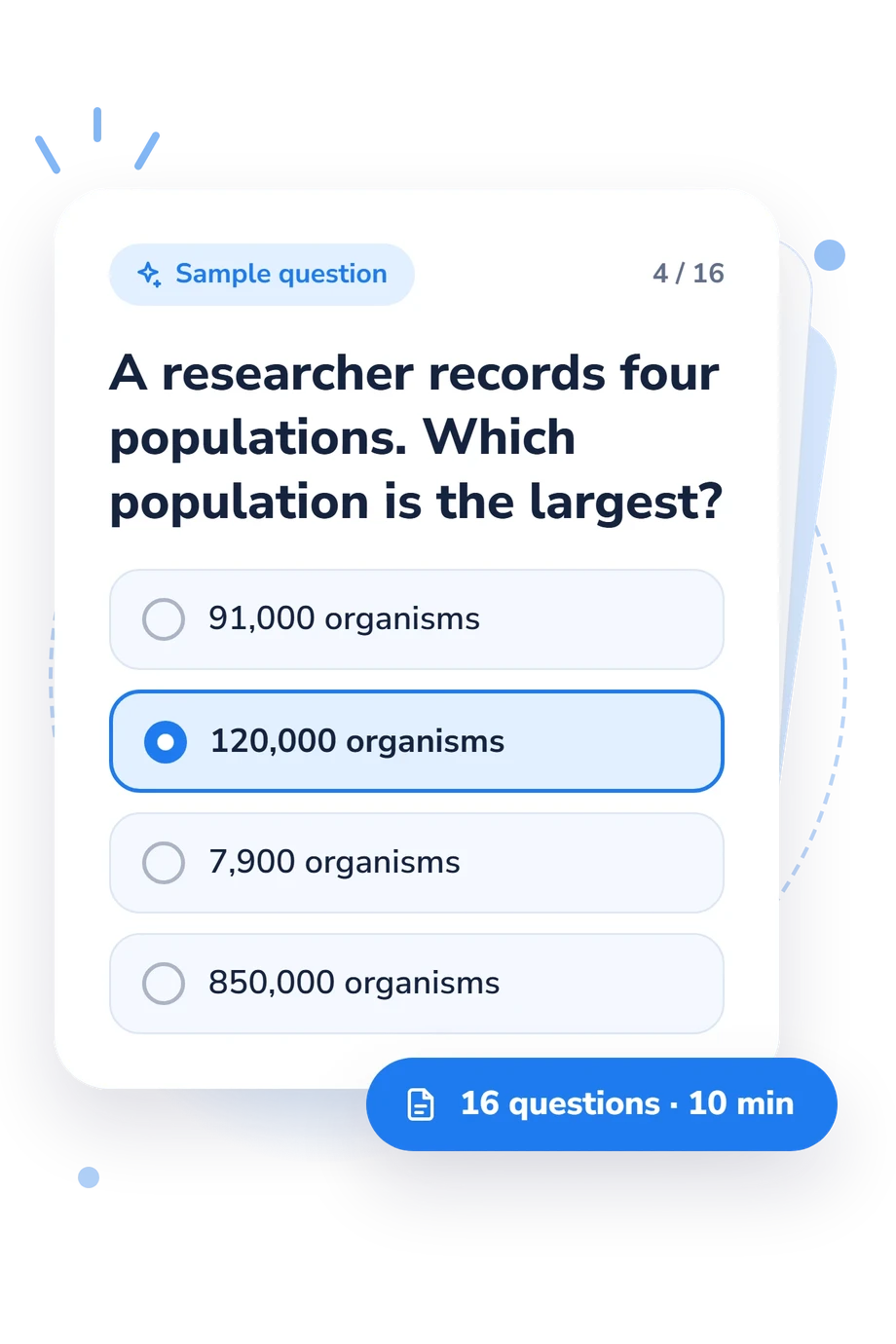
- 91,000 organisms
- 120,000 organisms
- 7,900 organisms
- 850,000 organisms
Scientific Notation Quiz - Description and methodology of the test
Students, teachers, and independent learners can use this assessment to check whether powers of ten are understood as numbers rather than memorized notation. The scientific notation quiz focuses on the decisions that matter when reading very large and very small quantities. It suits learners who want a scientific notation practice quiz for homework, revision, or classroom work; the result summarizes overall knowledge across the areas covered.
What This Assessment Measures
The questionnaire checks practical command of scientific notation: normalized form, decimal movement, exponent signs, comparisons, and operations in contexts such as measurements and populations. As a scientific notation test, it covers these content areas, while the result summarizes overall knowledge across them rather than diagnosing the source of an individual error.
The question themes cover four connected abilities:
- Recognizing normalized form shows whether the coefficient stays at least 1 and below 10.
- Converting notation shows whether exponent signs guide decimal movement correctly.
- Comparing magnitudes shows whether powers of ten order values correctly.
- Calculating with notation shows whether coefficients and exponents combine correctly.
The result uses Scientific Notation Knowledge (0-16): Foundations to build (0-6) marks core skills to practise; Developing knowledge (7-12) reflects many correct conversions with some gaps; Strong knowledge (13-16) indicates reliable work across conversions, comparisons, arithmetic, and applications.
Methodology and Evidence Base
Each item in the online questionnaire uses four answer options. The respondent selects the expression or value that correctly represents a conversion, comparison, or calculation; this scientific notation assessment records correct outcomes rather than the reasoning steps behind them. The score is the number of correct responses and is interpreted using the catalogue’s stated categories.
The questionnaire is conceptually consistent with Cangelosi et al. (2013), particularly its attention to negative signs and exponential expressions, but it is not presented as that study’s adaptation or standardized administration. Common Core Mathematics standards 8.EE.A.3-4 describe the expected use of powers of ten with real quantities.
Accordingly, the result is an educational snapshot rather than a norm-referenced score: the categories describe performance by correct-answer total, not population standing. Guessing, attention, calculator familiarity, and recent classroom exposure may influence performance, so the clearest next step is to review the rule or operation behind any missed item.
- Hacısalihoğlu Karadeniz, Mihriban, and Yasemin Çalışkan. “What Are the Misconceptions About Scientific Notation Of Very Large And Very Small Numbers?” International Journal of Educational Studies in Mathematics, vol. 10, no. 2, 2023, pp. 142-165. 10.17278/ijesim.1280683.
- Cangelosi, Richard, Silvia Madrid, Sandra Cooper, Jo Olson, and Beverly Hartter. “The Negative Sign and Exponential Expressions: Unveiling Students’ Persistent Errors and Misconceptions.” The Journal of Mathematical Behavior, vol. 32, no. 1, 2013, pp. 69-82. 10.1016/j.jmathb.2012.10.002.
- Common Core State Standards Initiative. Common Core State Standards for Mathematics. 2010. Grade 8, Expressions and Equations, standards 8.EE.A.3-4.
Updated: