
Science Grade 9 Quiz
How the Scales are Structured
Who Usually Takes This Test?
See How You Compare
Below is a preview of how scores are typically distributed across each scale.
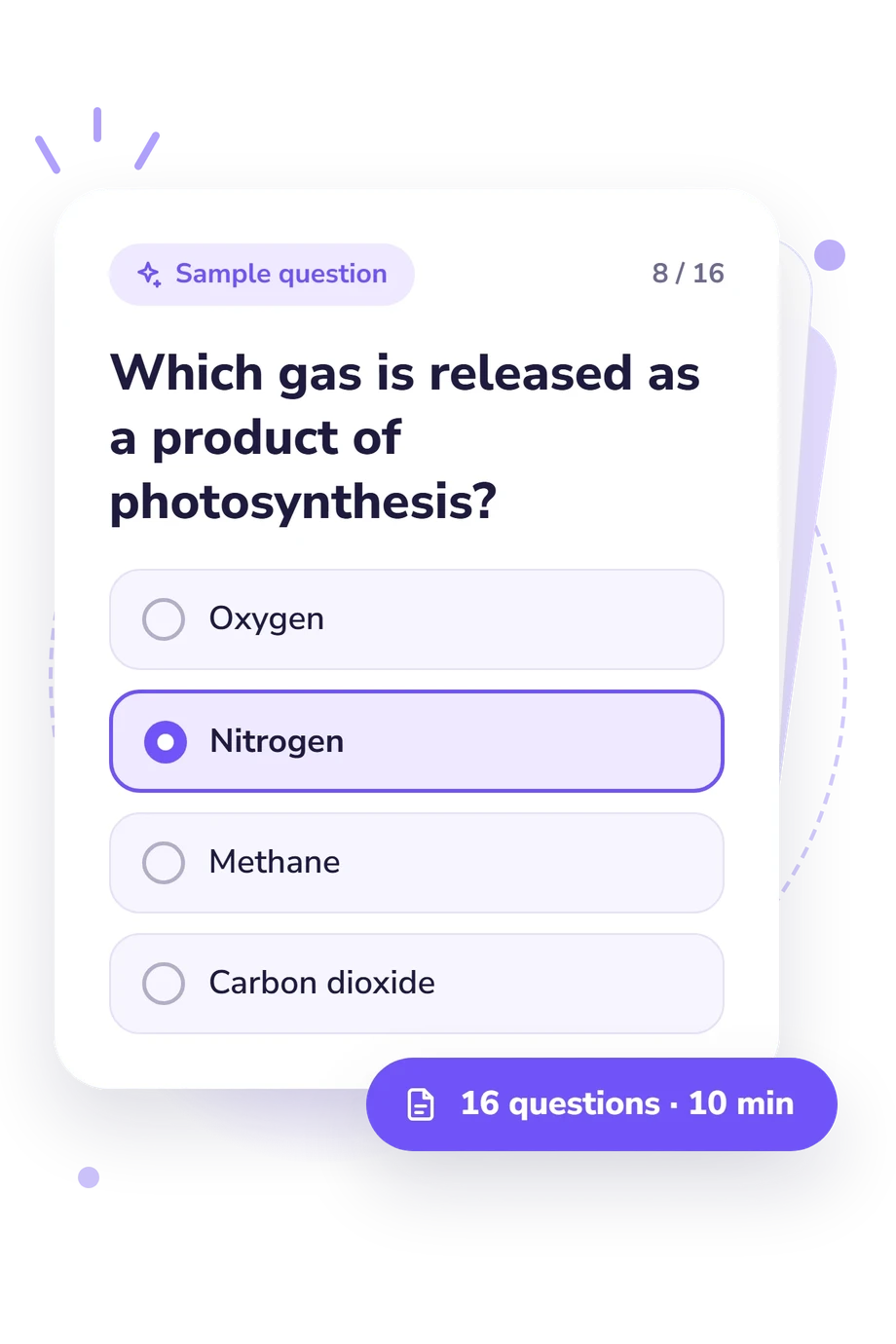
Example Questions From the Test
- A capillary
- A venule
- An artery
- A vein
- Nucleus
- Ribosome
- Mitochondrion
- Cell membrane
- Natural selection
- Meiosis
- Fertilization
- Mitosis
Science Grade 9 Quiz - Description and methodology of the test
Students who want a focused check of school-level biology can use this assessment, the Science 9 Quiz, to review how well they connect facts with biological processes. It suits learners revising classroom material, teachers seeking a quick knowledge snapshot, and anyone building confidence before further study. Designed for learners working at Grade 9 level, this biology knowledge quiz turns familiar topics into a concise self-check rather than a broad judgment of scientific ability.
What This Assessment Explores
The questions test recognition of biological structures, explanation of processes, and application to classroom situations. Items move from identifying an artery or ribosome to predicting water movement, population limits, inheritance, and ecological effects.
For classroom review, the assessment works as a science quiz for class 9 and covers these content areas:
- Cell biology shows how well you connect structures with cellular functions.
- Human biology measures understanding of circulation, lungs, exercise, and gas exchange.
- Plant biology examines photosynthesis, stomata, water balance, and environmental response.
- Ecology covers food webs, decomposers, carrying capacity, and bioaccumulation.
- Genetics and change tests inheritance, mutation, selection, and antibiotic resistance.
The test produces one aggregate biology-knowledge score. The Grade 9 Biology Knowledge scale runs from 0-16: Foundational is 0-6, Developing is 7-12, and Strong is 13-16. The bands describe this set of knowledge questions, not overall science ability.
Methodology and Evidence Base
Each item in this biology knowledge test presents four answer choices and one best answer. One point is awarded for each correct response, contributing to the overall result before it is placed in its stated band. This is a knowledge score, not a measure of motivation or general intelligence.
Its content is appropriate to a 9th grade biology quiz and conceptually consistent with the High School Biology Concept Inventory, a published instrument for assessing biological content knowledge. Its educational framing also fits the National Research Council’s K-12 science framework and the Next Generation Science Standards, especially their focus on disciplinary core ideas, crosscutting concepts, and applying knowledge to phenomena.
Interpret the result as a broad indicator of performance across the biology content sampled here, rather than as separate topic scores. A higher or lower aggregate score may show whether broad review is useful, but it does not by itself identify a specific concept for reinforcement. Scores can reflect prior revision, memory, guessing, and current context, so use the result as a starting point for study.
- Malone, Kathy L., William J. Boone, Andria Stammen, Anita Schuchardt, Lin Ding, and Zakee Sabree. "Construction and Evaluation of an Instrument to Measure High School Students Biological Content Knowledge." EURASIA Journal of Mathematics, Science and Technology Education 17, no. 12 (2021): em2048. 10.29333/ejmste/11376
- National Research Council. Next Generation Science Standards: For States, By States. Washington, DC: National Academies Press, 2013. 10.17226/18290
- National Research Council. A Framework for K-12 Science Education: Practices, Crosscutting Concepts, and Core Ideas. Washington, DC: National Academies Press, 2012. 10.17226/13165
Updated: