
SAT Vocab Quiz
How the Scales are Structured
Who Usually Takes This Test?
See How You Compare
Below is a preview of how scores are typically distributed across each scale.
Example Questions From the Test
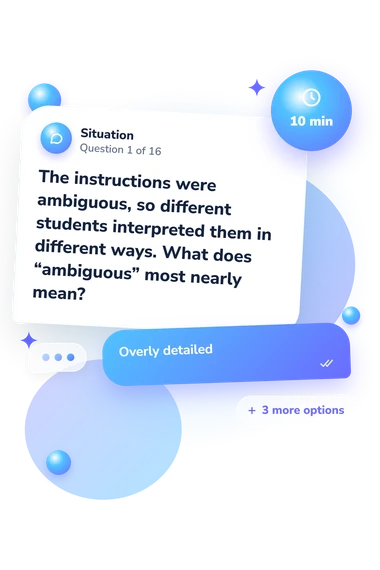
- Overly detailed
- Difficult to carry out physically
- Based on outdated information
- Open to more than one interpretation
- It contradicted the account with stronger evidence.
- It summarized the account more briefly.
- It provided support for the account.
- It revealed who had requested the account.
- She was reluctant to speak openly about it.
- She was unable to remember the reason.
- She was eager to correct a false account.
- She considered the reason unimportant.
SAT Vocab Quiz - Description and methodology of the test
Students who want to strengthen academic reading can use the SAT Vocab Quiz to examine how accurately they recognize challenging words in context. It suits learners preparing for school or college reading and anyone seeking a focused SAT vocabulary quiz to identify study priorities. The result describes vocabulary knowledge, not overall intelligence, reading ability, or official SAT performance.
What This Assessment Explores
These questions focus on academic vocabulary whose meaning depends on context rather than a dictionary definition. In practice, this SAT words quiz asks you to distinguish close meanings, infer a term’s function, and use surrounding evidence to choose the best interpretation. The items sample several abilities:
- Recognizing meaning in context shows how well you connect a target word with its sentence.
- Handling nuance shows whether you can separate near-synonyms such as cautious, uncertain, and noncommittal.
- Interpreting academic relationships measures understanding of words that signal support, contrast, limitation, or combination.
- Applying vocabulary to ideas reflects whether you can use meaning while reading arguments, explanations, and evidence.
Together, these themes help identify what to review. A lower result may point toward practice with context clues and word families, while a higher result suggests steadier access to academic language across the situations represented here.
Methodology and Evidence Base
Each item places a target word in a sentence or short passage and offers four choices. Selecting the meaning or function that best fits the context tests word knowledge alongside reading, including attention to nearby clues and relationships among claims and evidence.
The scale shown is SAT Vocabulary Knowledge (0-16), with one point for each correct answer. Results fall into Foundations (0-6), Developing (7-12), or Strong (13-16). These catalogue-defined educational bands are not an official SAT scale, and the result does not predict an SAT score.
The evidence base is conceptual, not a claim that this questionnaire is a published adaptation. It is conceptually consistent with Academic Vocabulary Test (Lawrence et al., 2022), which relates academic-vocabulary item features to reading proficiency; this quiz is not that instrument. Coxhead (2000) supports its emphasis on academic words across texts, and College Board (2024) describes context, inference, and evidence evaluation in SAT-related reading.
Reviewing missed items in complete sentences can make this SAT vocab words quiz more useful. Prior exposure and attention can affect performance. As a quiz game for SAT vocab, it may make practice more engaging, but it does not measure the full range of reading skill.
- Joshua F. Lawrence, Rebecca Knoph, Autumn McIlraith, Paulina A. Kulesz, and David J. Francis. (2022). Reading Comprehension and Academic Vocabulary: Exploring Relations of Item Features and Reading Proficiency. Reading Research Quarterly, 57(2), 669-690. 10.1002/rrq.434
- College Board. (2024). The Cognitively Complex Thinking Required by Select Digital SAT Suite Questions. New York: College Board.
- Averil Coxhead. (2000). A New Academic Word List. TESOL Quarterly, 34(2), 213-238. 10.2307/3587951