
Romeo and Juliet Act 4 Quiz
How the Scales are Structured
Who Usually Takes This Test?
See How You Compare
Below is a preview of how scores are typically distributed across each scale.
Example Questions From the Test
- She wants to write a public confession for Paris.
- She needs privacy to drink the potion without interference.
- She hopes Romeo will secretly visit her chamber.
- She plans to escape through the window during the night.
- They refuse to play because the household is in mourning.
- They replace it with a wedding song requested by Paris.
- They leave immediately because Capulet refuses to pay them.
- They play it as the funeral procession leaves the house.
- Send the Nurse to Mantua with a message for Romeo.
- Hide in the Capulet tomb until Friar Laurence arrives.
- Tell her parents that she is already married to Romeo.
- Return home, appear cheerful, and agree to marry Paris.
Romeo and Juliet Act 4 Quiz - Description and methodology of the test
Students preparing for discussion or revisiting the tragedy can use the Romeo and Juliet Act 4 Quiz to examine how private strategy becomes public catastrophe. As an Act IV quiz on Romeo and Juliet, it connects Shakespeare’s dramatic choices across the act rather than asking readers to remember isolated plot points.
What This Assessment Explores
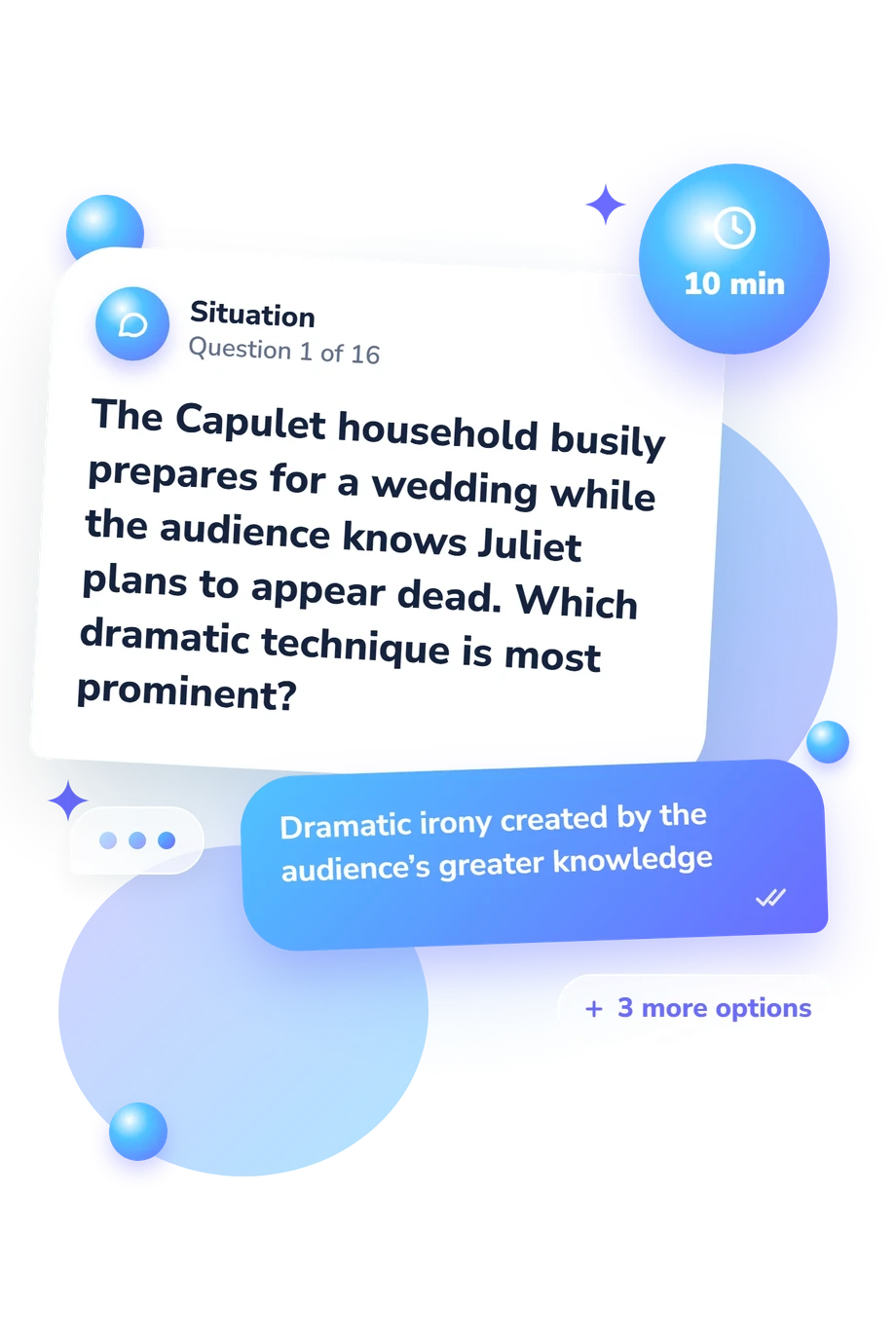
Act 4 turns a private plan into a public household crisis. The assessment traces Capulet’s haste, Juliet’s secrecy, Friar Laurence’s plan, and the family’s mistaken reading of her condition. It examines dramatic irony, appearance versus reality, death imagery, verbal ambiguity, and the reversal of wedding into funeral ritual.
Rather than asking only who did what, this multiple-choice quiz on Act 4 of Romeo and Juliet connects each scene or speech to its strongest explanation. The result reflects recall plus attention to sequence, motive, and dramatic effect.
The Romeo and Juliet Act 4 Knowledge scale runs from 0 to 16, with these bands:
- Foundations to revisit (0-6) marks sequence, motives, and details needing review.
- Developing understanding (7-12) shows plot knowledge with some language or thematic links to revisit.
- Strong command (13-16) reflects secure understanding of events, irony, imagery, and choices.
Methodology and Evidence Base
Each prompt presents four answer choices and asks the reader to identify an event, motive, technique, or interpretation. Across these Act 4 questions, performance depends on linking details to sequence, character intention, and dramatic effect; guessing or partial recall can change the total.
The literary anchor is Shakespeare’s Act 4, which supplies the events, language, imagery, and dramatic structure examined here. Jeremy L. Smith’s study of the musicians’ scene examines its interplay of music, celebration, mourning, and rhetorical contrast. The questionnaire is conceptually consistent with these sources, but it is an online knowledge check rather than a published adaptation or standardized version of either work.
The displayed bands are descriptive levels; no standardized norms or reliability estimate are established for this online questionnaire. The result is therefore best read as a focused revision profile. Familiarity with a particular edition, prior study, attention to wording, and guessing may affect performance, so the score captures this selection of Act 4 knowledge rather than the whole of a reader’s literary understanding.
- Shakespeare, William. The Tragedy of Romeo and Juliet. Edited by Barbara A. Mowat and Paul Werstine. The New Folger Library Shakespeare. Washington Square Press, 2004.
- Smith, Jeremy L. "What Do Shakespearean Musicians Think? Complementary Rhetorical Devices in Romeo and Juliet and Byrd’s O that most rare breast." Journal of Musicological Research, vol. 36, no. 4, 2017, pp. 336-363. 10.1080/01411896.2017.1379820
Updated: