
Reproductive System Quiz
How the Scales are Structured
Who Usually Takes This Test?
See How You Compare
Below is a preview of how scores are typically distributed across each scale.
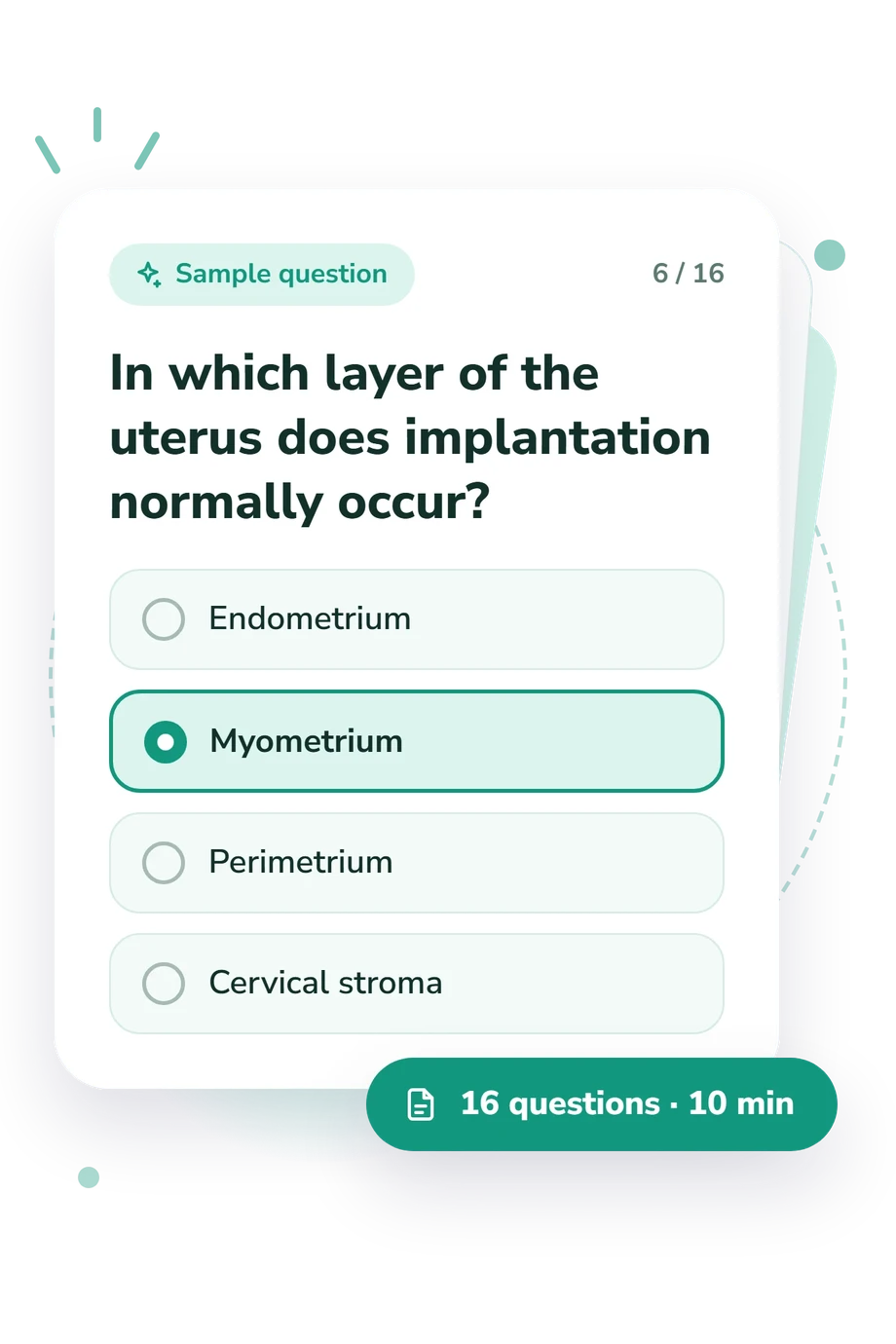
Example Questions From the Test
- Inside the ovary
- In the ampulla of the uterine tube
- Within the uterine cavity
- Within the cervical canal
- Ovary → uterine tube → uterus
- Uterus → uterine tube → ovary
- Ovary → uterus → uterine tube
- Uterine tube → ovary → cervix
- Movement from the endometrium into the cervix
- Movement from the cervix into the vagina
- Movement from the uterus back into the ovary
- Movement through the uterine tube into the uterine cavity
Reproductive System Quiz - Description and methodology of the test
People who want to check their grasp of basic human biology can use this reproductive system quiz to review how organs, ducts, hormones, and reproductive events fit together. As a reproductive anatomy quiz, it is designed for learners, educators, and curious adults, with questions checking how structures, pathways, and functions connect.
What This Assessment Explores
Questions examine functional anatomy and basic physiology across both reproductive systems, asking how structures connect and what they do. They test more than isolated naming: you may follow an oocyte, identify the implantation layer, connect glands with secretions, or relate hormones to reproductive events. As a reproductive system anatomy quiz, this questionnaire focuses on connections among structures and functions.
The question themes cover four areas:
- Structure and location show whether you can identify organs and tissues in context.
- Transport pathways show whether you can trace oocytes, sperm, and fluids through relevant structures.
- Hormonal and cyclical function shows whether you can connect ovulation, progesterone, implantation, and menstruation.
- Applied anatomy shows whether you can use knowledge in short clinical-style situations.
The combined result is Reproductive System Knowledge (0-16): Foundation to build (0-6), Developing knowledge (7-12), or Strong knowledge (13-16).
Methodology and Evidence Base
Each item presents one best answer among four options, making the questionnaire a reproductive organs quiz with a structured knowledge-check format. The displayed educational result summarizes performance on the tested content. This is an educational score, not an assessment of fertility or reproductive health, and it is not presented as a standardized clinical measure.
The content is conceptually consistent with Ampatzidis et al. (2021), which examined knowledge of reproductive physiology and anatomy; this questionnaire is not presented as an adaptation of that study. Betts et al. (2022) provide a standard anatomy-and-physiology framework for the structures, pathways, and functions addressed here.
In practice, this quiz about reproductive system concepts can help identify misunderstandings, but responses are self-reported and scores depend on attention, wording interpretation, prior instruction, recall, and test-taking conditions. Bertozzi et al. (2021) highlight the difficulty of quantifying knowledge change in educational settings, so one result cannot establish lasting learning. Used alongside study materials, the score can guide broad review of reproductive organs and biology.
- Ampatzidis, G., Georgakopoulou, D., & Kapsi, G. (2021). Clitoris, the unknown: what do postgraduate students of educational sciences know about reproductive physiology and anatomy? Journal of Biological Education, 55(3), 254-263. 10.1080/00219266.2019.1679658
- Bertozzi, E., Bertozzi-Villa, A., Padankatti, S., & Sridhar, A. (2021). Outcomes assessment pitfalls: challenges to quantifying knowledge gain in a sex education game. Gates Open Research, 4, 73. 10.12688/gatesopenres.13129.3
- Betts, J. G., Young, K. A., Wise, J. A., Johnson, E., Poe, B., Kruse, D. H., Korol, O., Johnson, J. E., Womble, M., & DeSaix, P. (2022). Anatomy and Physiology 2e. Houston, TX: OpenStax.
Updated: