
Psychology 100 Quiz
How the Scales are Structured
Who Usually Takes This Test?
See How You Compare
Below is a preview of how scores are typically distributed across each scale.
Example Questions From the Test
- Retroactive interference
- State-dependent memory
- Proactive interference
- The spacing effect
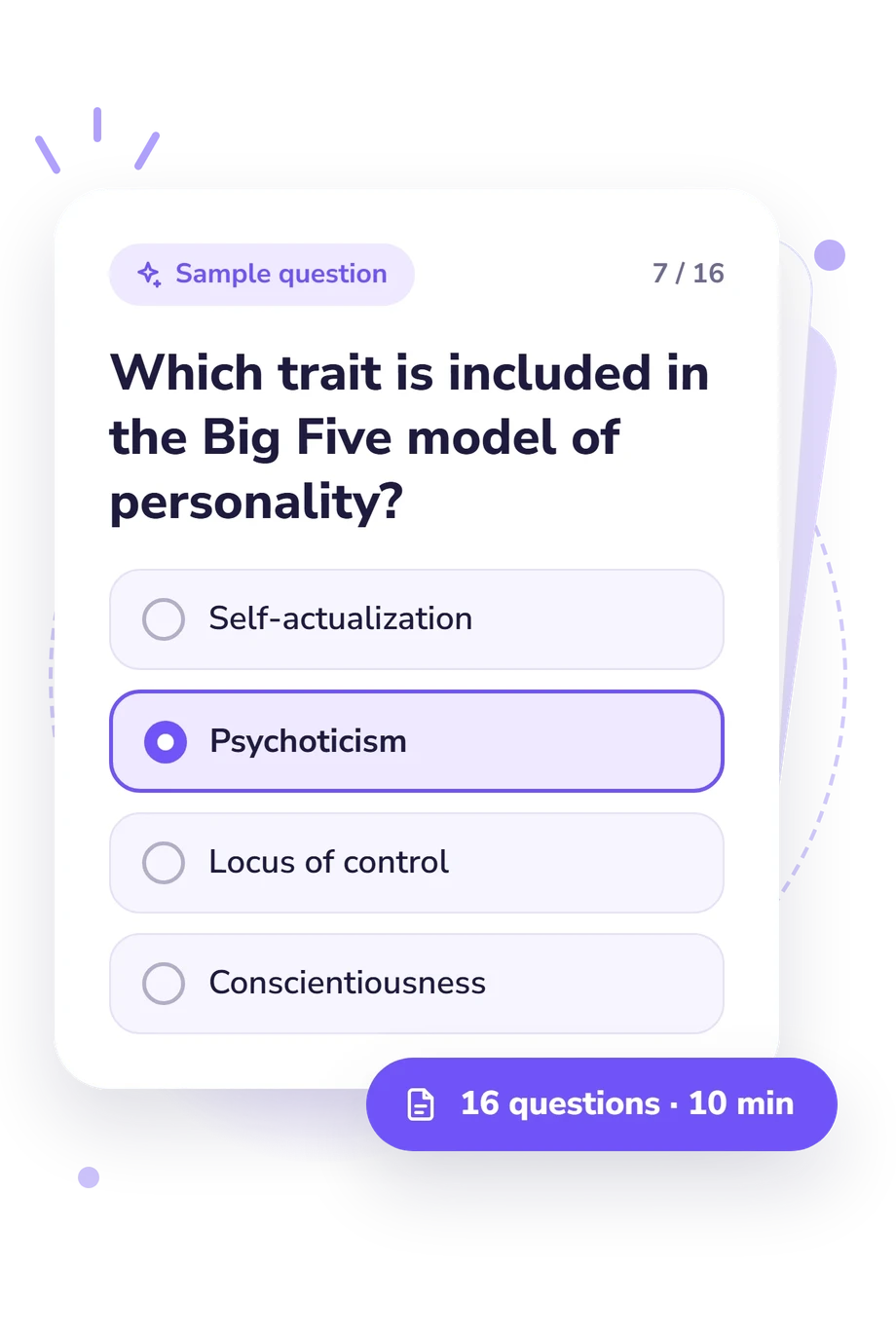
- Self-actualization
- Psychoticism
- Locus of control
- Conscientiousness
- Fixed interval
- Variable ratio
- Variable interval
- Fixed ratio
Psychology 100 Quiz - Description and methodology of the test
Students who want to check their command of foundational psychology concepts can use the Psych 100 Quiz 1 as a focused knowledge check rather than a measure of personality or mental health. This psychology 100 quiz is suited to learners revising introductory material, preparing for coursework, or checking overall performance across the introductory collection. The result offers a compact interpretation of performance across the tested material.
What This Assessment Explores
The questions sample major introductory domains through short scenarios and definition-based choices. They ask the respondent to distinguish related concepts, interpret a basic research finding, and apply a term to a familiar example. As an introductory psychology quiz, it suits students and independent learners reviewing first-course material.
The questions cover recurring content areas, while one displayed scale, Psychology 100 Knowledge, produces the result:
- It runs from 0-16 and summarizes performance across the collection: Emerging foundation (0-6), Developing foundation (7-12), and Strong foundation (13-16).
- Research methods and learning cover correlation, causation, random assignment, operational definitions, conditioning, reinforcement, and interference.
- Memory, development, and biological foundations cover working memory, sensory adaptation, object permanence, and neuron structures.
- Personality and social behavior cover traits, conformity, the bystander effect, and attribution bias.
Methodology and Scientific Basis
Methodologically, the questionnaire uses four-option multiple-choice items. A respondent selects the alternative that best fits a concept, scenario or research conclusion, and the score summarizes performance across the answers. The format tests recognition and application rather than extended written explanation.
The item content is conceptually consistent with the Basic Psychology Knowledge Test (Peter et al., 2015) and the Introductory Psychology Knowledge Inventory (Solomon et al., 2021), both relevant examples of introductory knowledge assessment. This questionnaire is not presented as an adaptation or standardized reproduction of either instrument. The displayed educational bands are not norms or validation results taken from those instruments.
As a psychology knowledge test, the result is best read as a snapshot of current mastery. Higher performance indicates more accurate answers to the tested concepts and scenarios, while a lower result suggests revisiting the tested material rather than a fixed limit on ability. Preparation, guessing, wording, language, and concentration can affect performance, and the scale is educational rather than clinical or professional. Reviewing missed concepts can make a later attempt useful, although repeated exposure may also increase familiarity with the items.
- Peter, Johannes, Nikolas Leichner, Anne-Kathrin Mayer, and Günter Krampen. “A Short Test for the Assessment of Basic Knowledge in Psychology.” Psychology Learning & Teaching, 14(3), 224-235, 2015. 10.1177/1475725715605763
- Solomon, Erin D., Julie M. Bugg, Shaina F. Rowell, Mark A. McDaniel, Regina F. Frey, and Paul S. Mattson. “Development and Validation of an Introductory Psychology Knowledge Inventory.” Scholarship of Teaching and Learning in Psychology, 7(2), 123-139, 2021. 10.1037/stl0000172
- Spielman, Rose M., William Jenkins, and Marilyn D. Lovett. Psychology 2e. OpenStax, Houston, Texas, 2020.
Updated: