
Pre-Marriage Counseling Quiz
How the Scales are Structured
Who Usually Takes This Test?
See How You Compare
Below is a preview of how scores are typically distributed across each scale.
Example Questions From the Test
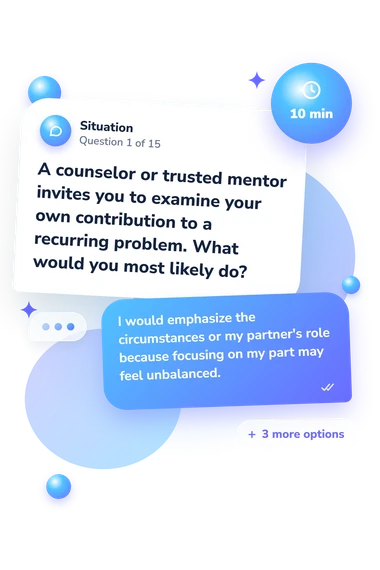
- I would emphasize the circumstances or my partner's role because focusing on my part may feel unbalanced.
- I would acknowledge a possible contribution but wait for clearer guidance before changing anything.
- I would identify one part I can influence and try a concrete change.
- I would examine my part with curiosity, choose a specific action, and review its effect without taking responsibility for everything.
- I prefer to leave the underlying pattern alone and hope circumstances change it.
- I concentrate on settling the current disagreement rather than examining the pattern.
- I mention that the conflict seems familiar, but we do not always identify a different approach.
- We identify the recurring pattern, consider each person's part, and test a specific change.
- We rarely agree on when to return, so the subject often fades without resolution.
- One of us usually restarts the conversation, although the original issue may remain unclear.
- We return to the issue and usually reach a workable short-term understanding.
- We agree when to reconnect, discuss what happened, and decide what to do differently.
Pre-Marriage Counseling Quiz - Description and methodology of the test
Couples who want a clearer starting point for conversations about married life can use this quiz before marriage to examine everyday habits before difficulties become entrenched. The pre marriage counseling quiz is intended for partners preparing to marry who want a structured way to consider communication, expectations, decisions, and openness to support. Its result highlights topics for focused conversations and practical next steps.
What This Assessment Explores
This premarital quiz examines coordination, feedback, repair, and shared planning. It is most useful when both people answer honestly and compare habits with preferred ones.
The displayed dimensions are:
- Communication & Repair (0-15) reflects direct discussion, emotional disclosure, and reconnection after conflict: Conversation barriers (0-5), Emerging repair skills (6-10), or Established dialogue (11-15).
- Growth & Support Readiness (0-15) reflects feedback, follow-through, and use of suitable support: Support barriers (0-5), Conditional openness (6-10), or Active growth stance (11-15).
- Shared Expectations & Decisions (0-15) reflects turning differences about money, family, roles, values, and the future into joint decisions: Unspoken assumptions (0-5), Partial alignment (6-10), or Deliberate partnership (11-15).
Together, bands describe discussion and decision habits, not compatibility or marital outcomes: lower bands identify barriers or unspoken areas, middle bands show developing skills, and upper bands indicate established communication, support, or planning.
Methodology and Scientific Basis
Each item presents a relationship situation with four ordered responses, moving from avoidance or defensiveness toward direct, collaborative action. Scenarios address recurring conflict, emotional impact, household responsibilities, money, family boundaries, parenting, values, counselor selection, and follow-through on agreed changes. This premarital counseling quiz focuses on observable communication and decision habits rather than personality labels.
Responses are converted into three reflective scores and named result bands. The questionnaire does not specify how many points each option contributes, so the ranges do not justify inferring a per-answer scoring rule. Results work best as conversation prompts: a lower band identifies a topic to explore, while a higher band suggests a more active or established pattern in that domain.
Conceptually, the structure is consistent with PREPARE (Fowers & Olson, 1986) and with the PREPARE-ENRICH inventories described by Fournier, Olson, and Druckman (1983). Its wording and scoring remain specific to this online questionnaire. Fawcett and colleagues (2010) place premarital education in a broader context of potentially beneficial relationship programs.
Self-report answers can shift with current stress, defensiveness, memory, and self-awareness, so the displayed bands are reflective summaries to consider alongside real conversations.
- Fowers, Blaine J., and David H. Olson. "Predicting Marital Success with PREPARE: A Predictive Validity Study." Journal of Marital and Family Therapy, vol. 12, no. 4, 1986, pp. 403-413. 10.1111/j.1752-0606.1986.tb00673.x
- Fournier, David G., David H. Olson, and Joan M. Druckman. "Assessing Marital and Premarital Relationships: The PREPARE-ENRICH Inventories." In Marriage and Family Assessment: A Sourcebook for Family Therapy, edited by E. E. Filsinger, Sage, 1983, pp. 229-250.
- Fawcett, Elizabeth B., Alan J. Hawkins, Victoria L. Blanchard, and Jason S. Carroll. "Do Premarital Education Programs Really Work? A Meta-analytic Study." Family Relations, vol. 59, no. 3, 2010, pp. 232-239. 10.1111/j.1741-3729.2010.00598.x