
Possessive Adjectives Spanish Quiz
How the Scales are Structured
Who Usually Takes This Test?
See How You Compare
Below is a preview of how scores are typically distributed across each scale.
Example Questions From the Test
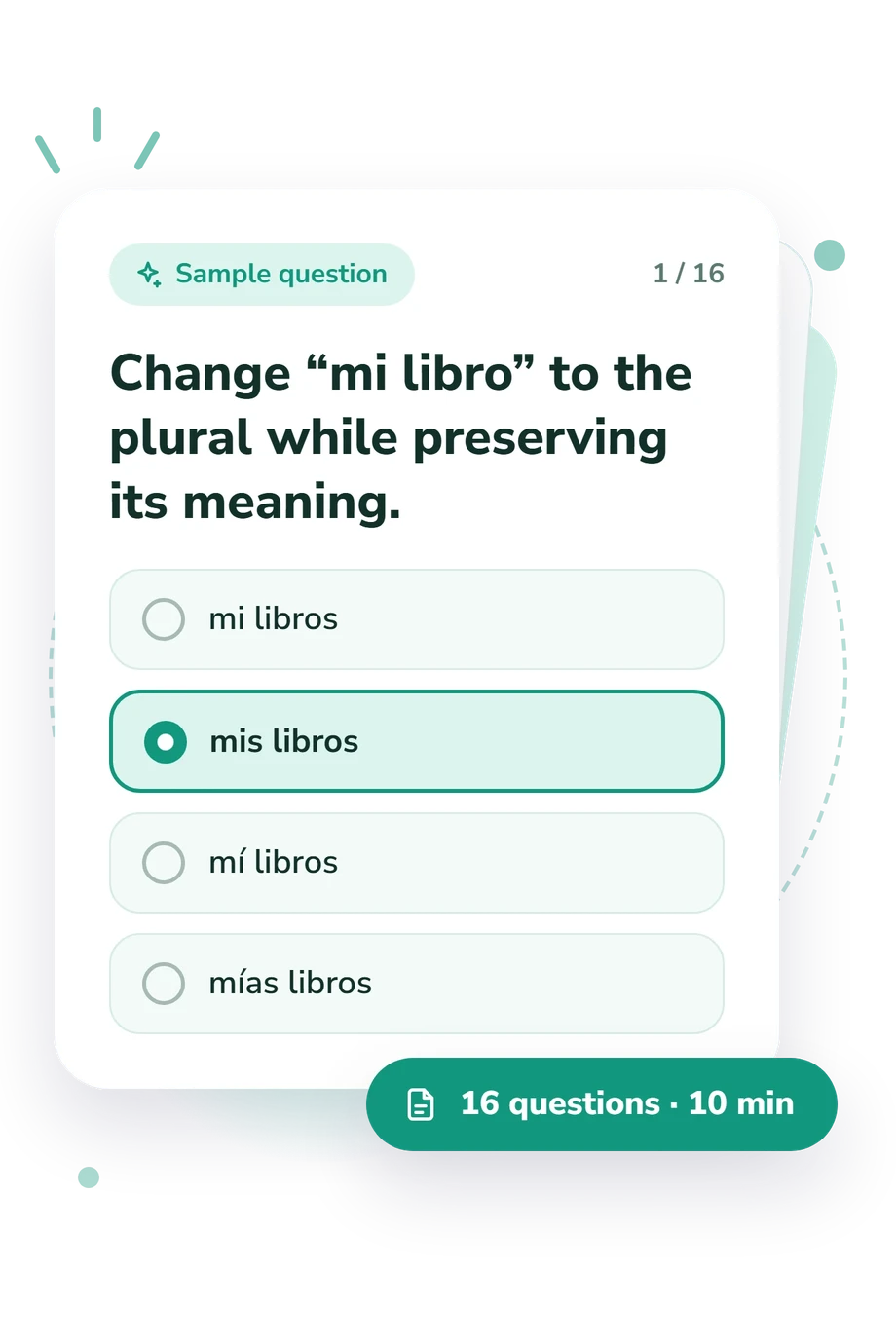
- mi libros
- mis libros
- mí libros
- mías libros
- Nuestro
- Mi
- Nuestra
- Nuestros
- nuestro
- nuestros
- nos
- nuestra
Possessive Adjectives Spanish Quiz - Description and methodology of the test
Learners who want to check whether they can choose Spanish possessive forms accurately in real sentences can use the Possessive Adjectives Spanish Quiz as a focused knowledge check. Because the quiz tests possessive adjectives in Spanish at sentence level, it suits people studying standard Spanish who want clearer feedback on agreement, stressed forms, ownership, and formal address. The result points to rules that may deserve targeted review.
What This Assessment Explores
The questionnaire tests choosing a form for the possessed noun: the possessor determines meaning, context sets the situation, and grammatical agreement, where applicable, follows that noun. It covers short forms such as mi, tu, su, and nuestro; stressed forms such as mío and suyo; singular and plural nouns, gender-sensitive forms, formal address, and Spain’s vosotros forms. As a Spanish possessive adjective test, it suits learners who know basic vocabulary but hesitate when options appear plausible.
The result describes command of these grammar decisions, not overall fluency. The displayed scale is Spanish Possessive Adjectives Knowledge (0-16), with these bands:
- Foundations to build (0-6) indicates that basic forms and agreement need review.
- Developing command (7-12) shows understanding of common forms, with practice still needed for agreement, formal address, or stressed forms.
- Strong command (13-16) reflects accurate use across standard Spanish sentences.
Methodology and Evidence Base
Each item offers four answer choices and asks for a completion, translation, or grammatical judgment. Context determines whether the learner must identify noun number, match a form to the owner, distinguish a short adjective from a stressed possessive, or interpret su as his, her, their, or formal your. It is a selected-response grammar assessment, not a personality measure.
Scoring awards one point for each correct answer and combines the item results into the total. The result reflects performance on these forms, not general language proficiency. The exercise provides Spanish possessive adjective practice by showing whether review should focus on agreement, formal address, stressed forms, or su.
Grammatically, the quiz is conceptually consistent with Butt et al. (2019), which discusses agreement, short and stressed possessives, and context-dependent meanings. Eckhardt (2019) and Nissenberg (2020) provide complementary instruction. These books are grammar references only, while the online quiz has no established norms or validation data.
Performance can depend on attention, prior instruction, and the answers selected, so use the score to identify which tested forms to revisit before practising similar sentences.
- Butt, John, Carmen Benjamin, and Antonia Moreira Rodríguez. A New Reference Grammar of Modern Spanish. 6th ed. Routledge, 2019. 10.4324/9781315648446
- Eckhardt, Paul. First Year Spanish 1. Mt. Hood Community College, 2019.
- Nissenberg, Gilda. Practice Makes Perfect: Complete Spanish Grammar, Premium Fourth Edition. 4th ed. McGraw-Hill Education, 2020.
Updated: