
Poetry Terms Quiz
How the Scales are Structured
Who Usually Takes This Test?
See How You Compare
Below is a preview of how scores are typically distributed across each scale.
Example Questions From the Test
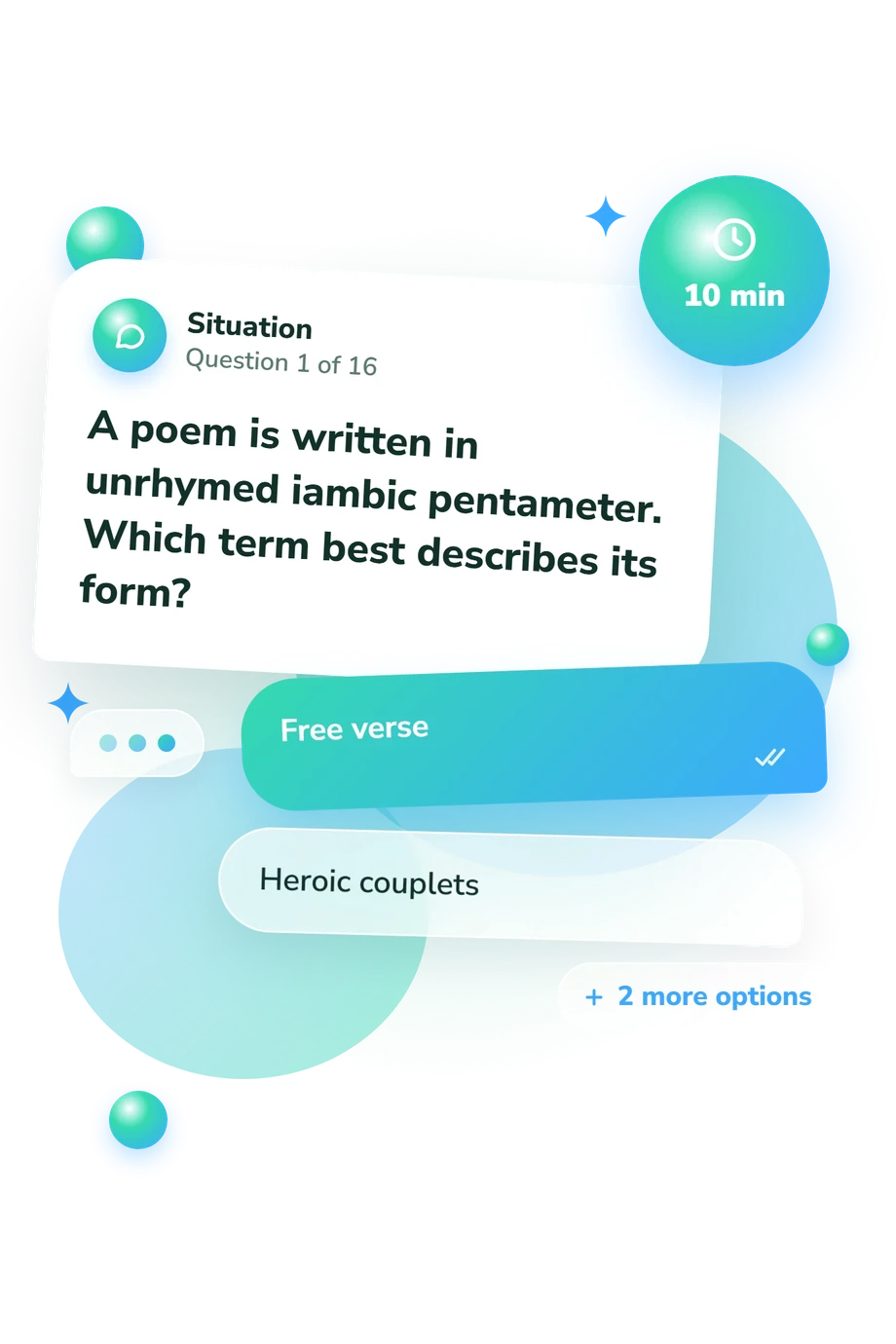
- Free verse
- Heroic couplets
- Blank verse
- Prose poetry
- Alliteration
- Consonance
- Assonance
- Internal rhyme
- The biographer
- The speaker
- The addressee
- The editor
Poetry Terms Quiz - Description and methodology of the test
For readers who want a clearer grasp of poetic language, this assessment checks whether familiar terms are understood accurately in context. The poetry terms quiz suits students, independent readers, and anyone preparing for close reading who wants a focused snapshot of foundational knowledge. As a poetry vocabulary quiz, it can also show which distinctions deserve review, from meter and rhythm to metaphor and personification.
What This Assessment Explores
This assessment checks recognition of the terms used to describe sound, rhythm, structure, voice, imagery, and figurative language. It serves readers testing terminology for classroom study or close reading, not creative writing or personal taste. Correct answers indicate a firmer foundation for discussing how poems create meaning.
Its main result areas are:
- Sound and rhythm show whether you distinguish alliteration, consonance, assonance, meter, feet, and caesura.
- Voice and figurative language show whether you identify the speaker, metaphor, apostrophe, and personification.
- Form and structure show whether you recognize blank verse, free verse, rhyme schemes, and the volta.
- Imagery and line movement show whether you connect sensory detail with enjambment and end-stopping.
This poetry terminology test reports one scale, Poetry Terms Knowledge (0-16), measuring command of foundational terms in context. The displayed bands are Foundation (0-6), Developing Command (7-12), and Poetic Prowess (13-16).
Methodology and Evidence Base
This objective knowledge assessment presents a definition, example, or poetic situation with four answer choices. Selecting the best term tests recognition and discrimination among related concepts rather than extended interpretation. The examples cover sound, meter, imagery, figurative devices, lineation, rhyme, and form.
Scoring is direct: the catalogue assigns one point for each correct answer, and the total is read through the bands stated above. These labels are easy to understand, but they are not published population norms. Performance can reflect prior instruction, familiarity with examples, guessing, and current concentration; it does not capture every aspect of literary understanding.
Arp and Johnson (2001) provide the closest conceptual anchor for the tested terminology and close-reading distinctions. The questionnaire is conceptually consistent with that treatment; Lennard (2005) and Greene and colleagues (2012) extend the relevant discussion of form, prosody, voice, and figurative language. It is not presented as an adaptation of any one publication. The poetry test questions make the assessment useful for structured review, guiding further reading when distinctions are missed.
- Arp, Thomas R., and Greg Johnson. Perrine's Sound and Sense: An Introduction to Poetry. 10th ed. Harcourt College Publishers, 2001, 435 pp.
- Lennard, John. The Poetry Handbook: A Guide to Reading Poetry for Pleasure and Practical Criticism. 2nd ed. Oxford University Press, 2005, 418 pp.
- Greene, Roland, Stephen Cushman, Clare Cavanagh, Jahan Ramazani, and Paul Rouzer, eds. The Princeton Encyclopedia of Poetry and Poetics. 4th ed. Princeton University Press, 2012. 10.1515/9781400841424.
Updated: