
Pixar Movie Quiz
How the Scales are Structured
Who Usually Takes This Test?
See How You Compare
Below is a preview of how scores are typically distributed across each scale.
Example Questions From the Test
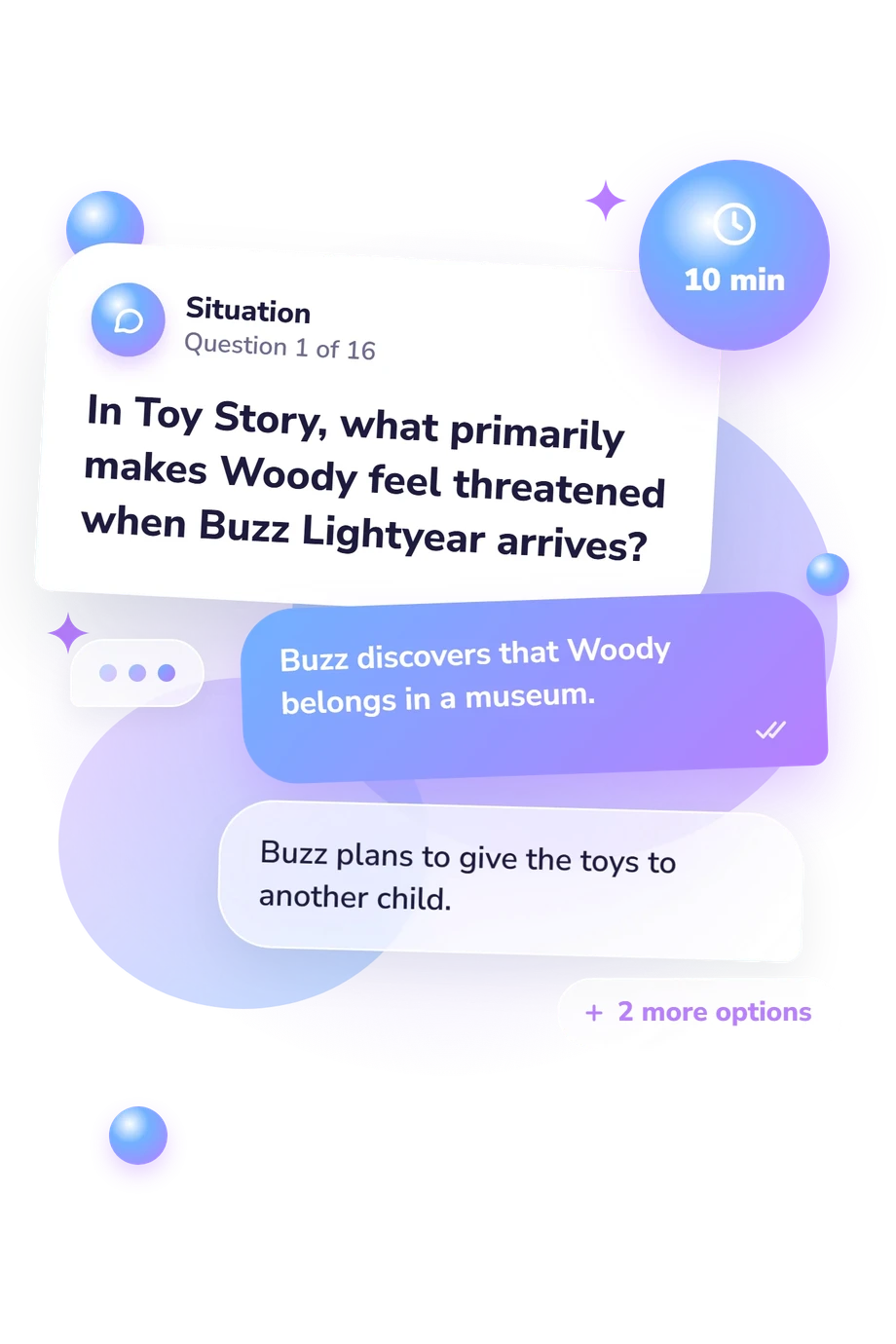
- Buzz discovers that Woody belongs in a museum.
- Buzz plans to give the toys to another child.
- Buzz takes Woody’s role in a television show.
- Buzz quickly becomes Andy’s favorite new toy.
- He wants to return Dory to her original home.
- He is following a migration route to find a new reef.
- He must warn the reef about an approaching fishing boat.
- He is searching for Nemo after a diver captures him.
- Grow plants for returning humans
- Repair the ships that evacuated humanity
- Collect and compact abandoned waste
- Search ruined cities for other robots
Pixar Movie Quiz - Description and methodology of the test
Casual fans, families, and film enthusiasts can use this pixar movie quiz to decide whether a short Pixar challenge suits their interests. It offers a light shared activity for people who enjoy animated storytelling and want to compare their recollections. A Pixar trivia quiz of this kind gives a simple indication of your level of Pixar knowledge, helping you choose whether to revisit familiar films or explore overlooked ones.
What This Assessment Explores
Questions focus on recognition of character motives, story goals, settings, relationships, and major events. They span films including Toy Story, Finding Nemo, WALL-E, Soul, Brave, Coco, Inside Out, and Up, so the result reflects breadth of recall as well as attention to memorable plot details.
The displayed Pixar Movie Knowledge scale (0-16) summarizes the result in three bands:
- Opening Scene (0-6) indicates recognition of some Pixar essentials, while many story connections remain unfamiliar.
- Feature in Progress (7-12) shows developing knowledge across several films and links characters with their stories.
- Pixar Spotlight (13-16) reflects strong recognition of characters, settings, motivations, and major plot events.
The questionnaire works as a Pixar film knowledge test, with the band giving a compact profile of the films sampled here.
Methodology and Evidence Base
The item design uses four-option multiple choice. Each question presents a character detail, motivation, setting, or plot event, and the respondent selects the answer that best matches the film. This is a recognition-based content assessment rather than a personality measure. The displayed score condenses the selections into one result and band; no extra scoring rule should be inferred from the range alone.
Its content is anchored to the Pixar feature-film canon. Paik and Iwerks provide studio history, Candel and colleagues examine Pixar’s fictional worlds, and Lasseter and Daly offer a production-focused reference point for Toy Story. These sources support the film and narrative details sampled here, but the quiz is not presented as an adaptation of any cited book, study, or formal psychometric instrument.
Because it functions as Pixar movie trivia, the result can vary with viewing history, recency, cultural familiarity, and memory. It has no stated norms or validation statistics, so the bands are descriptive rather than population-based cutoffs. Read the outcome as a snapshot of recalled knowledge on this selection of questions.
- Pixar Animation Studios. Feature Films. Pixar Animation Studios, n.d.
- Paik, Karen, and Leslie Iwerks. To Infinity and Beyond!: The Story of Pixar Animation Studios. Chronicle Books, 2007. ISBN 9780811850124.
- Candel, Daniel, Marta Giuliani Pedraza, Slavka Madarova, Paula Rubio Cáceres, Marta Ruiz Sanz, María Victoria Troyano Fernández, and Kristīne Treija. Analyzing the fictional worlds of Pixar with an eye on digital humanities. Semiotica, no. 218, 2017, pp. 91-117. 10.1515/sem-2016-0081.
- Lasseter, John, and Steve Daly. Toy Story: The Art and Making of the Animated Film. Disney Editions, 1995. ISBN 9780786861804.
Updated: