
Pillow Quiz
How the Scales are Structured
Who Usually Takes This Test?
See How You Compare
Below is a preview of how scores are typically distributed across each scale.
Example Questions From the Test
- Strongly disagree
- Disagree
- Not sure
- Agree
- Strongly disagree
- Disagree
- Not sure
- Agree
- Strongly disagree
- Disagree
- Not sure
- Agree
Pillow Quiz - Description and methodology of the test
People who wake with neck strain, overheating, or irritation from pillow materials can use this pillow quiz to clarify how to read their comfort priorities. The pillow test suits people comparing everyday pillow designs and helps turn those experiences into a comparative profile. Rather than promising a single answer, it highlights the trade-offs behind your preferences so you can compare everyday options more deliberately.
What This Assessment Explores
The questionnaire links sleep position, shoulder space, neck alignment, warmth, allergies, and firmness to features readers can compare. Its three scales are:
- Cooling & Allergy Sensitivity (0-20) measures how much cooling, ventilation, hypoallergenic materials, and easy cleaning matter: Low Sensitivity 0-6; Moderate Sensitivity 7-13; High Sensitivity 14-20.
- Loft Need (0-20) estimates the height likely to support alignment across sleep position, shoulder width, and mattress firmness: Low loft need 0-6; Medium loft need 7-13; High loft need 14-20.
- Support Preference (0-20) measures how strongly you benefit from and prefer a supportive, shape-holding pillow over a plush, sink-in feel: Plush feel 0-7; Balanced support 8-14; Support-forward 15-20.
These scores indicate greater cooling and allergy-related constraints, greater loft need, or a stronger preference for supportive, shape-holding construction, depending on the scale. The pillow assessment helps compare adjustable fill, breathable fabrics, washable covers, and structured designs.
Methodology and Scientific Basis
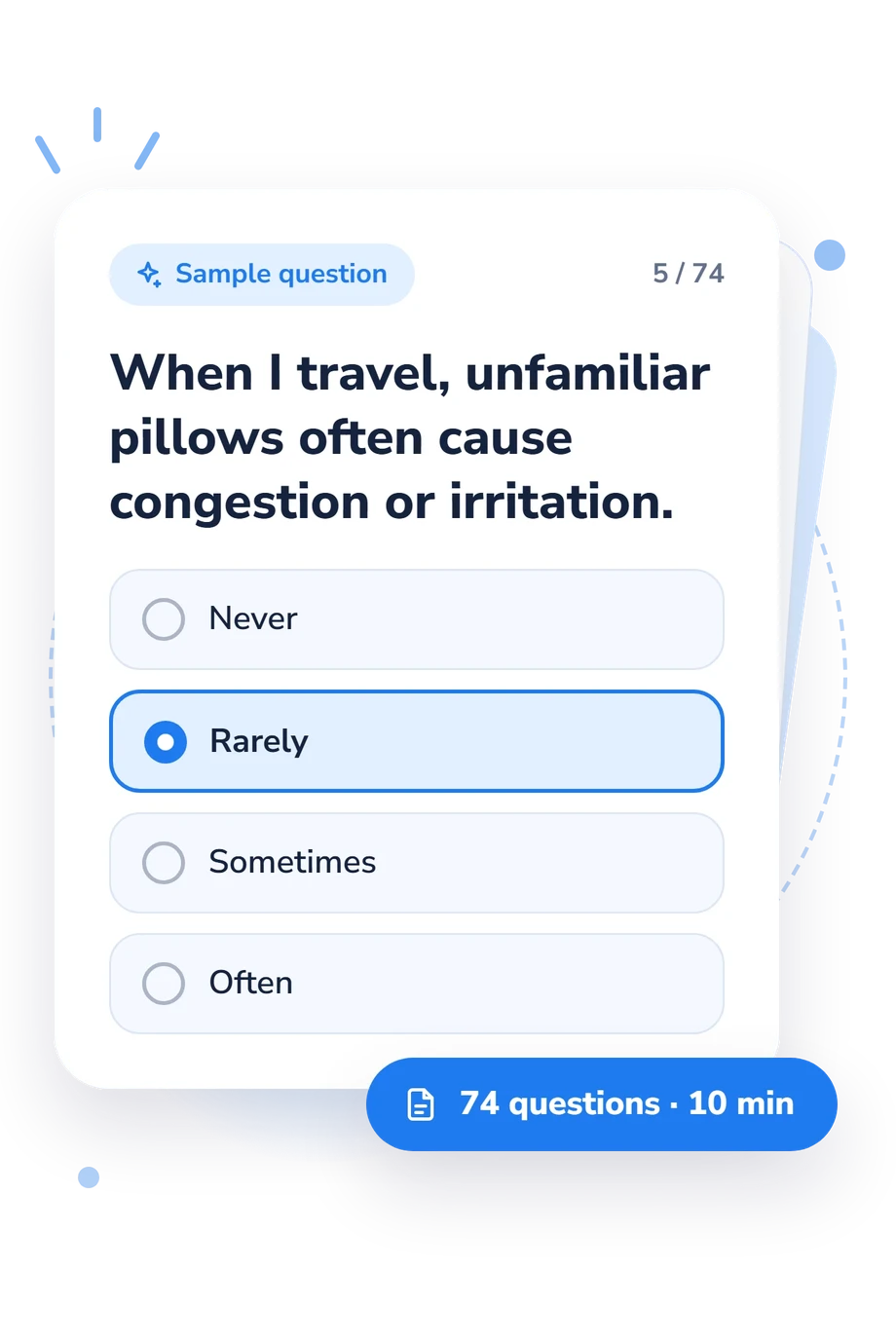
Among the shown items, agreement statements use four-point choices from Strongly disagree to Agree; frequency statements vary, including Never-Rarely-Sometimes-Often and Never-Sometimes-Most nights-Every night. Statements address recurring experiences such as changing height, feeling too warm, sinking, or wanting push-back, rather than brands.
Responses combine into three scores, but the displayed ranges do not show how many points each answer contributes. The result is a comparative pillow profile based on self-described habits and comfort reactions.
The pillow-comfort survey by Son and colleagues is the closest conceptual reference for pillow comfort, support, sleep position, and related symptoms. Work by Gordon and colleagues adds evidence on side sleepers, cervical discomfort, sleep quality, and comfort. A synthesis by Pang and colleagues brings together findings on pillow design, neck symptoms, spinal alignment, and sleep outcomes. The questionnaire is conceptually consistent with these studies but is not an adaptation of them, and those studies do not validate or standardize this online scoring system.
Because answers depend on honest self-report and current sleep conditions, the profile is best interpreted as a preference guide rather than a diagnosis.
- Juhyun Son, Sungwook Jung, Haseung Song, Jihee Kim, Seonghwan Bang, and Sangwoo Bahn. A Survey of Koreans on Sleep Habits and Sleeping Symptoms Relating to Pillow Comfort and Support. International Journal of Environmental Research and Public Health. 2020;17(1):302. 10.3390/ijerph17010302
- Susan J. Gordon, Karen Grimmer-Somers, and Patricia Trott. Pillow use: the behaviour of cervical pain, sleep quality and pillow comfort in side sleepers. Manual Therapy. 2009;14(6):671-678. 10.1016/j.math.2009.02.006
- Pang JCY, Tsang SMH, and Fu ACL. The effects of pillow designs on neck pain, waking symptoms, neck disability, sleep quality and spinal alignment in adults: A systematic review and meta-analysis. Clinical Biomechanics. 2021;85:105353. 10.1016/j.clinbiomech.2021.105353
Updated: