
Personality Test for Kids
How the Scales are Structured
Who Usually Takes This Test?
See How You Compare
Below is a preview of how scores are typically distributed across each scale.
Example Questions From the Test
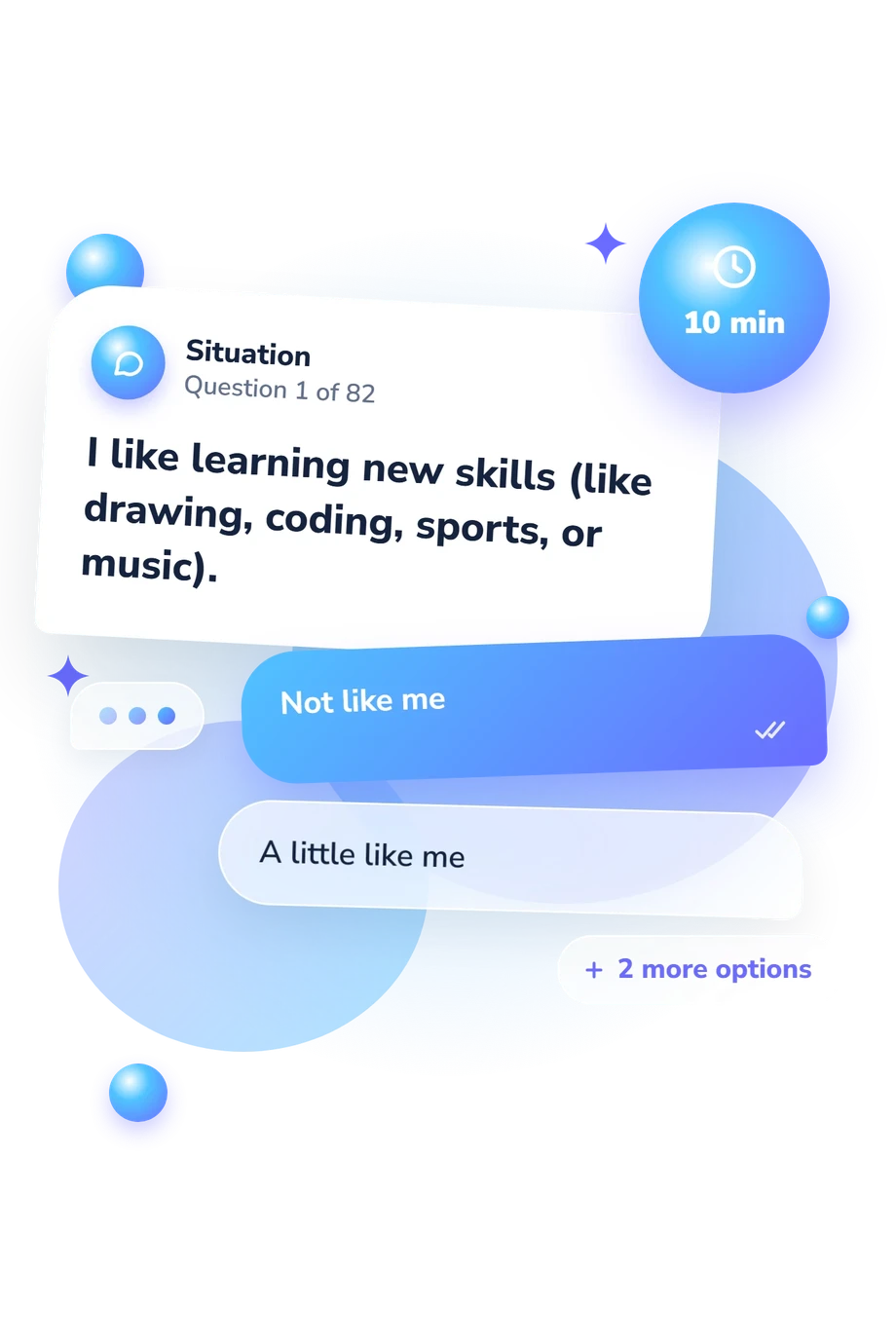
- Not like me
- A little like me
- Mostly like me
- A lot like me
- Not like me
- A little like me
- Mostly like me
- A lot like me
- Not like me
- A little like me
- Mostly like me
- A lot like me
Personality Test for Kids - Description and methodology of the test
Designed for children aged 7-12 and the adults who support them, this personality quiz for kids helps make everyday personality patterns easier to discuss. A personality test for kids can clarify how a child approaches shared activities, unfamiliar ideas, and emotionally charged moments without turning a developing personality into a fixed label. Families can use this assessment as a profile for conversation, reflection, and shared understanding in everyday situations.
What This Assessment Explores
These items cover learning, exploration, fairness, cooperation, emotional reactions, and awareness of other people’s feelings. This children's personality questionnaire describes tendencies in familiar settings, not permanent abilities or a single type.
The three reported dimensions are:
- Cooperation (0-30) shows how readily the child helps, shares, takes turns, follows agreements, and negotiates; Low cooperation 0-10, Medium cooperation 11-20, High cooperation 21-30.
- Curiosity (0-30) shows interest in learning, questions, exploration, and unfamiliar activities; Low 0-10, Medium 11-20, High 21-30.
- Emotional Sensitivity (0-30) shows how strongly the child notices and reacts to feelings, criticism, change, conflict, and others’ emotions; Low 0-10, Medium 11-20, High 21-30.
The profile is a snapshot of these tendencies in the situations covered, not a judgment about character or ability.
Methodology and Scientific Basis
The sampled items use one of two four-step formats. Some ask how much a statement is like the child, from Not like me to A lot like me; others ask how often a behavior is true, from Never true for me to Almost always true for me. Together, they cover preferences, social behavior, and emotional reactions.
Answers produce scores on the dimensions, and those scores are interpreted through the displayed bands. The verbal choices describe the response, but the ranges do not reveal how many points each answer contributes, so that rule should not be inferred.
The closest published conceptual reference is the Big Five Questionnaire for Children (Barbaranelli et al., 2003). Its dimensions overlap selectively with the child-focused HiPIC-30 described by Vollrath et al. (2016). These sources support comparison of themes, not a claim that this online questionnaire is an adaptation or equivalent form.
For interpretation, a child personality assessment is most useful alongside context, recent experiences, and the child’s explanations. Mood, memory, social desirability, and reading comprehension can shape self-report. This online version has no stated norms or standardization, so its categories are descriptive rather than clinical cutoffs.
- Barbaranelli, C., Caprara, G. V., Rabasca, A., & Pastorelli, C. (2003). A questionnaire for measuring the Big Five in late childhood. Personality and Individual Differences, 34(4), 645-664. 10.1016/S0191-8869(02)00051-X
- Vollrath, M. E., Hampson, S. E., & Torgersen, S. (2016). Constructing a short form of the hierarchical personality inventory for children (HiPIC): The HiPIC-30. Personality and Mental Health, 10(2), 152-165. 10.1002/pmh.1334
Updated: