
Pasta Quiz
How the Scales are Structured
Who Usually Takes This Test?
See How You Compare
Below is a preview of how scores are typically distributed across each scale.
Example Questions From the Test
- Rice flour and whole eggs
- Soft wheat flour and butter
- Durum wheat semolina and water
- Cornmeal and olive oil
- Soft throughout and easy to mash
- Cooked through but still firm to the bite
- Browned lightly around the edges
- Chilled immediately after cooking
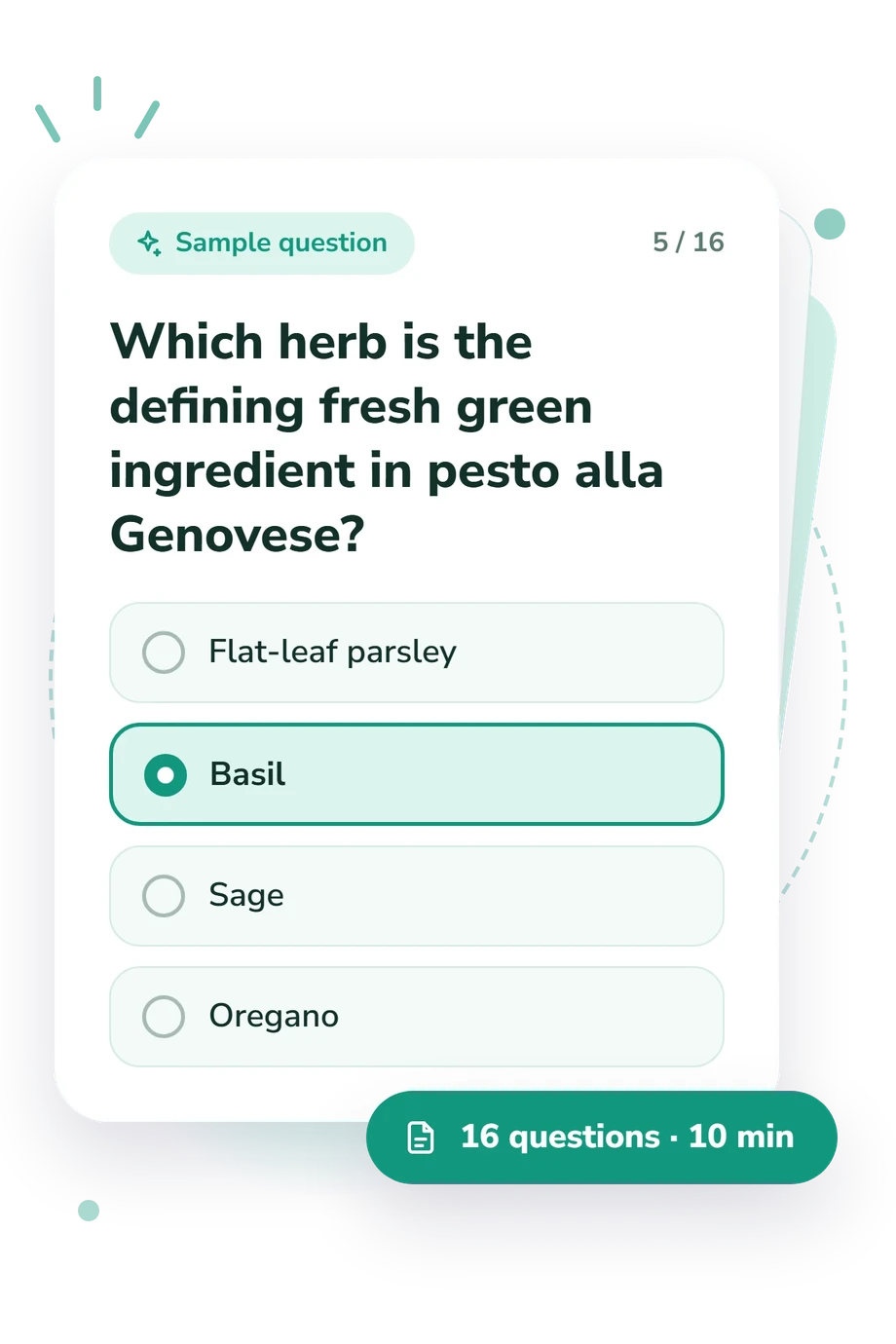
- Flat-leaf parsley
- Basil
- Sage
- Oregano
Pasta Quiz - Description and methodology of the test
Anyone who wants to check practical pasta know-how can use this pasta quiz to connect everyday cooking decisions with Italian food traditions. It suits curious home cooks, culinary learners, and experienced kitchen users who want a clearer picture of what they already recognize and where their knowledge is less secure. A pasta knowledge test can turn that curiosity into a focused check of shapes, ingredients, sauces, and technique.
What This Assessment Explores
This assessment focuses on practical recognition rather than preference or cooking style. It asks whether you can identify pasta families, match shapes to sauces, recognize traditional ingredients, and apply basic preparation principles. It suits readers who want a way to examine food knowledge.
The main dimensions covered are:
- Shape and family recognition shows whether you connect pasta names with forms and culinary uses.
- Ingredients and classic dishes indicate whether you recognize combinations associated with pesto, carbonara, and cacio e pepe.
- Cooking technique and sauce integration reflect understanding of al dente texture, salted water, starch, timing, and gentle handling.
Together, these themes make this a pasta knowledge assessment rather than a measure of talent or taste. Its single Pasta Knowledge scale runs from 0-16. Results are labelled Foundations 0-6, Developing Knowledge 7-12, or Pasta Proficiency 13-16.
Methodology and Evidence Base
Each item presents one culinary question with four answer choices, combining factual recognition with short application scenarios. You may identify a shape for a chunky sauce or decide how to finish nearly cooked pasta, so the pasta trivia quiz tests terminology alongside practical reasoning.
The questionnaire does not state how individual answers are weighted, so the displayed bands should be read as descriptive categories for this assessment rather than as a point-by-point rule. Because the scenarios ask about shapes, sauce matching, cooking stages, and ingredient choices, results reflect both recall and applied preparation knowledge. Guessing, prior culinary exposure, cultural familiarity, and attention can also affect the outcome.
The content is conceptually consistent with Hildebrand and Kenedy (2010) on shapes and sauce relationships. De Noni and Pagani (2010) support the treatment of dried-pasta cooking properties, while Zanini De Vita (2009) and McGee (2004) add culinary and food-science context. These works support the subject matter, but the questionnaire is not an adaptation of any one source. Use the result as a focused guide to further learning.
- Hildebrand, Caz, and Jacob Kenedy. The Geometry of Pasta. London: Boxtree, 2010. 288 pp. ISBN 978-0-7522-2737-5.
- De Noni, Ivano, and Maria A. Pagani. "Cooking Properties and Heat Damage of Dried Pasta as Influenced by Raw Material Characteristics and Processing Conditions." Critical Reviews in Food Science and Nutrition 50, no. 5 (2010): 465-472. 10.1080/10408390802437154.
- Zanini De Vita, Oretta. Encyclopedia of Pasta. Translated by Maureen Fant. Berkeley: University of California Press, 2009. 400 pp. ISBN 978-0-520-25522-7.
- McGee, Harold. On Food and Cooking: The Science and Lore of the Kitchen. New York: Scribner, 2004. 896 pp. ISBN 978-0-684-80001-1.
Updated: