
NR509 Week 3 Quiz
How the Scales are Structured
Who Usually Takes This Test?
See How You Compare
Below is a preview of how scores are typically distributed across each scale.
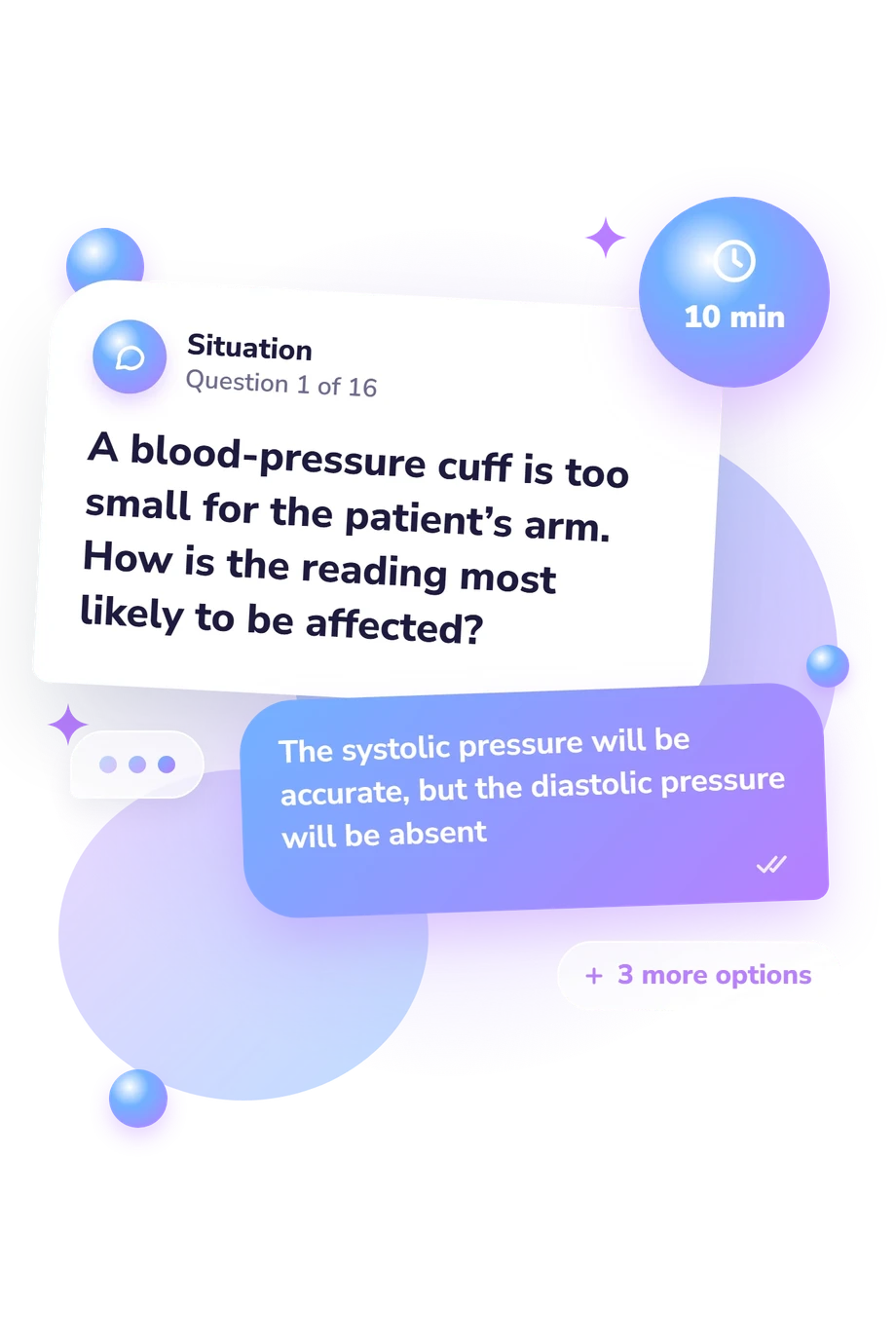
Example Questions From the Test
- The patient appears to have a serious throat infection
- The patient’s breathing seems much better today
- The patient has normal skin for their age
- A 2-cm round erythematous area is present on the left forearm
- Palpate non-tender areas first and assess the tender area last
- Avoid palpating every abdominal quadrant
- Percuss only the tender area and end the examination
- Begin with deep palpation directly over the tender area
- Ophthalmoscope
- Penlight
- Snellen chart
- Ishihara plates
NR509 Week 3 Quiz - Description and methodology of the test
Students preparing for practical nursing assessments can use this assessment to identify which physical-assessment principles deserve further study. The NR509 Week 3 Quiz result helps prioritize review before coursework or skills practice. For a learner, this NR 509 Week 3 quiz can direct study toward weak areas rather than repeating familiar material.
What This Assessment Measures
This assessment examines applied knowledge of routine physical examination. Learners connect equipment choices, examination order, safety actions, and objective language with the finding or response that fits each situation.
Questions cover blood-pressure cuffs, visual and ear tools, thyroid movement, pulse checks, abdominal technique, respiratory sounds, pupils, capillary refill, percussion, and documentation. The result reflects reasoning across common bedside tasks.
Themes contributing to the single score include:
- Physical-assessment knowledge is reported on the NR509 Week 3 Physical Assessment Knowledge scale (0-16): Foundations to review (0-6), Developing knowledge (7-12), or Strong knowledge (13-16).
- Technique and safety are represented by items on appropriate sequences and patient protection.
- Findings and documentation are represented by items on expected signs and objective recording.
The result highlights topics for physical assessment study and review.
Methodology and Evidence Base
Each item presents a brief clinical situation with four answer choices. The best response depends on applying examination principles, such as choosing the correct sequence, responding safely to dizziness, or distinguishing an objective description from an impression.
The educational approach is consistent with bedside assessment principles described by Douglas and colleagues, Giddens, and Jarvis and Eckhardt: systematic examination, accurate observation, suitable equipment, and practical use of findings. This questionnaire is conceptually consistent with those sources, not an adaptation or validated administration of them.
The score is presented as an unvalidated educational result, and its display does not state how individual answers are weighted. Read it as a study signal: stronger performance suggests firmer command of the tested principles, while missed items identify material for review. The bands describe educational progress rather than patient status.
Performance can also reflect recall, wording, test-taking strategy, and recent coursework. Reviewing errors during nursing assessment preparation and supervised practice is especially important for safety-sensitive steps. This questionnaire can support preparation, but its result cannot capture communication, hands-on technique, clinical judgment, or changing patient context.
- Douglas, Clint; Windsor, Carol; Lewis, Peter. Too much knowledge for a nurse? Use of physical assessment by final-semester nursing students. Nursing & Health Sciences. 2015;17(4):492-499. 10.1111/nhs.12223
- Giddens, Jean F. A survey of physical assessment techniques performed by RNs: lessons for nursing education. Journal of Nursing Education. 2007;46(2):83-87. 10.3928/01484834-20070201-09
- Jarvis, Carolyn; Eckhardt, Ann L. Physical Examination and Health Assessment. 9th ed. Elsevier; 2023.
Updated: