
Night Chapter 1 Quiz
How the Scales are Structured
Who Usually Takes This Test?
See How You Compare
Below is a preview of how scores are typically distributed across each scale.
Example Questions From the Test
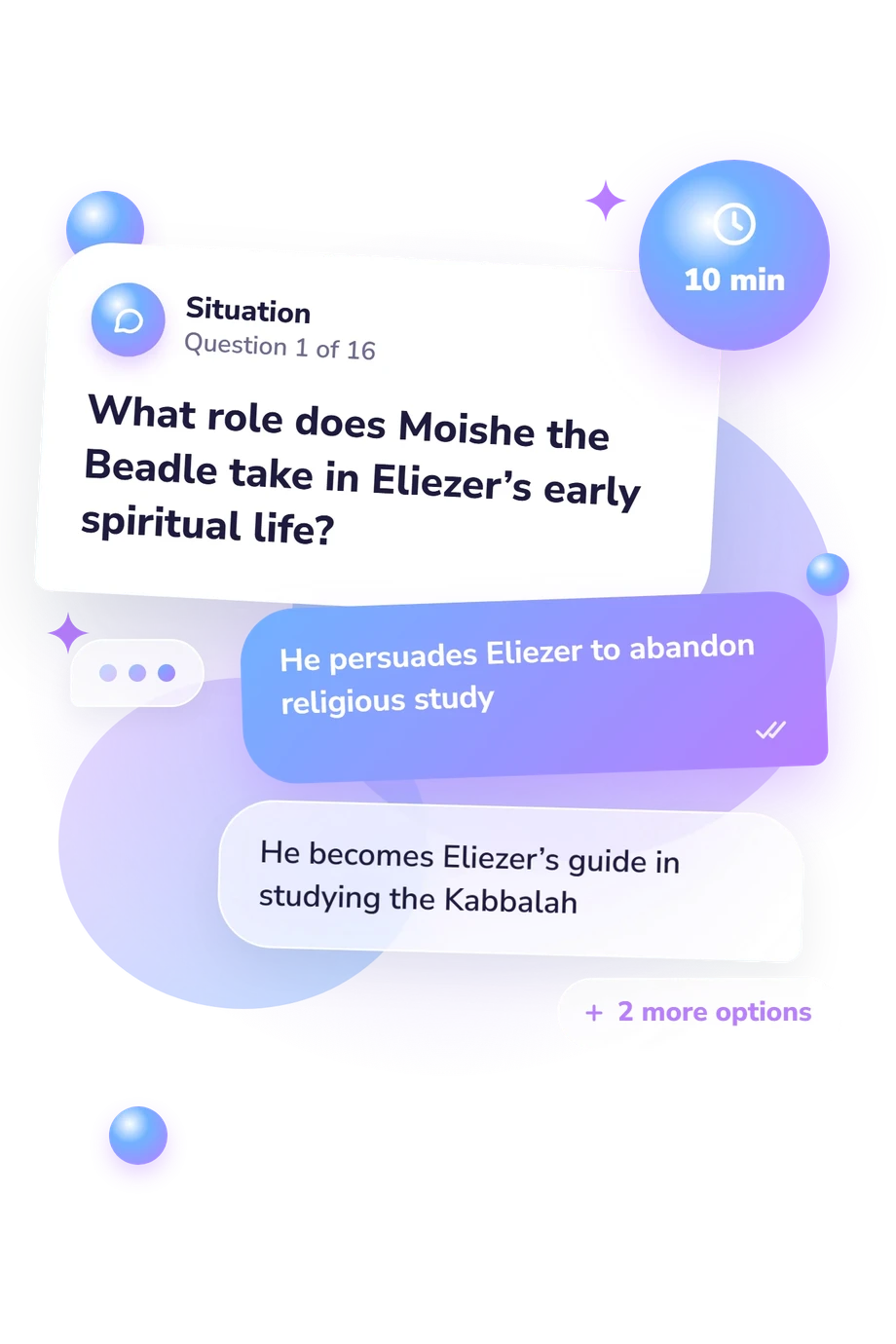
- He persuades Eliezer to abandon religious study
- He becomes Eliezer’s guide in studying the Kabbalah
- He teaches Eliezer in his father’s shop
- He prepares Eliezer to become the town’s rabbi
- He is accused of organizing armed resistance
- He publicly refuses to wear the yellow star
- He is classified as a foreign Jew
- He is selected because he has no occupation
- Sighet, in Transylvania
- Budapest, the Hungarian capital
- Warsaw, in occupied Poland
- Auschwitz, in Upper Silesia
Night Chapter 1 Quiz - Description and methodology of the test
For students, teachers, and independent readers, the Night Chapter 1 Quiz offers a focused way to decide whether they are ready to discuss or review Elie Wiesel’s opening chapter. This opening chapter quiz connects factual recall with chronology, cause-and-effect, and interpretation of warnings. The result helps a reader choose between joining a discussion, continuing onward, or returning to key passages.
What This Assessment Explores
Questions cover characters, settings, restrictions, and Chapter 1’s turning points. They include Moishe, Eliezer’s interest in Kabbalah, Sighet, the yellow star, ghettoization, deportation, and hopeful explanations of danger. Items require inferences, including dramatic irony. Readers can use Night Chapter 1 study questions for review or discussion.
The questions group into thematic areas; the result reports one knowledge score:
- Character and spiritual context connect Moishe, Eliezer, his father, and the chapter’s religious questions.
- Chronology and historical pressure cover restrictions, warnings, ghettoization, and removal as an escalating sequence.
- Night Chapter 1 Knowledge (0-16) measures the chapter’s events, sequence, and literary meaning. Foundation to revisit (0-6) means some people or events are recognized but chronology and warnings need review; Developing knowledge (7-12) shows central events and themes, with details or inferences to revisit; Strong knowledge (13-16) indicates a secure grasp of these elements.
Methodology and Evidence Base
Each of the 16 items presents a prompt with four answer choices. Selecting the best-supported option combines recall, chronology, cause-and-effect reasoning, and close reading. The displayed result uses three knowledge bands, so it describes performance on the chapter questions rather than the intensity of a feeling or behavior.
The questionnaire is a chapter-focused educational check, not a standardized psychological instrument; its four-choice design makes it a reading check for the opening chapter rather than a psychological measure. Its questions draw on the events and interpretation of Night, including historical context, narrative development, guided inquiry, translation choices, testimony, and literary nuance. Sternlicht’s literary discussion, Simon et al.’s guided-inquiry work, and Davies’s analysis clarify those contexts; the quiz is conceptually consistent with them, not an adaptation of any of them.
The displayed bands describe performance on this chapter-focused quiz, not norms for general reading ability. Scores can vary with prior study, memory, interpretation, and the English edition read, so they are most useful when deciding whether to revisit the chapter’s sequence, warnings, or literary meaning.
- Wiesel, Elie. Night. Translated by Marion Wiesel. Revised edition. New York: Hill and Wang, 2006.
- Sternlicht, Sanford. Student Companion to Elie Wiesel. Westport, CT: Greenwood Press, 2003.
- Simon, Rob, Ashley Bailey, Jason Brennan, Antonino Calarco, Kevin Clarke, Will Edwards, Catherine Fujiwara, Amir Kalan, Julia Kruja, Emily McInnes-Greenberg, and Anna Pisecny. “In the Swell of Wandering Words”: The Arts as a Vehicle for Youth and Educators’ Inquiries into the Holocaust Memoir Night. Perspectives on Urban Education, 11(2), 90-106, 2014.
- Davies, Peter. Translation and the Uses of a Holocaust Testimony: Elie Wiesel’s La Nuit in German Translation. German Life and Letters, 64(4), 552-569, 2011. 10.1111/j.1468-0483.2011.01551.x
Updated: